
Sensors, digital twins and virtual power plants are squeezing more out of existing grids and homes. Investors and founders explain what’s driving adoption – and what still holds it back.
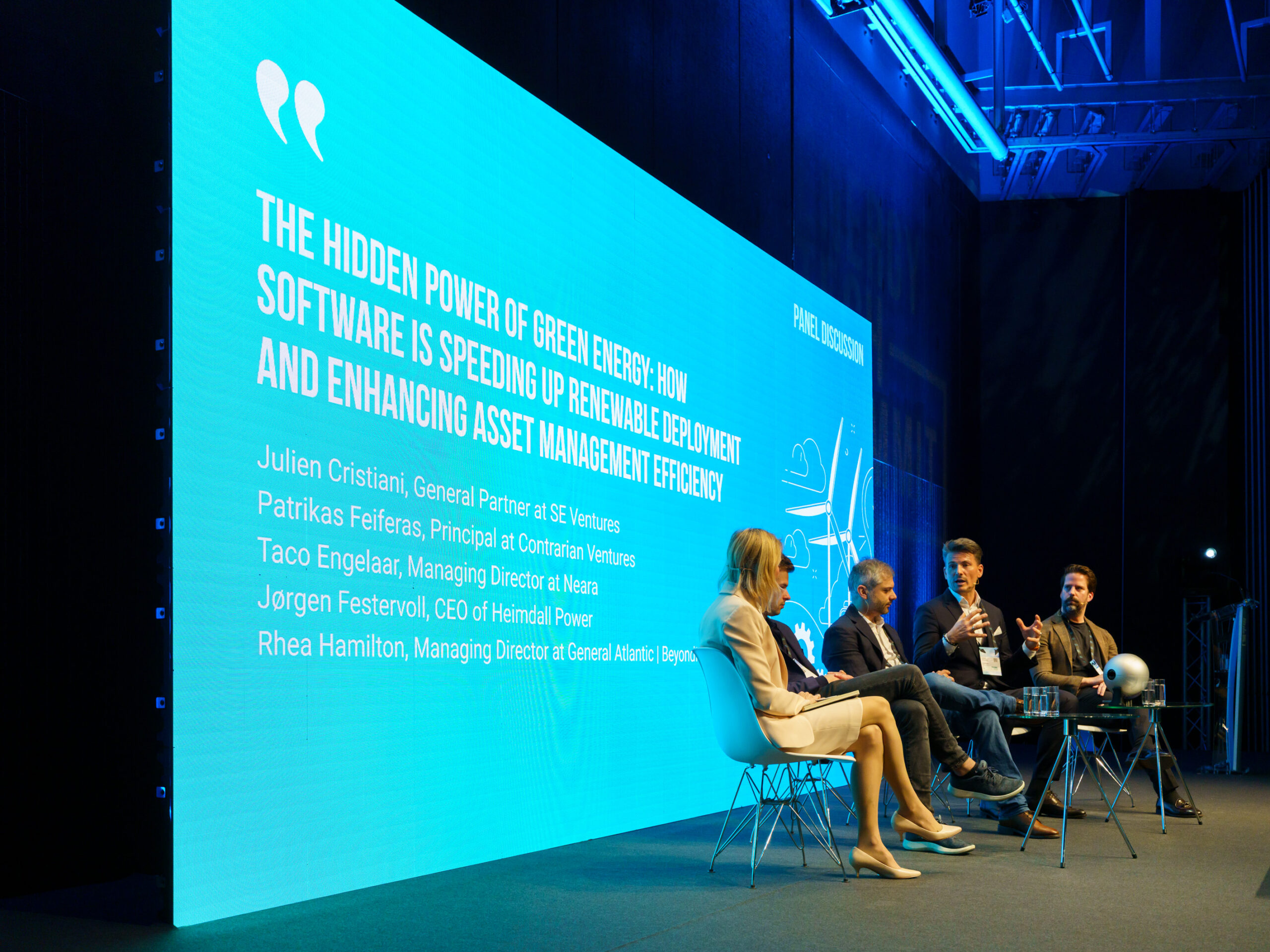
Renewable deployment depends on more than new wind and solar farms. Increasingly, energy software determines how quickly clean power reaches the grid and how efficiently assets run. At Energy Tech Summit, a panel explored that opportunity. Ria Hamilton, Managing Director at General Atlantic | BeyondNetZero, moderated. She was joined by Julien Cristiani, General Partner at SE Ventures, Taco Engelaar, Managing Director at Neara, Jorgen Festervoll, CEO at Heimdall Power, and Patrikas Feiferas, Principal at Contrarian Ventures.
Why energy software matters in the home
Feiferas has focused on home electrification. One opportunity lies in streamlining how residential assets such as EV chargers, solar panels and heat pumps get deployed. Installers are scarce, so platforms that align installers, customers and equipment sellers can make them far more efficient.
The bigger shift comes after installation. A decade ago, the only flexible asset in most homes was a gas boiler. Now homes hold batteries, EVs and heat pumps, and new OEMs make data available through simple API integrations. Meanwhile, generation and demand are both becoming more variable, destabilizing the grid. Aggregating millions of home assets into virtual power plants can help fix that. In Feiferas’s view, “that’s the real use case of AI that we can put to action”.
Cristiani sees two linked worlds. On one side sit consumer-facing players, such as solar and battery installers that eventually aggregate assets into VPPs. On the other side sits grid flexibility, which connects those assets to markets, utilities and grid operators. SE Ventures has invested in both areas, including Ostrom, AutoGrid, Prisma Photonics and AI Dash. However, the two worlds are not yet well connected, with most VPP deals still bilateral and local.
Sensors that reveal hidden grid capacity
Festervoll brought a physical sensor on stage. Heimdall Power mounts it on power lines to give utilities real-time grid awareness. Why now? Over the past decade, the cost of building overhead lines has more than doubled, while the cost of sensor technology has fallen by around 90%. Satellite and LTE connectivity also mean sensors can reach anywhere.
A power line’s limit is its temperature – effectively its speed limit. Without a sensor, operators don’t know how close they are, and “when you’re driving critical infrastructure, you do not want to speed”. So utilities rely on conservative static ratings. Dynamic line rating replaces those with real measurements. According to Festervoll, that typically unlocks 30 to 40% more capacity from existing lines. The same sensors also track icing, wildfire risk, line galloping and electrical faults.

Rhea Hamilton, Managing Director at General Atlantic | BeyondNetZero
Digital twins that double renewable capacity
Neara builds digital network models focused on the grid’s mechanical, physical and engineering characteristics. Utilities use them to simulate storms, assess resilience and find physical limits on capacity. Neara has modeled around two to three million kilometers of grid worldwide.
That matters because expanding the grid will take decades. Engelaar shared an example from Australia. After modeling 180,000 kilometers of Essential Energy’s network, Neara found it had double the capacity the utility thought – allowing twice as much renewable energy without physical upgrades. As a result, the utility could connect far more clean power while still operating safely and within regulation.
Overcoming slow utility adoption
Promising results don’t guarantee fast uptake. Sales cycles are long, and “It’s an industry not necessarily prone to change.” Engelaar’s approach is to prove impact quickly in a small environment, then scale. Investors provide the runway to survive long cycles. Europe adds another hurdle: a success in France doesn’t necessarily convince Germany.
Festervoll put it memorably: “utilities are standing in line to be number three to adopt our technology”. Nobody wants to go first, but in the US nobody wants to be fourth either. Demonstrations help. Heimdall Power uses autonomous drones to mount sensors on live lines in seconds. One skeptical US customer agreed to a single drone installation – and then asked for every sensor to be installed that way. Once utilities commit, Engelaar added, they tend to stay and expand.
Pressure from politicians and ratepayers is also accelerating adoption. As rates rise, utilities “know that if they don’t act they will be acted upon”. Traditional regulation rewards capex, so software that reduces investment once looked unattractive. Now, however, utilities have more projects than they can fund or permit. In one case, sensors showed a utility needed to reconductor only half a mile of a 20-mile line, saving millions of dollars.
Engelaar wants these conversations to reach national policy. In the Netherlands, grid congestion is estimated to cost the economy tens of billions of euros a year as companies struggle to get connections.
Data quality, ownership and trust
Is there enough data? For Engelaar, “There’s enough data out there.” The challenge is quality, and bringing together the five to fifteen systems many utilities run. Festervoll disagreed on quantity. “Only less than 1% of overhead lines in the world have any sensors.” In short, “We have no idea what’s going on on our overhead lines.” Measured flows can also validate simulations, so the two approaches work well together.
Cristiani looks at who owns consumer data. Installers have a one-off relationship, so SE Ventures favors energy retailers, who stay in constant contact, and home renovation players, who can build a digital twin of a house. Feiferas added that consumers will electrify mainly for savings: “if that lowers the energy bill I’m going to do it”. Retailers are shifting from maximizing margin to giving more back, because “It’s all about the stickiness, right?”
Information flows both ways. Neara’s polling suggests people are twice as likely to accept new pylons nearby if they understand they serve renewable energy. That matters, since permitting can delay new lines by a decade or more.

Julien Cristiani, General Partner at SE Ventures and Patrikas Feiferas, Principal at Contrarian Ventures
speaking on stage
AI as a co-pilot for the grid
Both founders use AI internally, but grid applications demand more caution. As Festervoll explained, “You can’t be fairly accurate. You have to be 100% every time.” He expects AI to evolve like autonomous driving: first a co-pilot suggesting actions based on weather, demand and grid capacity, then gradually more automation. For example, wind farms could use next-day grid capacity forecasts to operate alongside batteries and use every drop of available capacity.
Where the next opportunities lie
Looking ahead, Feiferas is most excited about batteries, especially behind the meter. Modeling battery returns is far more complex than solar, creating room for new software. Engelaar cautioned that “there’s no silver bullet”: flexibility, grid modeling, batteries and hydrogen will need to work as an ecosystem. Festervoll argued that rising complexity leaves utilities little choice. On buying grid software or sensors, he said, “I don’t think that’s an option anymore.” Finally, Cristiani expects incremental innovation among utilities, but disruption in energy retail from integrated players owning the full electrification journey.
Takeaway
Much of the capacity renewables need already exists – in power lines, home assets and data that utilities don’t yet use. Energy software, sensors and AI can unlock it faster and more cheaply than new infrastructure alone. The barriers are now cultural and regulatory, not technical. As complexity grows, however, digital tools are becoming essential rather than optional.
Secure your pass
Want to meet the founders and investors digitalizing the grid? Join founders, investors and corporates at Energy Tech Summit Europe 2027 in Bilbao, April 7–8. Founder’s Pass: €699.