
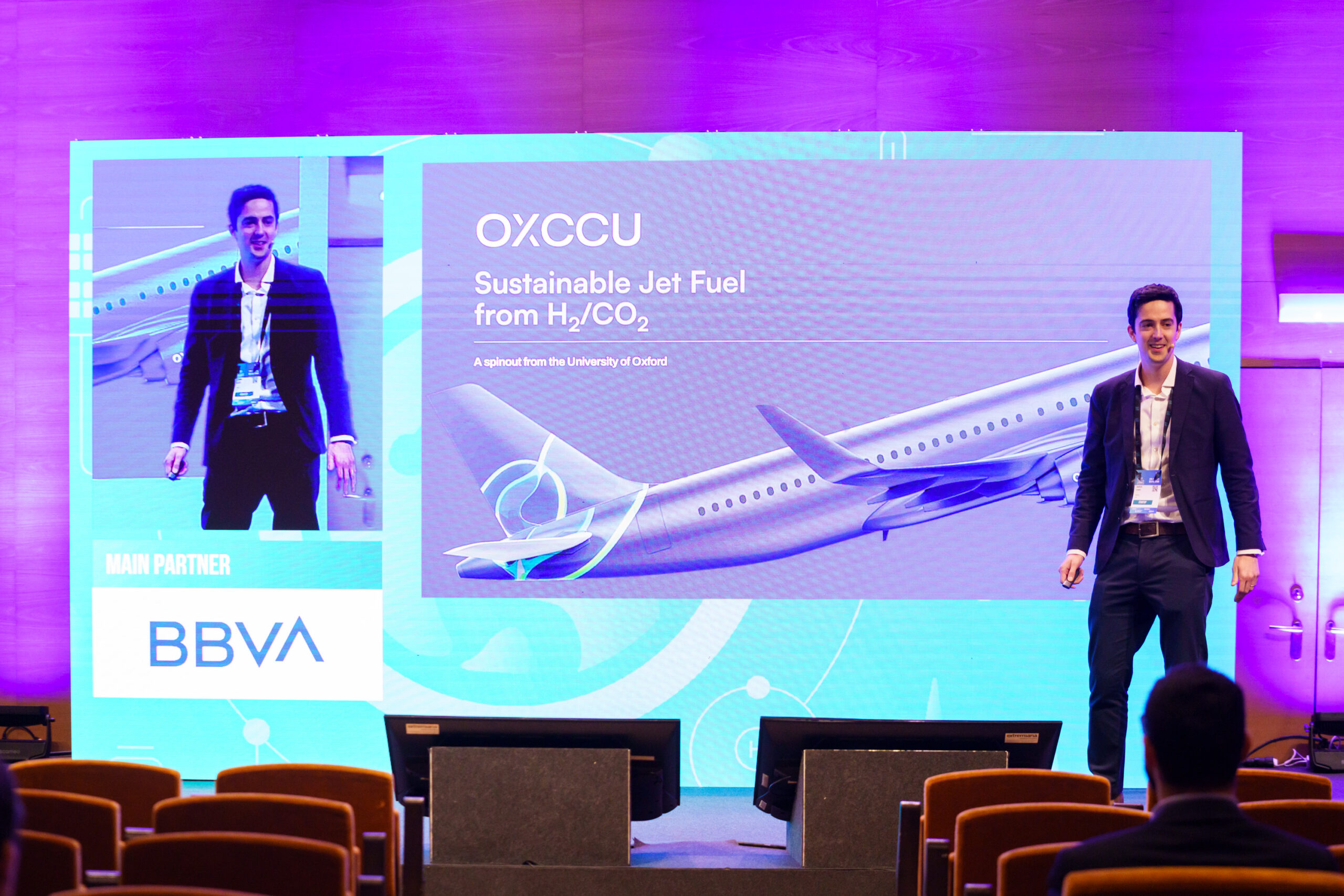
Mandates are creating real demand for synthetic jet fuel. The problem is price – and OXCCU believes the answer lies in a century-old catalyst with a twist.
Demand for sustainable aviation fuel is rising fast, and power-to-liquids will need to supply a large share of it. At Energy Tech Summit, Andrew Symes, CEO and co-founder of OXCCU, explained why this route is still too expensive – and how his company plans to change that. The name, he noted, combines Oxford with carbon capture and utilization, and the company’s roots lie in Oxford University chemistry.
Why SAF must move beyond vegetable oil
Air travel keeps growing, driven by Asia as well as Europe and the US. As Symes put it, “People do not want to stop flying.” The challenge, therefore, is to keep the same planes, airports and experience while cutting emissions. Sustainable aviation fuel makes that possible because it works with existing infrastructure.
Today, however, most SAF comes from vegetable oils, largely used cooking oil. Current production stands at around 0.1 billion liters a year, much of it based on feedstock from China. Symes was blunt: “That is simply not going to be enough.” Scaling up means turning to waste biomass and CO2, together with large amounts of green hydrogen.
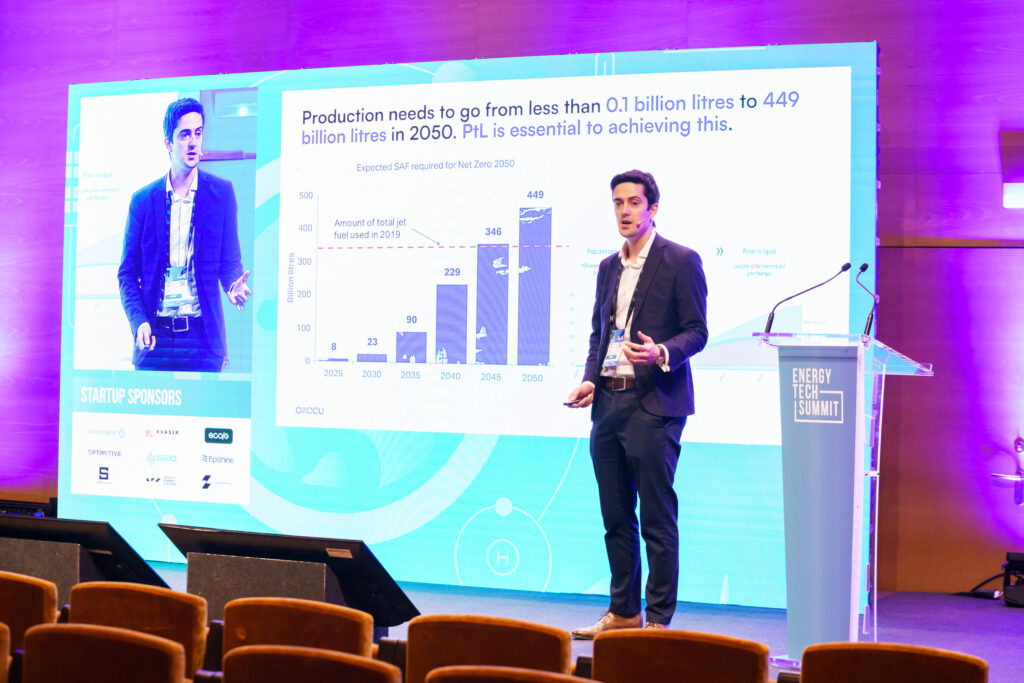
Andrew Symes, CEO of OXCCU
Why power-to-liquids costs too much
Demand for power-to-liquids SAF is now real, thanks to mandates in the UK and the EU. In the EU, synthetic fuels made from CO2 and hydrogen are set to account for a large share of aviation fuel by 2050. Investment is following those mandates. Still, “The key challenge is cost.”
In short, “Power to liquid SAF is just too expensive.” It currently costs around five to ten times more than fossil jet fuel. Symes pointed to two causes. First, multiple process steps drive up capital costs. Second, operating costs stay high because green hydrogen needs a lot of energy. Low selectivity makes things worse, since many byproducts consume expensive hydrogen and dilute the value of the jet fuel.
Going back to iron
OXCCU’s answer is to reinvent the chemistry. Co-founder Tiancun Xiao has worked on Fischer-Tropsch technology throughout his career. The process was invented more than a century ago using iron catalysts. Later, the industry switched to cobalt, which works well with carbon monoxide and hydrogen but not with CO2. As a result, most current routes first
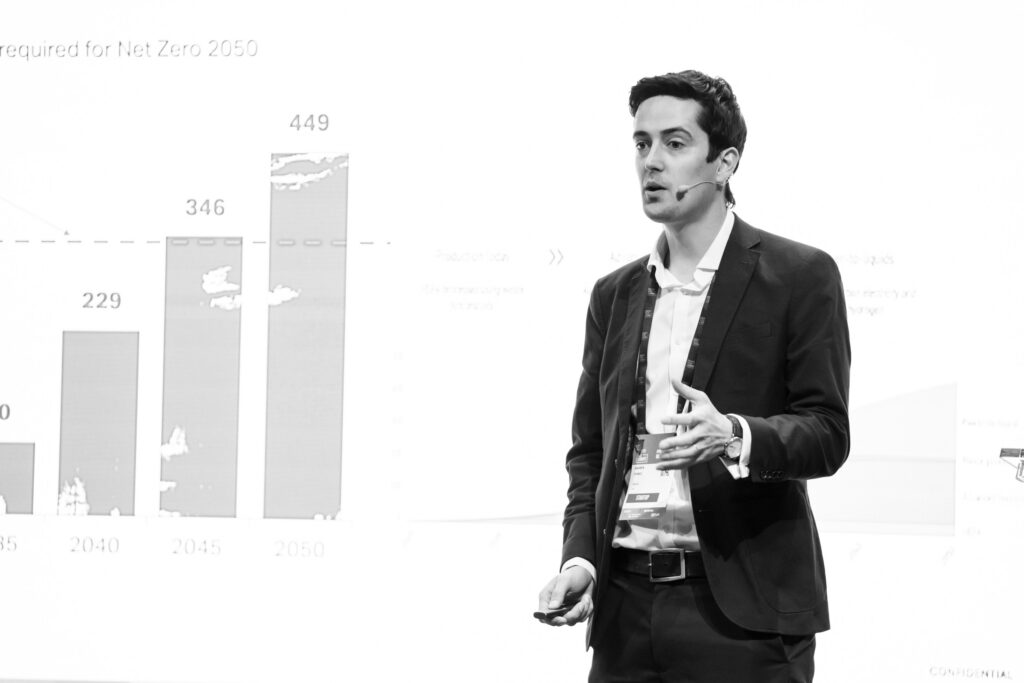
Andrew Symes, CEO of OXCCU
Takeaway
Mandates have created demand for power-to-liquids jet fuel, but cost still stands in the way. OXCCU’s bet is that simpler chemistry, not just cheaper hydrogen, can close that gap. By going back to iron and cutting process steps, the company aims to make synthetic SAF affordable enough to scale. As Symes put it, “We’ve got a huge challenge, but we can solve it.”
Secure your pass
Want to meet the founders tackling the cost of clean fuels? Join founders, investors and corporates at Energy Tech Summit Europe 2027 in Bilbao, April 7–8. Founder’s Pass: €699.