
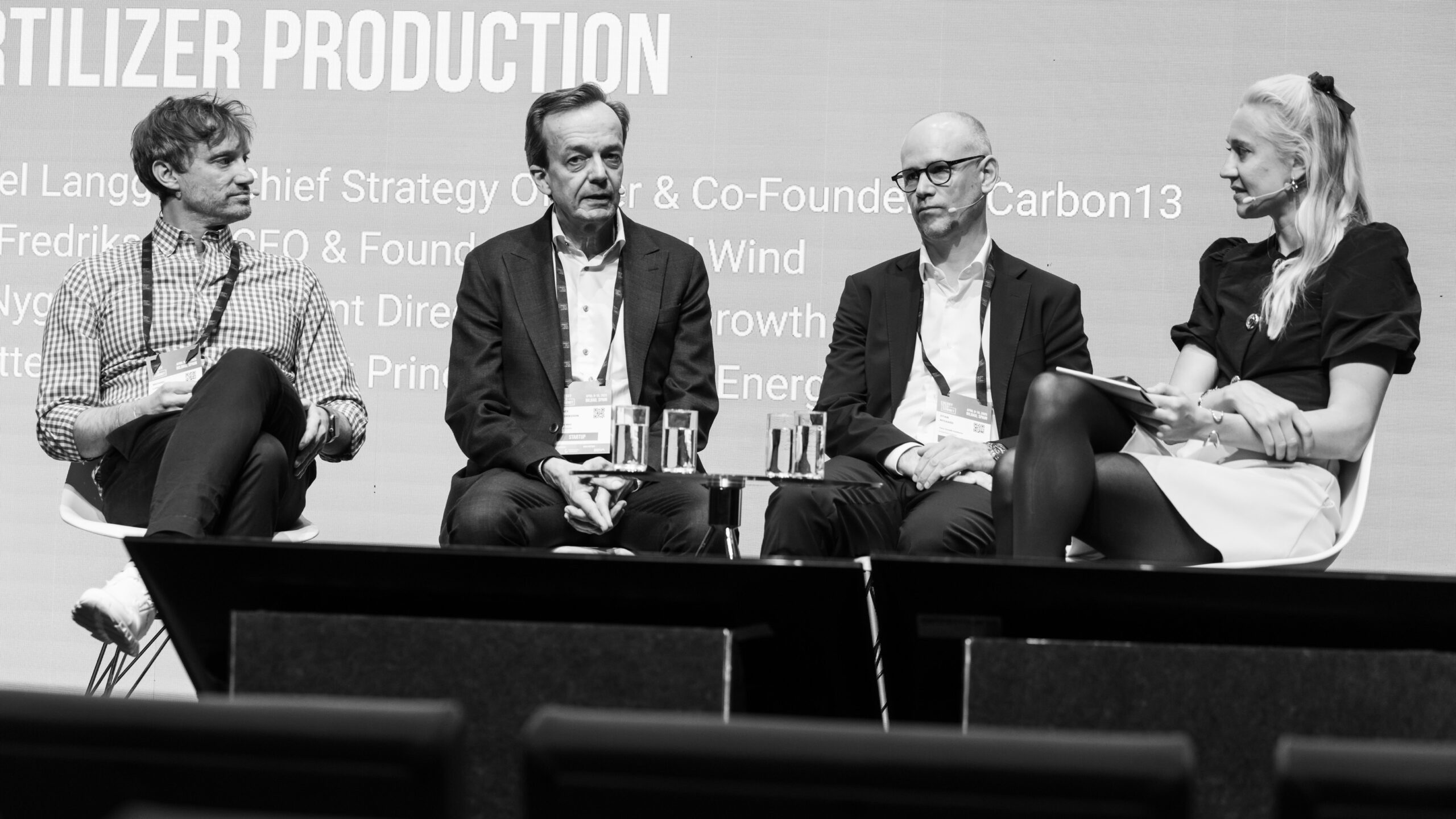
Investors and developers from Yara Growth Ventures, Liquid Wind, Carbon13 and Clean Energy Ventures on technology risk, corporate partnerships and the policy that will unlock demand.
Green ammonia and eMethanol could reshape two hard-to-abate sectors: shipping and fertilizer production. Getting there, however, means bridging the gap between new technology and projects that banks will finance. At Energy Tech Summit, Charlotte Kirk, Investment Principal at Clean Energy Ventures, moderated a panel on exactly that gap. She was joined by Claes Fredriksson, CEO & Founder of Liquid Wind, Stian Nygaard, Investment Director at Yara Growth Ventures, and Michael Langguth, Chief Strategy Officer & Co-Founder of Carbon13.
Bankable technology first, innovation second
Kirk opened with a tension. Startups climbing the TRL scale need pilots, while project developers need proven technology to reach a final investment decision. Fredriksson answered with Liquid Wind’s own story. Early on, the company invited technology providers to bid as complete value chains. It then selected one chain and brought its members in as co-owners. Over the years, a few partners changed, but the principle held. For Liquid Wind, it was clear that “we need to get the technology in place ASAP and we needed to have technology that is going to work”.
That doesn’t close the door on startups. Liquid Wind runs a design and performance center where its partners work together, and gradual improvements follow. Still, in Fredriksson’s view, “you need to be fairly safe in order to get funding so you can get started and then you can be more creative”.
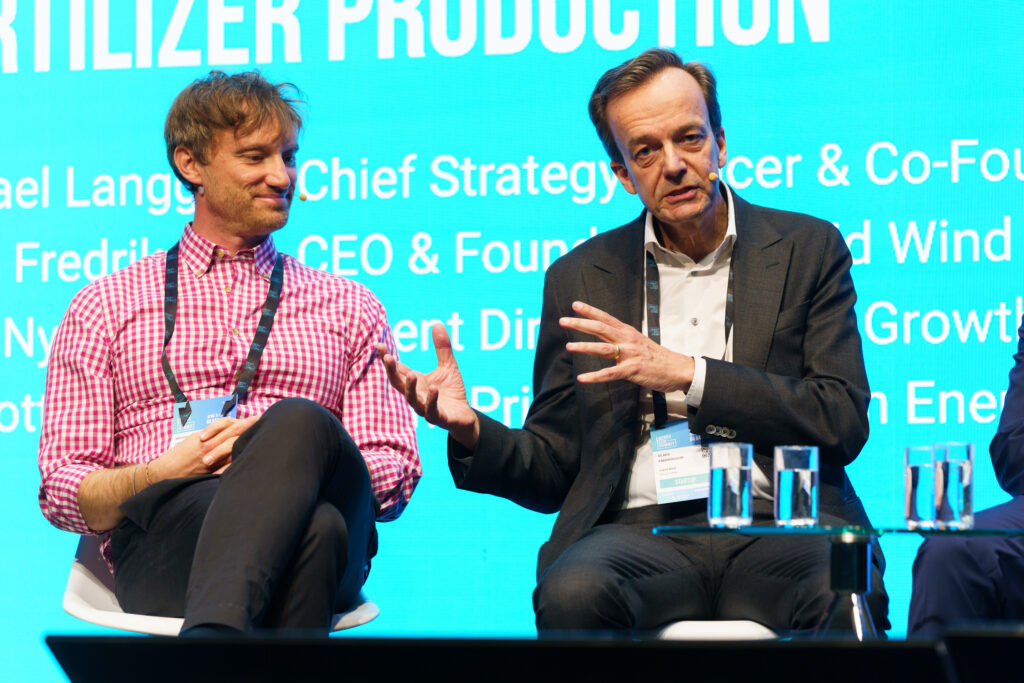
Claes Fredriksson, CEO & Founder of Liquid Wind and Michael Langguth, Chief Strategy Officer & Co-Founder of Carbon13 speaking on stage
How green ammonia startups can win corporate partners
Langguth argued that hardware rarely scales like software, so relationships matter even more. In his experience, “the best founders in our programs are the ones that start these conversations early and they build trust over time with corporate partners”. Often, the step before a pilot is the right university partner, followed by a small test case.
Nygaard explained how Yara’s venture arm manages expectations. Before investing, the team makes one thing clear: “we cannot guarantee either a pilot or an offtake agreement or a sales contract”. Instead, it opens doors through an ambassador program that connects business units with the startup world. Industrial plants also set a high bar. New technology needs thousands of hours of operation under specific conditions before it enters a plant. Moreover, Yara typically relies on an EPC contractor to choose technology, so startups should build links with EPCs too.
Fredriksson shared the developer’s side. Getting into Siemens Energy took Liquid Wind a couple of years, until a senior Nordic executive spotted the company at Hannover Messe and assigned an internal champion. Even then, the work continues across departments, because corporates “are huge machines” whose focus can shift.
Langguth added a warning for founders. Many chase only the largest corporate venture arms, and “I think that’s a bit of a mistake”. Instead, companies that are big in their niche can make better partners. One Carbon13 portfolio company producing hydrogen from biomass, for example, benefits most from a pellet producer that can supply its feedstock.
Grants, sponsored pilots and the capital stack
Hardware startups have a tool that B2B SaaS companies rarely use: grants. Langguth advised founders to team up with an industry partner and apply together. After all, public money for a pilot makes even well-funded corporates more willing to say yes. Nygaard noted that Yara has limited space for pilots on its own sites. As a result, it sometimes sponsors pilots elsewhere in exchange for access to the results. Adding a university partner also makes public funding easier to secure.
For project developers, the capital stack evolves with each stage. Liquid Wind began with crowdfunding, moved to angel investors and then brought in corporates. At project level, it now combines grants such as the Innovation Fund, the Hydrogen Bank and Sweden’s Klimatklivet with a mix of strategic and financial investors. Debt comes next, and lender interest has grown, even for the construction phase. Ultimately, Fredriksson said, it comes down to “whatever the bank at the time considers to be bankable”.
State-backed guarantees help here. In the audience Q&A, Fredriksson explained that a state guarantee can cover the debt portion of an early 70/30 equity-debt structure. That makes lending cheaper and easier. It also signals that a third party has vetted the project. He added that recent high-profile collapses have made some banks more cautious, while French and Asian funds have become particularly active.
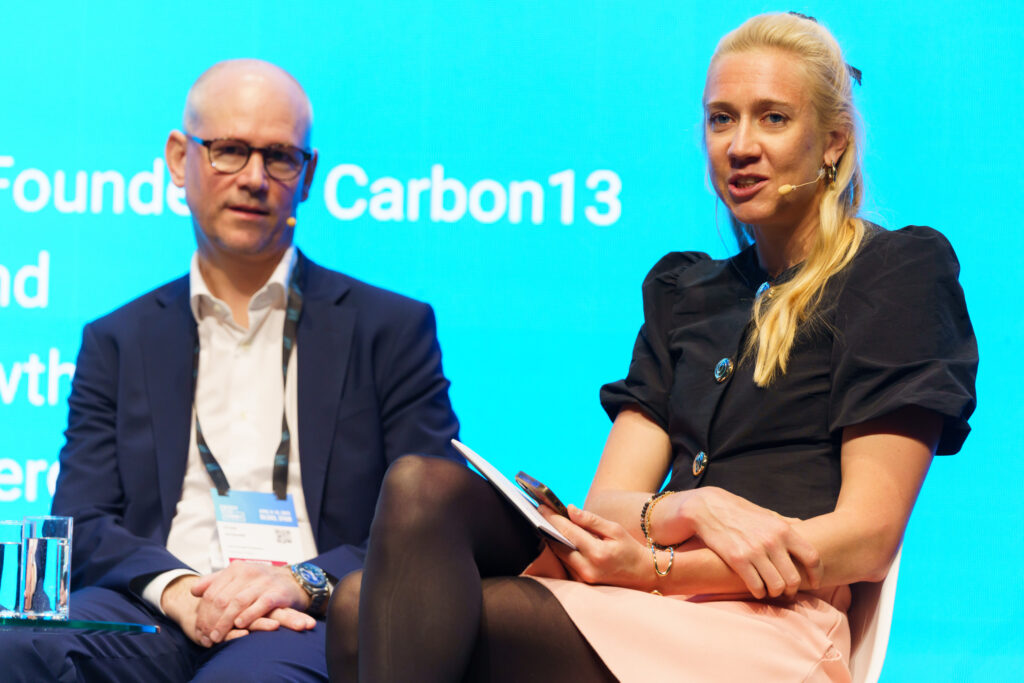
Moderator Charlotte Kirk, Investment Principal at Clean Energy Ventures and Stian Nygaard, Investment Director at Yara Growth Ventures
on stage
Standardization, scale and decentralization
Langguth sees two strong trends among new founders. First, AI is being applied to hard sciences and R&D, and many founding teams now combine an AI developer, a scientist and a commercial lead. Second, decentralization lets startups build container-sized systems – a trend so common that it “makes me laugh when I hear another startup saying it’s in a container”. Joking aside, decentralized ammonia production is more resilient, a point gaining weight as security rises up the agenda.
Liquid Wind takes a different route to scale, although modularity is still central. The company builds one standard facility size, much like the Model T era of car manufacturing. Each facility produces 100,000 tons of eMethanol from 160 megawatts of power and is split into 44 modules built off-site. Standardization also extends to contracting, legal work and commercial terms. Each plant becomes a separate SPV, so investors can back several projects from one portfolio. According to Fredriksson, that size balances CO2 supply, power access and logistics.
Nygaard, by contrast, measures everything against Yara’s global system. Although the company scouts decentralized green production, any new model must compete with large-scale plants and ships that move ammonia from low-cost to high-cost markets. As he put it, “it’s very hard to compete with that kind of beast of a logistics machine”.
Where demand for green ammonia and eMethanol will come from
For Nygaard, shipping is the market to watch. Ammonia-powered vessels are starting to enter service, creating the first real demand. Price depends heavily on power costs. Green ammonia made with European electricity can cost around four times as much as conventional fuel, while blue ammonia in the US is close to cost parity. Fertilizer remains a smaller niche. Green fertilizer lets a food company decarbonize its value chain, yet consumer willingness to pay a premium is still unproven. Langguth sees the startup opportunity in closing that gap with technologies that match gray ammonia on cost within five to ten years.
Fredriksson is focused on shipping as well. Around 400 methanol-capable ships are either built or on order. Blending lets operators add green methanol gradually while keeping prices reasonable. Meanwhile, Liquid Wind is agreeing non-binding offtake at the prices, volumes and ten-year terms it wants. Beyond shipping, he pointed to eSAF via methanol-to-jet, methanol hybrid cars and liquid energy storage.
Energy security is changing the pitch too. In Fredriksson’s view, hydrogen derivatives haven’t gone out of fashion; the framing has simply shifted. Security now comes first, and “then you get the climate as part of the package”.
Policy, power prices and the path to green hydrogen
Asked about the biggest bottleneck, Fredriksson pointed to returns. Product prices and production costs must line up, and in e-fuels that takes grants for first-of-a-kind plants plus mandates that lift demand. Nygaard gave an example of carbon pricing at work. With a carbon tax of around €80 per ton in the Netherlands, capturing and storing CO2 from a Yara plant under the North Sea became cheaper than emitting it. Regulation had been the real barrier, since rules blocked cross-border CO2 transport until they changed.
A final audience question asked whether Europe can produce competitive green hydrogen. Nygaard said it depends on location. Where power is scarce and expensive, green production needs a very large premium. In contrast, northern Norway and Sweden have abundant wind power. Cheaper electrolyzers would also allow peak shaving, running only on grid surplus. Langguth agreed that innovation in efficiency and capex is essential. Fredriksson, whose plants sit in Sweden’s power-surplus region, stayed optimistic: “it’s just a matter of time and there’s a lot of us working on it”.
Takeaway
Green ammonia and eMethanol face a scaling challenge more than a technology one. Developers need bankable technology, startups need patient corporate partners, and both need policy that turns interest into long-term offtake. Meanwhile, energy security is giving the sector a fresh argument – and shipping looks set to be the first market to prove it.
Secure your pass
Want to meet the investors and developers scaling green molecules? Join founders, investors and corporates at Energy Tech Summit Europe 2027 in Bilbao, April 7–8. Founder’s Pass: €699.