

The hype says autonomous grids. The panel said contract automation, back-testing and getting the tariff right. A useful gap.
AI in energy management gets discussed at two speeds. Namratha Kothapalli, Investment Principal at Speedinvest, opened by naming the tension directly: AI is impossible to avoid for an hour a day, while energy is complicated, heavily regulated and slow-moving. Can the hype deliver here?
Where AI earns its place
Jan-Willem Rombouts, Founder and CEO of Beebop, set the bar: AI has to be relevant where it is genuinely needed and solves real problems, rather than being nice to have. The power system, he noted, has more than enough genuinely complex problems to qualify.
His own case is specific. Customer assets – home batteries, rooftop PV, heat pumps, EVs – sit behind the meter, and those customers have no access to where the value actually is: wholesale energy markets, not just day-ahead but intraday in 15-minute blocks, and grid markets where operators procure flexibility.
The difficulty is a mismatch in character. Trading and grid operations demand extremely high reliability, comparable to a gas-fired plant or a utility-scale battery. On the other side sit enormous numbers of complex, individually unreliable resources. Bridging the two is where AI becomes necessary rather than optional – because controlling a million assets minute by minute cannot be done with systems that scale linearly with assets under management.
Andreas Langholz, Head of Technology at Ingrid Capacity, works at the other end of the same system, solving power transportation with both digital and physical assets – large battery storage in the Nordics, plus helping grid companies plan and decide.
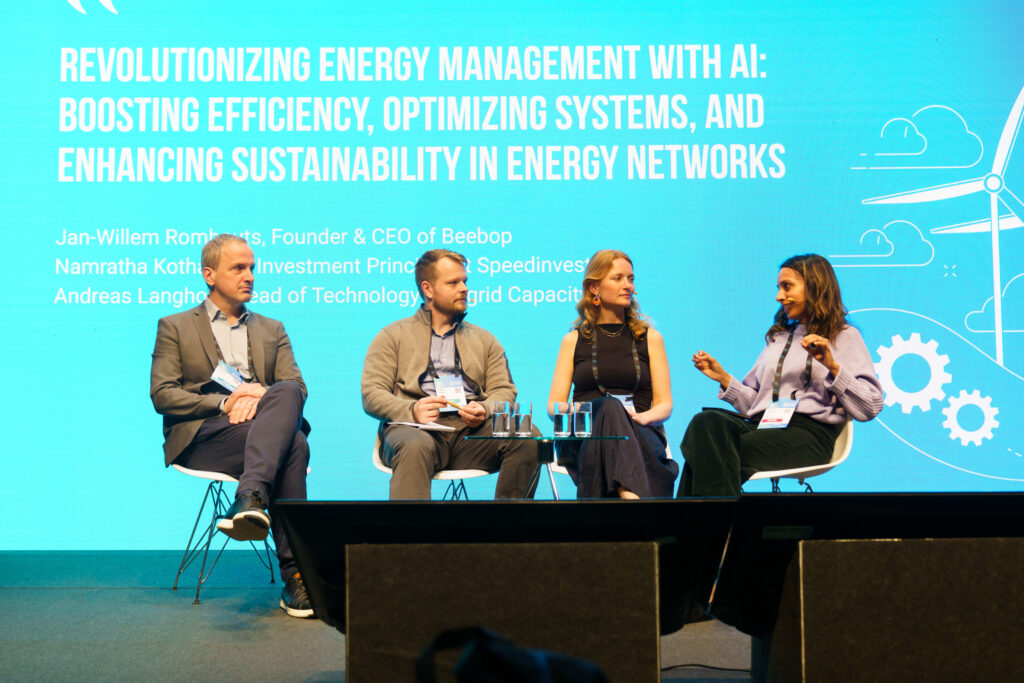
Panel discussion featuring speakers: Jan-Willem Rombouts, Founder & CEO of Beebop; Ellen Smeele, Investment Manager at SET Ventures; Andreas Langholz, Head of Technology at Ingrid Capacity and moderator: Namratha Kothapalli, Investment Principal at Speedinvest
The last mile problem
Asked about frustrations in commercializing AI, Rombouts gave an unusually candid answer about his own engineering team.
Before tackling complex power system problems, the obvious first move is using AI to make software engineering more efficient. Integrations with documented OEM APIs look like an ideal candidate – why spend five weeks when you could spend three days and focus the rest on testing?
The feedback he gets is that the tools get it almost right, and the team still spends substantial time on the last mile. So engineers gravitate toward autocomplete-style assistance rather than trusting AI to write a whole integration. He was honest about not knowing whether that reflects experienced engineers locked into patterns or a genuine limitation – and noted he sees the same last-mile issue using chatbots for market research.
On the deeper problems he extends more grace, for a reason that should be on a poster somewhere: “The last thing that you want is hallucinations on the power grid every day. That would not be a great first use case.”
Langholz added a different frustration, about counterparties rather than code. Working with public and semi-public entities, transmission and distribution operators, the task falls to entrepreneurs to communicate why intelligence matters to the system – why a local municipality should spend effort exposing its data. Usually the resistance isn’t obstruction, he said. They don’t know what they’re missing.
He then made the point that recurs through the session: the glamorous work gets attention, but the value shows up elsewhere. Alongside identifying sites across Europe with AI and power trading, a great deal of value comes from automating contracts, legal and procurement – removing paperwork and friction from processes that were extremely manual.
Visibility before optimization
Smeele’s contribution was the panel’s clearest structural argument, and it came with a striking number.
The Dutch grid operator had that week identified 9 GW of additional capacity, available if used within certain time windows. The offer remains crude – yes at these hours, no at those – because they lack sufficient visibility across the infrastructure to steer it actively.
Digitize those assets, and you gain visibility into what is happening and where, which can be translated into price signals that flexibility providers can trade against. That gets far more from existing infrastructure without digging holes and laying new cable. Some new build is still necessary; a great deal is not.
That makes integration the starting point rather than optimization, which is why she looks at companies working on secure edge applications – small enough to run locally while still connecting to the cloud.
Rombouts extended it into an organizational observation. Households and businesses are electrifying heat and transport, but grid planners and operators often cannot see it, because it sits dormant behind customer meters. The same applies to suppliers, whose trading desks lack visibility into behind-the-meter assets – and, more importantly, don’t trust that they could use them with the reliability they’re accustomed to.

Panel discussion featuring speakers
Jan-Willem Rombouts, Founder & CEO of Beebop; Ellen Smeele, Investment Manager at SET Ventures; Andreas Langholz, Head of Technology at Ingrid Capacity and moderator: Namratha Kothapalli, Investment Principal at Speedinvest
Creating that transparency means building bridges inside organizations: between customer-facing teams and core grid planning and operations, and between the customer side and trading. AI can make a great deal visible there. Though as he acknowledged, that is double-edged – a trader’s first question is whether the AI can be trusted.
The trust argument, taken seriously
This produced the most interesting disagreement of the session.
Rombouts answered from two directions. Physically, a hundred thousand distributed assets can form a system more reliable than a single asset with a single point of failure. And on model trust, Beebop has invested heavily in back-test simulations. Trust builds the way it did for consumers with chatbots: gradually, through exposure.
Langholz pushed back, admitting bias toward trusting computers over humans. His concern is the compromise position. Build an AI power trader you don’t fully trust, then put a human in the loop to validate it, and you get the worst of both worlds. Neither the speed of automated decisions when an auction closes at midnight, nor the trader’s intuition.
His argument is for demonstrating what full automation actually looks like, in controlled and safe conditions. Back-test it thoroughly, but don’t let validation become a permanent block on development.
Rombouts’ response drew a useful distinction. Transient validation periods are normal – reinforcement learning from human feedback went through exactly that. But explainable AI does something different from human-in-the-loop oversight: it moves a decision from black box to something an operator can interrogate, showing which features drove it. That transparency builds trust without keeping a human in the decision path.
What actually gets measured
Asked about success metrics, both operators returned to business fundamentals over model performance.
Langholz named speed of deploying new assets that help the system, and return on those deployments. Forecasting error metrics matter, but the hype around impressive models has to be cut through to reach the bottom line. His example: you can gain a little on the top line in trading, but if tariffs and contracts aren’t well managed, it doesn’t matter. Using AI to support negotiations can improve a project by an order of magnitude more.
Rombouts was equally direct. For the end customer it is simply how much discount appears on the energy bill. For retailers it is customer lifetime value, which embeds churn and margin, plus acquisition cost. Then work backwards to find the biggest drivers.
Smeele confirmed the same from the investor seat: business value and near-term impact over vision, typically measured as cost saving.
Policy, lobbying and the role of crisis
Rombouts brought first-hand experience from founding a virtual power plant company in 2010, when the concept was genuinely novel. Conversations with grid operator executives started from explaining what a virtual power plant even was. It’s software, so where does it run, and how do you test something you can’t plug into a turbine? That required alignment across regulators, transmission operators and the wider ecosystem, which he called an intense choice for a first startup, though it delivered first-mover position in several countries.
<span class=”yoast-text-mark” style=”font-weight: 400;”>>With Beebop he has tried to avoid needing the same effort, while still speaking to policymakers regularly – arguing from first principles of affordability, cleanliness and reliability, then bringing those to life with real data.
Smeele offered a concrete counter-example from a portfolio company. The EU holds a strong single-market mentality and believes in market-based balancing through price signals, but individual national grid operators maintain their own bilateral arrangements, which makes scaling across regions hard. One portfolio company successfully lobbied to enforce the European central market mechanism, changing German regulation with major effect on its business case. It took a long time – but it worked.
What if we’re wrong?
Kothapalli’s closing question asked what happens if the optimism is misplaced.
Smeele named capital misallocation, and did so with some courage given the audience. Billions went into certain technologies without the benefits materialising, and the same risk applies here – investing heavily in AI that doesn’t deliver, while talent and money that could have built critical infrastructure and physical assets go elsewhere.</p>
Langholz added two. First, the solution space is wider than software: hardware answers exist, and if everyone had perfectly flexible generation in the basement, storage optimization would be moot. Second, the AI buildout itself is hard to gauge, risking either under- or serious overcapacity in the system.
Takeaway
The closing remarks split neatly. Smeele: both AI and the energy transition are early, they can accelerate each other, and the economic incentives are in place. Langholz: almost every type of asset and intelligence will be needed, and “the boring solution is often the most valuable”. It has good middleware, automated contracts, the things that actually get deployed. Rombouts: alongside AI-generated novelties, apply it to real problems with generational impact. And a final point they agreed on: as building AI systems becomes commoditized, domain expertise becomes the scarce thing. Building a product is easy now. Building the right business, with a path to customers, is not.
Secure your pass
Energy Tech Summit brings together the startups, investors and corporates building the energy transition. Founder’s Pass is €699, fixed.