
Nine founders on why the money isn’t reaching the projects – and the plumbing they’re building to move it.
Climate finance has a distribution problem rather than a supply problem. Capital exists, projects exist, and the two keep failing to meet because of missing data, mismatched ticket sizes, fragmented markets and manual processes. Every pitch in this track attacked a different point in that gap.
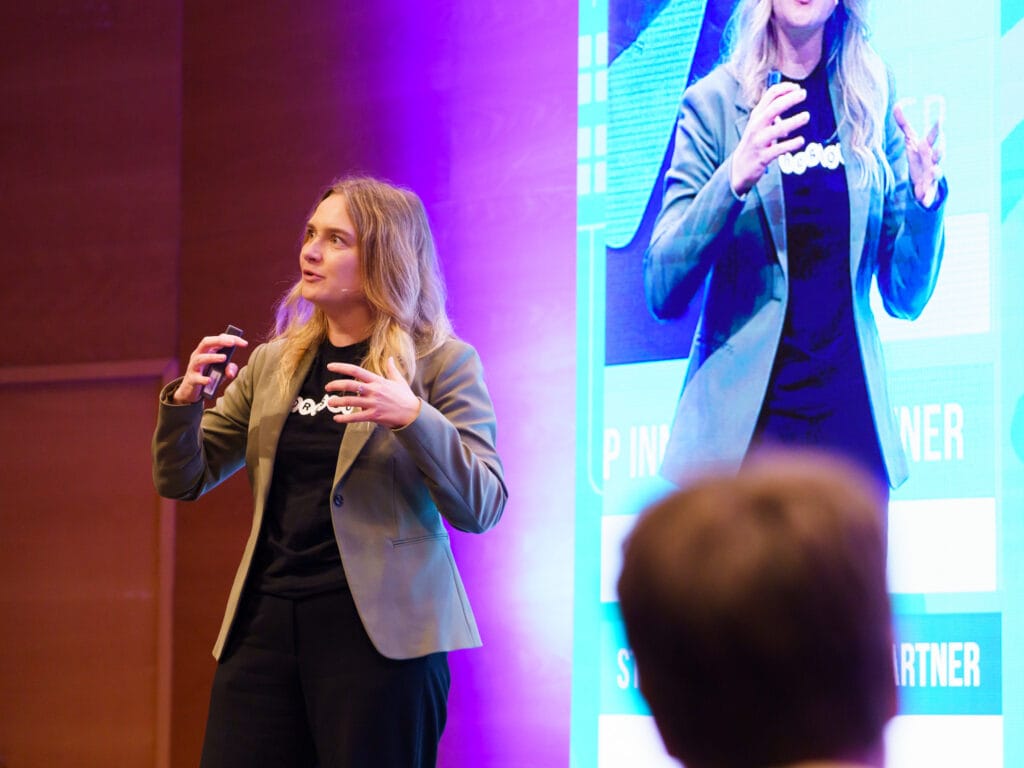
Sophie Bruusgaard Jewett, CEO of Morescope pitching their teams work at ETC2025.
atmo: making farm decarbonization bankable
Jen Godderidge opened on a mismatch. Agriculture produces a large share of global emissions while receiving a fraction of project-level climate financing.
The disconnect is structural. Food companies carry most of their emissions in the supply chain and cannot reduce them directly – the farmer can, but is squeezed on margin and lacks financing. Banks finance those same emissions. Everyone faces pressure, nobody has a scalable intervention.
atmo sits in the middle. Farmers see the interventions that cut emissions and improve profitability; banks and food companies get a portfolio view. The platform scopes interventions at farm level, builds the business case, connects farmers to suppliers through a marketplace, then feeds banks the information they currently lack to de-risk lending. It also measures the reductions so both sides can report them.
Her worked example: a digester where the farmer’s incremental revenue comfortably exceeds annual maintenance, the food company gets supply chain resilience, and the bank originates a loan while cutting financed emissions.
On credit, Godderidge was realistic. Banks assess credit risk rather than climate risk, largely from missing data. atmo cannot fix a bad credit score, but supplies the cash flow and emissions metrics that shape the decision.
Carbon X Tons: regulated permits on chain
Alfred Evans began with a definition. A low-carbon economy means a price on carbon, and that price already exists across major economies with a long compliance-market track record.
The problem is access. The markets are split across dozens of jurisdictions and thousands of credit-issuing projects, which puts them out of reach for most buyers on cost and regulatory grounds. Meanwhile the voluntary market has damaged its own credibility through failing projects and fraud.
His answer is what he called a central bank of carbon, based in Switzerland, holding a reserve of regulated carbon permits and tokenizing them. Two properties follow: every token is irrevocably linked to a tonne, and pricing tracks an independently set market, so it trades like a normal commodity.
Three markets stack in sequence – offsetting first, then trading, ultimately financial markets where investors hold permits for environmental and financial return while hedging their own offset commitments.
Energy Glare: energy efficiency as an asset class
Rumen Yordanov wants energy efficiency to become investable. The financing gap he described is enormous, with efficiency alone needing far more annually than currently flows, and emerging markets faring worse.
The causes are familiar: projects are simply not available to investors, verification risk is high, financial risk is high, and the market is fragmented.
His platform creates a common marketplace for efficiency projects, then tokenizes each contract to enable a secondary market and liquidity, and allows third parties to build further instruments on top. It tracks and verifies performance, issuing carbon credits on that basis.
The verification layer is the interesting part. Independent energy and carbon auditors sit on the platform as third-party verifiers today. An AI agent capable of running energy audits and due diligence autonomously is intended to cut that cost.
Yordanov’s closing line was a positioning statement: rewarding verified performance rather than promises, because “energy glare is not just a platform, it’s infrastructure for climate finance.”
Eoliann: forward-looking climate risk from orbit
Roberto Carnicelli opened by quoting a UN environment official on there being no person or economy left untouched by climate change, then explained why that creates a data problem.
Extreme events are not only increasing, they are becoming volatile – which makes historical data a poor guide to where the next one lands. Financial institutions and corporates need to move from backward-looking to forward-looking assessment to allocate resources sensibly.
Eoliann feeds satellite data from three constellations into in-house AI that quantifies three variables: probability, intensity and impact. The output is asset-level granularity across Europe, starting with flood and expanding to wildfire, drought and landslide.
His answer on granularity was unusually candid. Some inputs are simply not fine-grained – rainfall, for instance – while others, like wildfire ignition probability derived from terrain and fuel type, genuinely are. The final estimate inherits the resolution of the best available input rather than a uniform figure.
He was equally direct on competitors, naming two and arguing both are structurally limited for infrastructure: one is vertical on financial institutions, the other rigid around point-by-point analysis, neither suited to linear infrastructure. His differentiation is fewer risks at higher resolution and wider scope.
Granular Energy: clean power, hour by hour
Sebastian Porter asked what you are actually buying when you buy clean energy. Since individual electrons cannot be tracked, the answer is a certificate – issued by a producer, bought and cancelled by a consumer against their annual consumption.
That deliberately boring market is large and has become volatile, and it is now shifting from annual to hourly accounting. The benefits are real: closer alignment with physical reality, restored trust, and a far better price signal for renewables.
It also leaves suppliers managing a volatile commodity in spreadsheets while customers demand hourly transparency. Granular solves both, optimizing certificate management today and enabling premium green offers next.
Porter’s scaling logic is leverage. Certificates work broadly the same way worldwide, and winning one supplier effectively reaches tens of thousands of end consumers at once. The corresponding constraint is that suppliers are corporate behemoths with sales cycles running up to two years.
The forward view is convergence: as hourly accounting arrives, certificates start behaving like power markets, opening trading and arbitrage to battery operators and others.
Kumo: carbon removal that institutions can actually buy
Robin Klemens identified a pure size mismatch. Carbon removal projects need financing in the single-digit to low tens of millions. Institutional debt capital does not engage below a hundred million or more.
Kumo’s structure bridges it by amalgamating project cash flows into a Luxembourg SPV and issuing notes across a portfolio – diversifying risk while reaching investable volume.
A conversation with a major bank shaped the second product. Beyond structuring, they said, what banks need is data and diligence. As asset originator Kumo sees proprietary performance data, which supports building the financial data layer the carbon market currently lacks.
On timing, his argument was that both sides matured simultaneously. Banks have progressed from having no desk able to trade carbon credits, through compliance markets, to voluntary credits and client-facing products. And offtake volumes from major corporate buyers have risen sharply, with technologies like biochar carrying little remaining technical risk.
Latitudo 40: deciding where a city should invest
Francesco Amato framed cities as increasingly warm, dense and fragile, facing heat, flooding and energy poverty at once. The harder problem is deciding where and how to invest in resilience.
The company builds on satellite data, AI and simulation, sold two ways: a marketplace where a customer draws an area on a map, selects layers such as heat risk, flood risk or solar potential, and receives data within hours; and a SaaS platform offering customized access to historical data for a specific city or area.
The applied use case is renewable energy communities – local groups of citizens, businesses and municipalities producing and sharing energy collectively. Planning them without data leads to inefficiency, so the platform identifies the most suitable areas automatically.
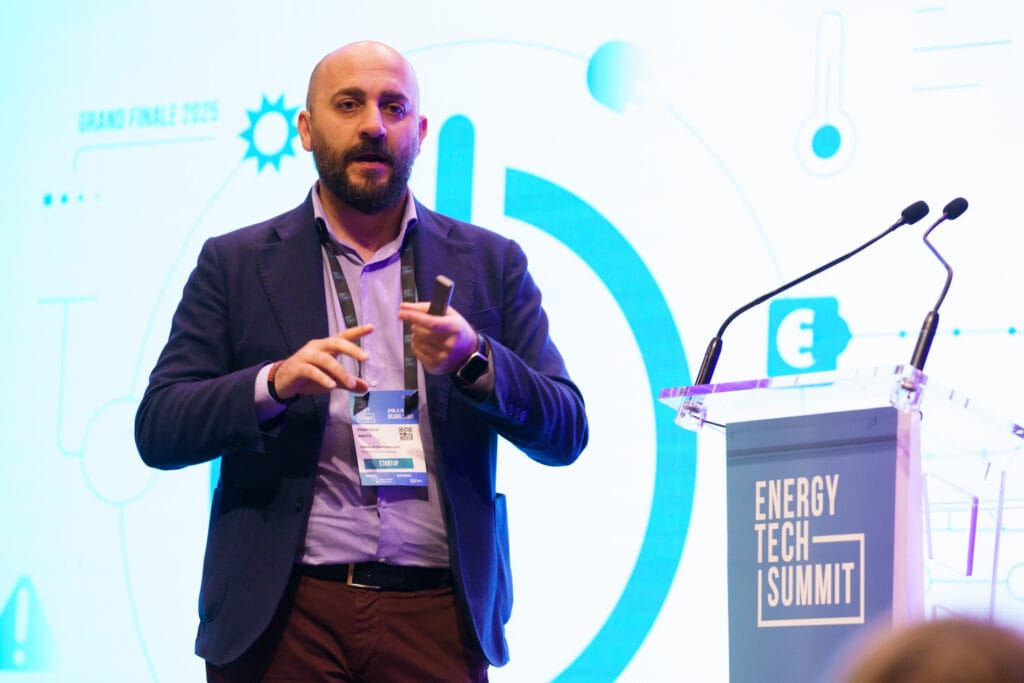
Latitudo 40 (EarthDataInsight) representative Francesco Amato at energy Tech Challengers 2025.
Morescope: what happens when reporting pressure lifts
Sophie Bruusgaard Jewett made the most contrarian opening of the track: the sustainability reporting boom is over, or at least paused – and that is good news for corporate decarbonization, because it frees time and resources for climate action rather than disclosure.
Her underlying point is that demand predates regulation. Companies were already fielding requests for carbon information from investors, banks, owners, employees and especially customers.
Having spent her career on corporate decarbonization, she framed the problem as accessibility: the work needs enormous data, business expertise across every function, and serious spreadsheet skills. “Why is something so urgent and something so business critical still so out of reach?”
Morescope tracks emissions across the supply chain through a proprietary data model, then generates contextualized suggestions for climate actions based on a company’s carbon profile, and quantifies the impact of those solutions – addressing both measurement and the scaling of solutions.
She was refreshingly direct about her hardest problem: an extremely crowded space, where being filed under ESG software is the constant risk, and differentiating for customers and investors is the daily work.
SEOS Energy: solar lending in Latin America
Juan Sebastian Pfeiffer Pulido opened by noting he was the only South American company presenting, then leaned into it: “we’re not sexy. We’re not doing carbon, hydrogen, anything like that.”
His case is that Latin America is decades behind on solar adoption despite ideal fundamentals – high radiance, no seasons, high electricity rates, low installation costs. The blocker is financing. Banks do not yet understand solar lending, installers work through manual processes, and the customer journey breaks.
SEOS builds the infrastructure layer connecting end users, installers, wholesalers and capital providers, with an agentic platform automating the processes installers need to close sales and lenders need to deploy de-risked loans.
The strategy is sequenced deliberately: prove a de-risked loan portfolio first, then scale the software. On the technical side, workflows disburse against milestones and enforce engineering standards – because the best collateral is a solar asset producing as expected.
The detail that landed hardest was legal: SEOS became the first creditor ranked above a mortgage in a client default. His stated zero default rate comes from origination discipline, and from the economics being straightforward for the borrower, who redirects a utility payment into a loan payment.
He closed on scale rather than product, pointing to the population ratio between global south and north as a reason to look beyond Europe.
Takeaway
Across nine pitches, climate finance kept coming back to the same structural failures. Ticket sizes that don’t match institutional minimums. Data that lenders need and don’t have. Markets fragmented across too many jurisdictions to access. Manual processes that lose the sale before financing is even discussed. None of these are technology problems, which is why the answers on stage were mostly plumbing – marketplaces, data layers, securitisation structures and workflow automation. The jury’s most frequent question was the same one every time: what exactly do you charge, and to whom.
Secure your pass
Energy Tech Summit brings together the startups, investors and corporates building the energy transition. Founder’s Pass is €699, fixed.