

A switch with no moving parts, a heat battery on a Euro pallet, and a transformer with a brain. Inside the Green Energy Infrastructure pitches at Energy Tech Summit.
Green energy infrastructure rarely gets the applause that generation does, yet it decides how much clean power actually reaches anything. This track went straight at that layer: the switchgear, the transformer, the charging connector, the heat pump and the household device. Several founders made the same underlying argument in different words – the equipment already installed can do far more than it currently does.
BLIXT Tech: switching without moving parts
Charlotta Holmquist opened by pointing at a component nobody thinks about. Electricity runs everything, yet we still control it with mechanical switches designed more than a century ago. Mechanics cannot move quickly enough, cannot adapt and cannot think.
Her framing was a category shift rather than an upgrade: “from mechanical to programmable power.” The product, a solid-state smart switchgear, lets operators see, move and control electricity in real time down to the circuit and sine wave level. She positioned it not as a better switch but as the digital brain of a power system.
Deployment is already varied. Industrial manufacturers use it for fast troubleshooting and protection to cut downtime, and a major utility uses it for advanced microgrid control. A newer product adds a fully programmable battery system, combining voltage conversion and storage with cell-level control, which removes the need for bulk inverters.
Asked what keeps her awake, Holmquist named regulation: rules still assume switchgear must be mechanical, so the company sits on the working committee pushing to change that. The second worry is large OEMs following the same evolutionary path, which is why IP came first.
Podero: monetizing devices already installed
Chris Bernkopf started with the duck curve – too much solar and wind midday, too much demand morning and evening. Batteries fix it, but expensively. Meanwhile Europe is already full of devices that could help: heat pumps, solar inverters, home batteries, air conditioners.
Podero builds the platform utilities use to monetize them. It shifts consumption into cheap hours and stabilizes the grid, and those two revenue streams subsidise cheaper electricity contracts.
The product comes in two forms. One is a white-label app a utility can launch immediately to test the concept. The other integrates into an existing virtual power plant, where Podero acts as a virtual battery and the whole device fleet trades through a single API.
Five optimization modes stack on top of each other, from self-consumption and day-ahead spot optimization through to intraday trading and balancing energy.
On the hard part – integrating every manufacturer – Bernkopf described a domino effect. Once a major heat pump brand joined and utilities began marketing those devices for the savings they unlocked, competitors followed. The industry has also shifted from hardware gateways to APIs, though pricing for API access ranges from free to expensive and remains unsettled.
Customer acquisition sits with the utility, deliberately. Only utilities can trade in these markets, and they already have millions of customers, so their marketing is far cheaper than Podero’s would be.

Chris Bernkopf, Co-founder & CEO of Podero GmbH
Cartesian: storing heat instead of electricity
Hakon Selvnes made a simple case for a neglected asset class. Around half of all end-use energy goes to heating or cooling, so storing heat directly avoids a conversion that costs money twice over. Cartesian is “in the business of delivering energy when you need it.”
The product is a compact thermal store for commercial buildings. It is modular, fits on a Euro pallet for easy transport into buildings, uses sustainable materials, and needs no servicing across its lifetime. Against the incumbent alternative – a water tank – it holds several times more energy in the same volume.
Price volatility does the selling. As renewables grow, the spread between cheap and expensive hours widens, which creates the incentive for end customers to store.
The near-term challenge is not the technology but the route to market: finding the right installation and HVAC integration partners across Europe. Longer term, Selvnes pointed towards ancillary services and heat as a service.
Easelink: charging that happens by itself
Hermann Stockinger identified the gap in an otherwise finished story. “A self-driving car can park itself, but without an automated way to charge, autonomy stops at the plug.”
Easelink’s matrix charging puts a connector on the vehicle that lowers onto a pad on the ground. Stockinger framed the opportunity as a standards battle rather than a product race – the market wants a de facto standard for automated charging, and nothing has claimed that position yet.
The commercial model is licensing. Suppliers scale the technology globally while Easelink owns the interface, which sits between the vehicle and the grid and enables a hardware-enabled software play. Because an automatically connected car is a connected car whenever parked, every parked battery becomes an accessible flexibility resource for load management, peak shaving and trading.
On operations and maintenance, Stockinger sidestepped the trenching problem entirely: the first applications are home and fleet charging, where the charge point ships with the car rather than requiring public infrastructure. Retrofit is also possible, which is how the taxi pilot works.
IONATE: a transformer with a brain
Luca Mezossy-Dona opened on cost: power quality problems carry an enormous annual price across the EU, and the grid meant to power EVs, batteries and AI data centres still runs on century-old technology.
IONATE’s answer is the hybrid intelligent transformer. On the surface it looks and connects like a standard transformer. “But this one has a brain.” It adds real-time data visibility and millisecond-precision power flow control, which turns a passive building block into something that resolves power flow problems autonomously.
The second-order effect is the real pitch. Each unit lights up a real-time control node, and once enough exist, software can coordinate them into a network that optimizes itself.
Manufacturing follows an Intel-inside logic. Rather than building factories, IONATE partners with established transformer makers who produce the bulk of the device while IONATE supplies the intelligence. That suits conservative, trust-based custommers and scales faster.
On transformer lead times, Mezossy-Dona was careful not to overclai: IONATE uses the same constrained supply chain and does not solve the shortage. What it offers partners is a higher-margin use of an existing production slot.
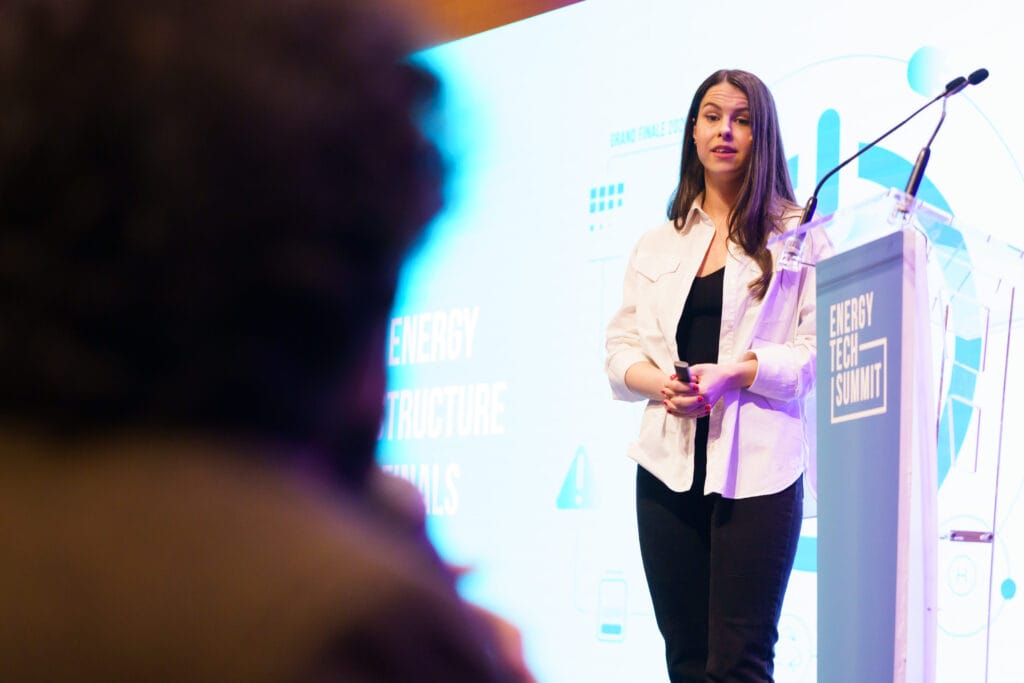
Luca Mezossy-Dona, Co-founder of IONATE
LionCharge: charging where people actually park
Venkata Saiveer Reddy Gutha started as a charge point operator in India and learned something from his own customers. Drivers were coming to public fast chargers not by preference but because their home or office would not let them install one.
Conversations with around fifty property managers produced three consistent reasons: independent wiring by occupants was refused as a fire hazard, individual meters lacked available load, and even where a common area existed, nobody could see how to monetize it.
LionCharge answers all three. It handles engineering, procurement and construction of the charging station in the building. Occupants get an app with AI-assisted issue resolution, and the facility gets a dashboard showing who charged when, how many sessions ran, and – crucially – collecting the money. A carbon savings tracker was added more recently.
Growth came from bulk orders with charger OEMs, passing the benefit to facility managers, combined with sustained email and WhatsApp outreach to those managers.
Asked about scaling constraints, Gutha named the B2B sales cycle, then reframed uptime as an opportunity: a premium plan offering same-day service rather than the standard 24-hour response.

Venkata Saiveer Reddy Gutha , Founder, CEO of LionCharge
Samara: installer first, utility second
Manel Pujol built his pitch on a market distortion. Spain has the most sun hours in Europe and one of the lowest residential solar penetrations, because regulation capped the market until around 2019. The overwhelming majority of Spanish homes still have no solar.
Samara set out to be the best possible installer first, and Pujol argued the results back it: national installation capability, a meaningful share of a large market, and the best customer ratings among Spanish installers. The company also installs batteries, heat pumps and EV chargers.
The strategic move came next. Samara became a licensed energy supplier and now bundles installation and tariff into a single subscription, shifting customers from an expensive, unpredictable bill to a cheaper and more predictable model.
That sequencing also answers the hardest question in consumer energy: acquisition cost. Samara does not acquire tariff customers like a retailer. It upgrades customers it already installed hardware for.
Community buildings are the next focus, which matters in a country with unusually high multi-family housing. The product guarantees savings, and a financing partner covers the hardware so residents avoid an upfront investment – typically the blocker in shared buildings.
tequs: a heat pump you can actually install
Vegard Dossland closed the track with a supply problem rather than a demand one. Europe needs tens of millions of heat pumps to replace fossil heating this decade, and the industry cannot produce them fast enough.
His product is a modular, high-efficiency, plug-and-play heat pump that uses CO2 as refrigerant. “Instead of making CO2 a part of the problem, it is now part of the solution.” Standardisation is the point: traditional units are custom-made, require scarce specialist competence, and cannot be verified until they are on site. A standardised, compact unit cuts installation from weeks to days and retrofits easily.
The commercial model is unusually clean. tequs sells directly to contractors and delivers to end customers with no specialists required, and customers pay before the manufacturer is paid – so growth is not capital-constrained. Manufacturing runs through an experienced European contract partner, which means capacity is not the bottleneck either.
The proof point is a national swimming arena in Norway, where the installation cut energy consumption sharply enough to pay back within a year. Dossland closed on the line the pitch was built around: “It’s time for redemption. It’s time to make the switch.”
Takeaway
Green energy infrastructure is where the transition meets its physical limits, and this track kept returning to one idea: the cheapest new capacity is the capacity already installed. A programmable switch, an intelligent transformer, a connected heat pump and an automatically charging car all do the same job – they make existing assets controllable. The jury’s sharpest questions were rarely about the technology. They were about who pays for customer acquisition, which partner does the manufacturing, and what happens when the incumbents notice.
Secure your pass
Energy Tech Summit brings together the startups, investors and corporates building the energy transition. Founder’s Pass is €699, fixed.