

Methanol from municipal waste, jet fuel from CO2, and a power plant that runs backwards. Eight founders pitched the Green Molecules track at Energy Tech Summit.
Green molecules occupy the hardest part of the transition. Electrons move; molecules must be built, and usually at a cost the fossil incumbent still beats. The founders on this pitch stage attacked that gap from opposite ends – some by changing the feedstock, some by removing process steps, and some by rethinking the materials inside the equipment itself.
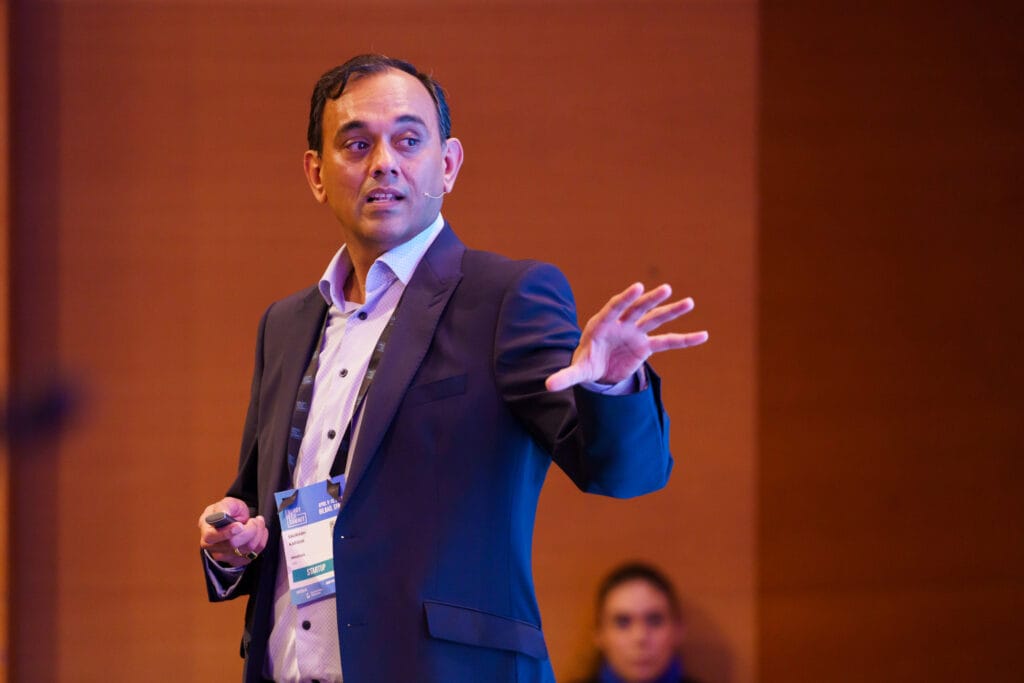
Saurabh Kapoor, CEO of Metafuels pitching their solution on Energy Tech Challengers 2025 stage.
ETGAS: methanol from negative-value feedstock
Ivars Pinkulis opened on scale. Methanol is an everyday commodity, used across manufacturing and household products, and renewable methanol represents an enormous market opportunity. The obstacle is the familiar one: a cost gap against the fossil route. Even with cheap hydrogen, e-methanol stays too expensive.
ETGAS closes that gap by changing the input. Waste carries a negative value, so the feedstock pays rather than costs. The company converts waste to syngas, then syngas to hydrogen and CO2, then synthesises methanol. All three steps are validated after two decades of work, which leaves the demo plant as the remaining task.
Asked why methanol rather than the many other uses competing for waste, Pinkulis pointed to circularity: methanol makes plastics through the olefins pathway, so plastic returns as feedstock. Siting follows the customer, and the customers are waste management companies solving a waste problem.
H2Vector: hydrogen as long-duration storage
Miguelangel Ocando Wahban is building a modular green hydrogen battery. It captures surplus energy, stores it, and returns electricity, heat and compressed gas for stationary and mobility use. The ambition is deliberate: “tackling climate change must be ambitious”.
The efficiency question always comes, and he answered it in three parts. On electricity alone, lithium wins over short durations. Counting heat as well, the system reaches over 90% overall efficiency. On embedded emissions, he claimed roughly half the scope 3 impact of an equivalent lithium system.
Duration decides the fit. Below six hours, lithium remains the right answer. The economics turn in hydrogen’s favour once a site needs 24 hours of autonomy or more, and seasonal storage stays too capex-heavy.
The company is now shifting from B2C to an energy-as-a-service model with a fuel logistics partner, which Ocando Wahban argued builds pipeline faster than selling project by project.
Matteco: the materials inside the electrolyser
Carlos Sanz Senon sells the layer everyone else builds around. Matteco makes the anode and cathode materials behind alkaline and AEM electrolysis, with the anode already integrated by customers and the cathode at lower TRL.
Two arguments carried the pitch. First, cost: process innovation delivers roughly 20% savings, which translates into substantial capex reduction per plant. Second, independence: the materials are PGM-free, so European hydrogen does not depend on inputs from Russia, China or the US.
The company is a University of Valencia spin-off with 15 years of research behind it, and it now runs full industrial capacity in Valencia with customer-specific sizes, formats and substrates.
On sales, the funnel runs from paid lab samples through pilot stacks to realistic sizes, with customers at every stage. Manufacturing stays in-house, protected by patents on both the catalyst powder and the process. Alkaline gets the current push, since AEM has no commercial electrolysers running yet.
Metafuels: methanol to jet
Saurabh Kapoor framed sustainable aviation fuel as a volume-and-price problem simultaneously. Metafuels targets the lowest production cost for e-SAF, and plants using the technology can switch between e-SAF and bio-SAF depending on feedstock.
Progress is staged and concrete. A pilot plant runs in Switzerland, and a tank-to-tank demonstration – methanol in, jet fuel out – approaches commissioning. Crucially, that unit uses the configuration intended for the field, so everything after it is scaling rather than proving.
The flagship project sits at the Port of Rotterdam, with a second, larger plant planned at the same site. Timing aims at the step change in the European SAF mandate.
Kapoor leaned on team pedigree from energy, oil and gas and hydrocarbon technology supply. That know-how stays in-house, which he argued makes processes efficient and conversations with incumbents easier. On cost, he put the process at roughly half of Fischer-Tropsch routes, since valuable hydrogen and carbon end up in jet fuel rather than byproducts.
Naco Technologies: using less of the critical stuff
Andris Krasovskis started with a supply problem. Demand for materials is set to double within a decade, and even materials considered non-critical today will face shortages severe enough to threaten the transition.
Naco attacks consumption rather than supply. The company develops nanocoatings, combining any elements it needs, and coats components used in energy systems. Performance and durability improve while critical material use falls by a factor of ten – and by considerably more in one joint study.
The process is high-speed magnetron sputtering. It pairs the quality of PVD with the scalability of electroplating, and because it relies on physical rather than chemical processes, it avoids water and hazardous chemicals and consumes less energy.
Coating already runs in electrolysers and fuel cells with around thirty customers, including major hydrogen names, and the team is exploring chemical reactor electrodes and exhaust catalysts. On economics: catalyst coating represents 25–30% of PEM electrolyser stack cost, so cutting material use moves the stack price meaningfully.
Osmoses: separation without heat
Francesco Maria Benedetti sells against thermal processes. Separating and purifying molecules consumes an enormous share of global energy and emissions, because industry still does it with heat.
Osmoses invented a family of ladder polymers that, manufactured into very thin membranes, leave pores sized like gas molecules themselves. Separation then happens by size, with no thermal step. The selectivity works at sub-angstrom differences, which is the technical crack that makes the rest possible.
Hydrogen and biogas come first, because both are low-carbon molecules where separation cost limits adoption. Helium follows, tied to semiconductors and AI demand.
Biogas drives current traction, since the customer base moves quickly and contracts arrive sooner. The membranes purify methane to over 98%, and they work as a passive barrier rather than an absorbent, so nothing needs regenerating. Commercially, Osmoses keeps the membrane module – the innovation and the margin – and partners with engineering firms and EPCs who package compressors, piping and valves around it. Benedetti closed on the line the company runs on: “where the smallest molecules meet the biggest opportunities in the energy transition”.
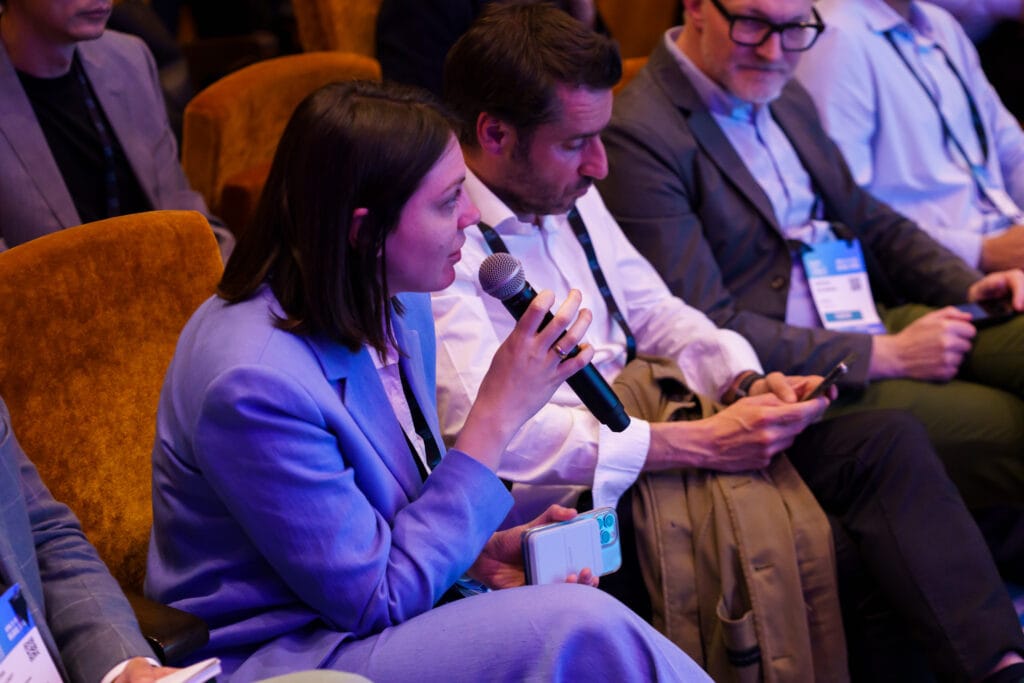
Green Molecules track jury listening to ETC2025 pitch battle finalists.
OXCCU: fewer steps to jet fuel
Andrew Symes put the aviation problem in one comparison: today’s SAF volumes are a rounding error against what 2050 requires, and almost all of it comes from vegetable oil. Scaling means using CO2 and waste biomass, and it means liquid fuel, because “if you want to travel long distances on an airplane, it’s got to be a hydrocarbon”.
Mandates in the EU and UK now commit the industry, and large rounds are flowing. “The challenge is cost. Everyone knows it.” Two drivers explain it: capital cost from multiple process steps, and operating cost from energy input and poor selectivity.
OXCCU turns CO2 and hydrogen into fuel in fewer steps, which cuts capex, and does it more selectively, which drives expensive hydrogen into jet fuel instead of byproducts. That matters more than headline hydrogen price, Symes argued – tonnes of SAF per tonne of hydrogen is the number that decides the economics.
The pathway is iron-based Fischer-Tropsch, already approved, and it tolerates CO2 where cobalt catalysts deactivate.
Reverion: the power plant that runs backwards
Stephan Herrmann is “making the ultimate power plant” – and the pitch was the clearest problem statement of the track. Build enough wind and solar and you get long stretches of surplus and long stretches of shortage. Batteries handle neither at that duration, so you end up building electrolysers for one and backup plants for the other, with most of it idle most of the time.
Reverion builds one containerised plant that does both. It runs at very high electrical efficiency, reverses to make hydrogen or methane when power is abundant, and captures CO2 as a side effect.
The first market is retrofitting biogas plants. Operators today either burn gas in an engine or upgrade to biomethane. Reverion combines the two, capturing the CO2 and upgrading it to methane during electrolysis, which lets a site feed roughly twice as much methane to the grid. That turns a single revenue line into revenue stacking.
A second product line will run on hydrogen alone, working as storage in both directions. Customers currently want methane injection because grids are not hydrogen-ready, though the same unit follows them when that changes. CO2 is liquefied on site and collected by truck.
Takeaway
The green molecules problem is cost, and this track showed three distinct routes at it. Change the feedstock so the input pays you. Remove process steps so capex and hydrogen losses both fall. Or go inside the equipment and cut the critical materials it depends on. The jury pressed hardest on the same question each time: what does the molecule actually cost once it leaves the plant.
Secure your pass
Energy Tech Summit brings together the startups, investors and corporates building the energy transition. Founder’s Pass is €699, fixed.