

Venture capital is no longer the whole story. Dealroom’s Head of Research maps how European energy tech gets funded, which segments are pulling ahead, and why the AI demand curve deserves more scepticism.
Energy tech financing in Europe looks different from the picture most people carry around. Venture volumes have come off their peak, yet the early stages hold firm. Meanwhile a second pool of capital has grown large enough to overshadow venture entirely. Lorenzo Chiavarini, Head of Research at Dealroom.co, took the Energy Tech Summit stage to walk through the numbers behind both shifts.
Dealroom tracks startups, venture capital and wider tech ecosystems, and works with investors, corporates and governments trying to read the market. So the keynote started with narrative, then moved to data.
Why energy tech financing now follows security
The framing has moved fast. A few years ago decarbonization carried every pitch. Today energy security sits at the top of the agenda – and in Europe the two arguments point the same way, because the continent has little domestic fossil fuel to lean on.
Chiavarini illustrated it with the language itself. Dealroom compared how startups wrote about themselves in press releases and pitches a few years ago against how they write now. Emissions, clean, renewable and transition all remain. Alongside them sit security, resilience, cost and price. The underlying solutions have not changed – renewables, nuclear, geothermal, hydrogen, batteries – but many have reached price competitiveness, so the benefits now lead the argument.
Events have moved just as quickly. The Baltic states disconnected from the Russian grid after decades of interconnection, and cities keep switching supply. That pace filters straight down to the startup market.
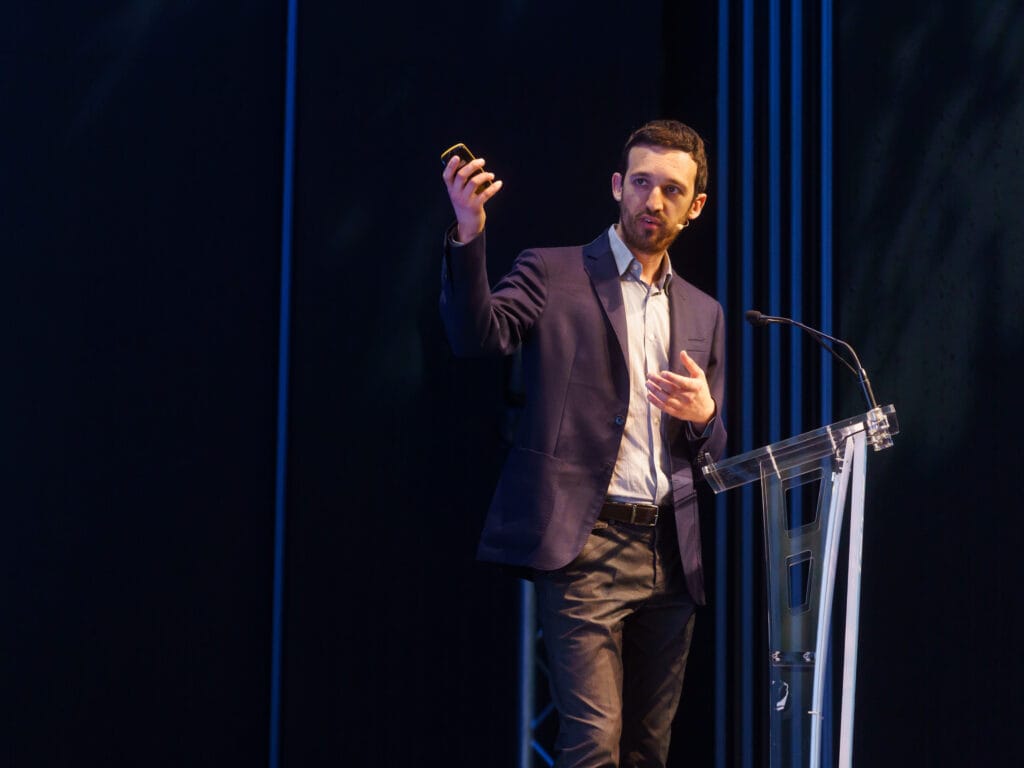
Lorenzo Chiavarini, Head of Research at Dealroom.co sharing a keynote
Europe’s progress, and the gap with China
Europe rarely gets credit for what has already changed, Chiavarini argued. During the 2022 crisis the continent spent an enormous sum on fossil fuel imports – money that simply left the region. Gas consumption has since fallen by around a fifth, and the transition is already producing measurable savings on energy costs.
Prices remain high nonetheless, because of how the market clears. Renewables are ramping, yet that has not fully reached bills. And the pressure keeps building: Europe is the fastest-warming continent on the planet.
Then came the uncomfortable comparison. “China is definitely winning the race,” Chiavarini said. China spends a far larger share of GDP on the energy transition than the global average, while Europe sits close to that average despite being unusually well positioned to push harder.
The United States sits in another league again, with defense priorities and abundant fossil fuels shaping its innovation. China, by contrast, leads across research, manufacturing, deployment and consumption. Chiavarini was blunt about Europe’s record: “we gave up solar more than a decade ago”, “We didn’t try to win on batteries so far”, and on electric vehicles, “we are behind”.
Where venture funding actually stands
Europe ramped up strongly and at one point overtook the United States in total energy tech financing. Since then volumes have slipped, while American activity has held up better than the political noise suggests, with more than half of global funding now landing there. Nuclear and batteries take a large share.
Within Europe, most capital still flows to hardware. Not all of it counts as deep tech – components, established categories, and some marketplace or software layers sit alongside the frontier plays.
The pain concentrates at the late stage, which has dropped sharply in volume. Early and growth stages, by contrast, sit close to all-time highs. The gap comes from missing mega-rounds: the enormous battery and green steel financings that once defined the market have largely stopped appearing. Plenty of activity continues below that ceiling, including a healthy count of rounds above $100 million.
Investor depth has improved too. Several hundred investors now qualify as core climate backers globally, and thousands more have done at least one European energy deal. So the sector has matured, and founders have more doors to knock on.
Beyond venture: debt, project finance and grants
The bigger structural change sits outside equity. Funding raised through debt, project finance and grants hit a record and reached roughly double the venture total. Startups and scaleups, in other words, have grown creative about how they fund growth.
The mix varies enormously by segment. Green molecules depend heavily on debt and project finance, because the work involves building plants rather than inventing entirely new technology. Energy efficiency sits at the opposite end, since asset-light software businesses lean on equity instead.
The lender landscape is equally varied. Grants come mostly from public bodies. On the debt side, public institutions such as the EIB sit alongside commercial banks, asset managers, insurers and infrastructure funds – each with its own risk appetite and preferred stage. As Chiavarini put it, “it’s really a bit hard I think for startups to navigate this sector”. Some venture investors now add value chiefly by helping founders through exactly that maze.
The segments pulling ahead
Growth has clustered around green hydrogen, nuclear, fusion and parts of carbon tech. Europe leads in several categories, including grid technologies, sustainable aviation and EV charging, while trailing in geothermal and nuclear. China leads on a different model altogether, driven by state investment rather than venture rounds.
Green molecules recorded a strong year for equity financing, with most activity in electrolysers, green hydrogen and e-fuels. Sustainable aviation stands out as a genuine European strength. Dealroom mapped startups across every decarbonization pathway there, from fuels and electric or hydrogen aircraft through to route planning and contrail avoidance.
Grid and flexibility management is the other hot area. The mapping spans grid infrastructure and software, stationary batteries and consumer-side flexible assets. Most activity sits with new suppliers building flexibility into their core offer, with distributed energy resources for consumers and with grid hardware for storage and monitoring.
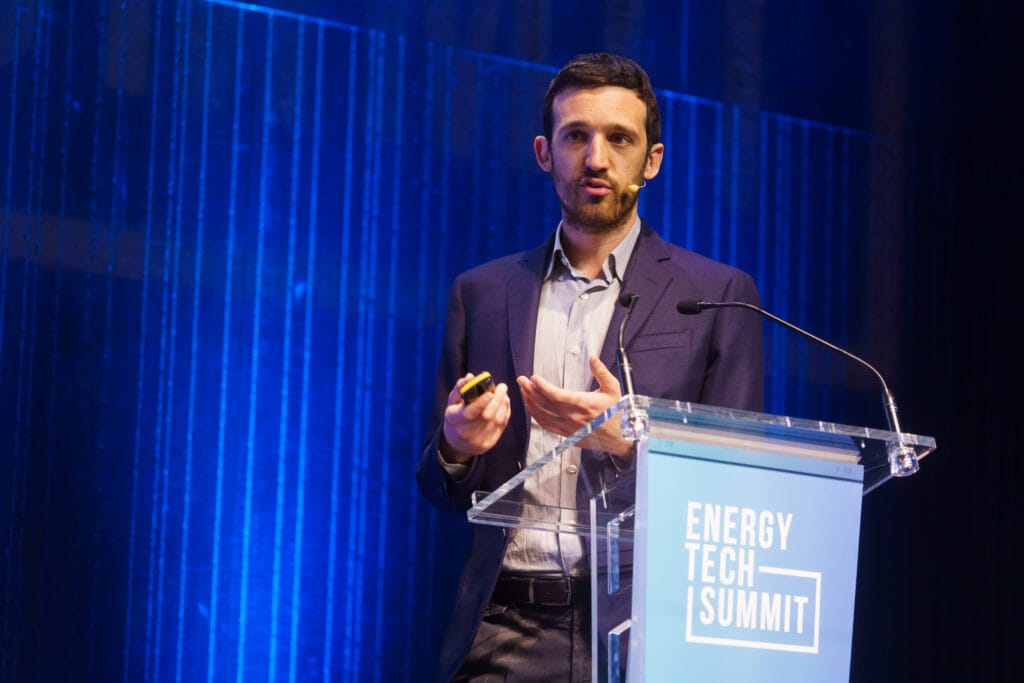
Lorenzo Chiavarini, Head of Research at Dealroom.co
AI demand is not inevitable
Chiavarini closed on a segment he felt nobody was discussing properly. Everyone predicts booming demand from AI data centres. That may prove correct, “but it’s not inevitable”, he cautioned.
History supports the caution. Over a previous decade, data centre demand rose steeply while consumption barely moved, because efficiency gains absorbed the growth. The same could happen again. Some industry leaders have also begun warning about overbuilding in both China and the United States.
A second point gets even less attention: today’s data centres are not clean. Operators buy power at scale through PPAs, yet the grids in the largest hubs remain far from clean. And nobody will build renewables or nuclear fast enough to decarbonize everything currently under construction.
One sector benefits directly from all this. Nuclear activity is strong on both sides of the Atlantic, concentrated in small modular reactors and, over a longer horizon, fusion – which fits the security and resilience narrative neatly.
Green computing as the other lever
The real opportunity, Chiavarini argued, lies in “reshaping computing itself” rather than only cleaning the power behind it. Dealroom mapped what it calls green computing, and in Europe the scene remains early: most companies were founded recently, though the segment is growing fast.
The category covers semiconductor materials such as GaN and SiC, chip design and manufacturing, in-memory and neuromorphic computing, photonics and optical interconnects for data centres, quantum over the longer term, and the software layer. Individually, some of these approaches cut energy consumption dramatically. The question is whether they scale quickly enough to meet demand.
AI cuts the other way too. Attention is rising around AI for climate, with applications across distributed energy supply and demand management, food and agriculture, biodiversity monitoring, earth observation and climate modelling. None of that removes the need to decarbonize consumption itself.
Takeaway
Energy tech financing in Europe has not dried up – it has changed shape. Late-stage equity is scarce, early stage is robust, and debt, project finance and grants now carry more weight than venture. Founders therefore need to understand which pool fits their business model, because a plant and a software platform raise money in completely different ways. Meanwhile the AI story cuts both ways, and the demand curve everyone assumes is far from settled.
Secure your pass
Energy Tech Summit brings together the investors, corporates and startups financing the energy transition. Founder’s Pass is €699, fixed.