
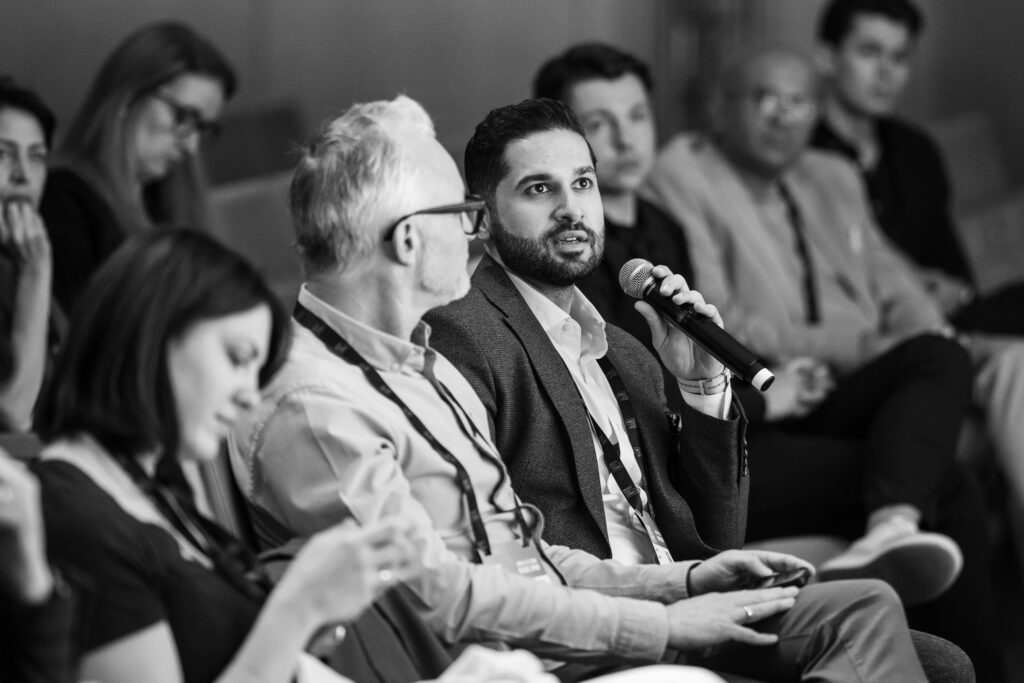
Audience questions at Energy Tech Summit
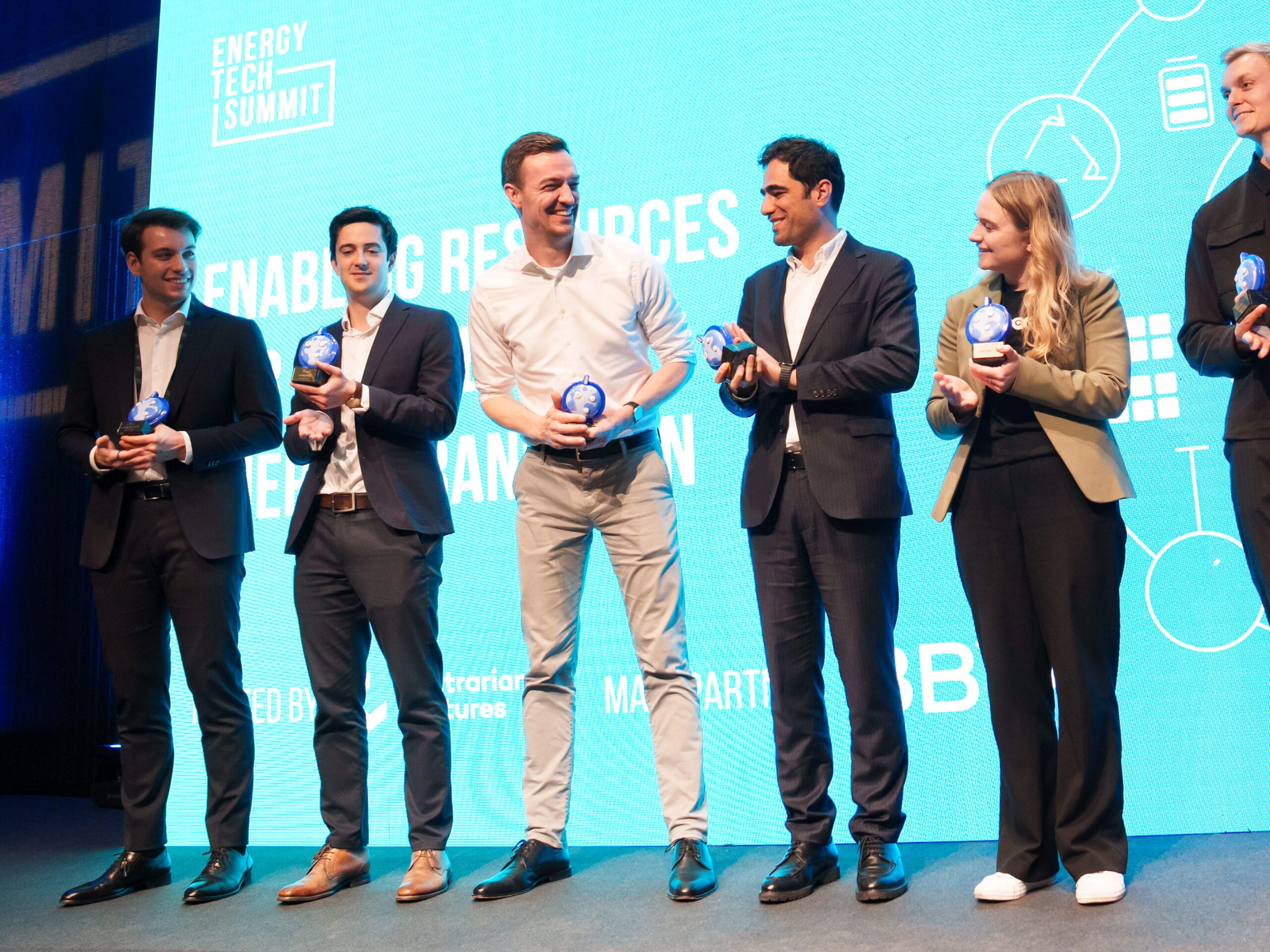
Three minutes to pitch, two to survive the jury. The track winners of Energy Tech Challengers took the stage at Energy Tech Summit, and one of them walked away with the title.
Every track at Energy Tech Challengers produces a winner. Those winners then meet on one stage for the superfinals, where a jury of investors and operators picks a single champion. The scoring is deliberately unromantic. Judges weigh the problem, the product, the go-to-market strategy, traction, the team and the potential to raise again.
What follows is each superfinalist in turn, in the order they pitched, along with the questions the jury chose to press on.
Podero: turning household devices into a trading asset
Chris Bernkopf, Co-founder and CEO of Podero, opened with a pitch aimed squarely at utilities rather than consumers. Podero does two things: it steers devices in the home, and it enables utilities to trade the resulting flexibility on electricity markets.
The logic starts with the utility’s problem. Electricity is a commodity, so customer acquisition costs run high and retention runs low. Meanwhile utilities must absorb market volatility, fend off new competitors and turn themselves into technology companies.
Podero’s answer comes in two products. The first is a white-label app that lets an end user connect a device and start saving immediately, steered against spot prices and their own solar production. The second connects that device fleet as a virtual battery into the utility’s virtual power plant, opening up day-ahead, intraday and balancing markets. The saving is the hook; the trading is where the utility earns.
The jury went straight at traction. Bernkopf said Podero works with more than a dozen utilities across six European countries, with a further market close behind, running several optimisation methods across many thousands of devices.
A second juror, speaking as a utility customer, asked the obvious threat question: what stops a client building this in-house? Bernkopf conceded some will. Most, he argued, already buy their virtual power plant and trading software rather than building them. His closing line made the point better than the argument did: “Not every bank builds their own payment system, they use Visa.”
OXCCU: cutting a step out of sustainable aviation fuel
Andrew Symes, CEO of OXCCU, framed aviation as a problem nobody gets to walk away from. People are not going to fly less, and sustainable aviation fuel is the available answer. Today almost all of it comes from vegetable oil, which cannot scale. Waste biomass helps, but the real growth has to come from using CO2 as the feedstock, and mandates in both the UK and the EU now make that market real.
The obstacle is cost, and it comes in two parts. Capital costs are high because conventional processes convert one thing into another across many separate units. Operating costs are high because making hydrogen takes enormous energy, and because conventional routes waste hydrogen into water and byproducts rather than into fuel.
OXCCU’s technology removes a step. Conventional processes first convert carbon dioxide into carbon monoxide before feeding it to a Fischer-Tropsch catalyst. OXCCU has an iron-based catalyst, built on more than a decade of Oxford University research, that reacts CO2 and hydrogen directly into jet-range hydrocarbons and water.
Asked about production cost, Symes said the company markets a roughly 50% reduction in capital cost and around 25% lower fuel cost, while noting that absolute figures depend on input costs and plant size. E-fuels currently sit far above fossil fuel prices, he said, and the goal is to reach the multiple at which biofuels trade today. On commercial commitments, he was careful about the company’s position: OXCCU is a technology provider talking to project developers, engaged with airlines on offtake, but not the sole project developer.
A demonstration plant was built in fifteen months, on time and on budget.
VEIR: superconductors for a grid that has run out of room
Mart Duitemeijer, Managing Director for Business Development and Regulatory Affairs in Europe at VEIR, opened with the constraint everyone in the room recognised. AI is hitting its limits on electricity rather than on chips, and data centres are now bounded by the power they can access.
VEIR’s founding team came out of MIT, Breakthrough Energy Ventures and Los Alamos National Laboratory to attack grid capacity directly. Its first product is a superconducting transmission line that moves five to ten times the capacity of a conventional conductor, at zero losses, in the same physical footprint.
The second product came from a customer conversation. While working with a hyperscaler on grid capacity, VEIR learned that cables and busbars had become a limiting factor inside the building itself. With server racks exceeding a hundred kilowatts, copper infrastructure is simply maxing out. A customer-paid demonstration powered a server rack and showed that superconducting cables can shrink power infrastructure more than tenfold. That cuts construction cost, and it lets servers sit closer together, which reduces latency during model training. Because the cables are actively cooled and lossless, cooling demand falls too.
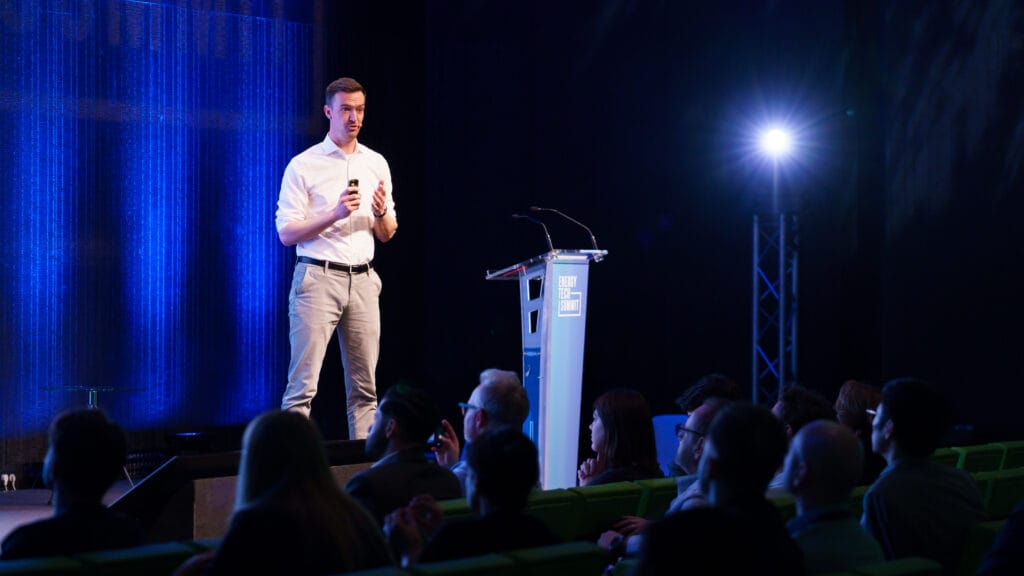
Mart Duitemeijer, Managing Director, Global Business Development
VEIR
Eneryield: predicting faults before the lights go out
Ebrahim Balouji, CEO and Co-founder of Eneryield, began with a question rather than a slide. What is the worst nightmare in any utility? Outages, and the cost of them runs into the hundreds of billions globally each year.
Eneryield predicts faults and failures in power systems using explainable AI. It does three things in sequence: it predicts the failure, localises where it is happening, and pinpoints the root cause. The company was founded on more than a decade of research at Chalmers University of Technology in Sweden, and the team is built around a core of PhDs alongside business development.
The claimed outcomes are specific. Balouji cited high accuracy across completed projects, meaningful reductions in operation and maintenance costs, a sharp drop in substation outages, longer transformer lifetimes and measurable energy savings per substation.
The jury asked about deployments and revenue model. Eneryield has deployed at around two hundred sites across the US, the Nordics, Spain and the Middle East. Sales are typically perpetual licences with support and maintenance, though subscription is available. Crucially, there is no hardware to install, which is why Balouji put return on investment for a utility at under a year.
Morescope: decarbonisation planning without the spreadsheet
Sophie Bruusgaard Jewett, CEO of Morescope, opened with a claim that landed as a provocation. The boom in sustainability reporting has stalled, and in her view that is good news for corporate decarbonisation, because it frees time and resources for actual climate action.
Her diagnosis was personal. Having spent her career in corporate decarbonisation, most recently as head of climate change at PwC, she described the work as painfully manual. It consumed time, demanded enormous data, required business expertise from every corner of a company and rested on serious spreadsheet modelling. The question that produced the company was simple: why is something this business-critical still out of reach?
Morescope runs a proprietary data model that tracks emissions across a company’s value chain, then generates contextualised, tailored suggestions for climate action based on that emissions profile. It also quantifies the impact of individual climate tech solutions, which means providers can be matched to customers and investors. The company therefore attacks the problem from both ends, reducing emissions and scaling the solutions that do the reducing.
The business model is straightforward SaaS, the team is predominantly technical, and traction has been concentrated in Norway before expanding across the Nordics.
Asked what she is proudest of, Jewett did not reach for a metric. She talked instead about having wanted a tool like this inside her previous job, so that companies could own decarbonisation themselves “rather than outsourcing it to consultants.”
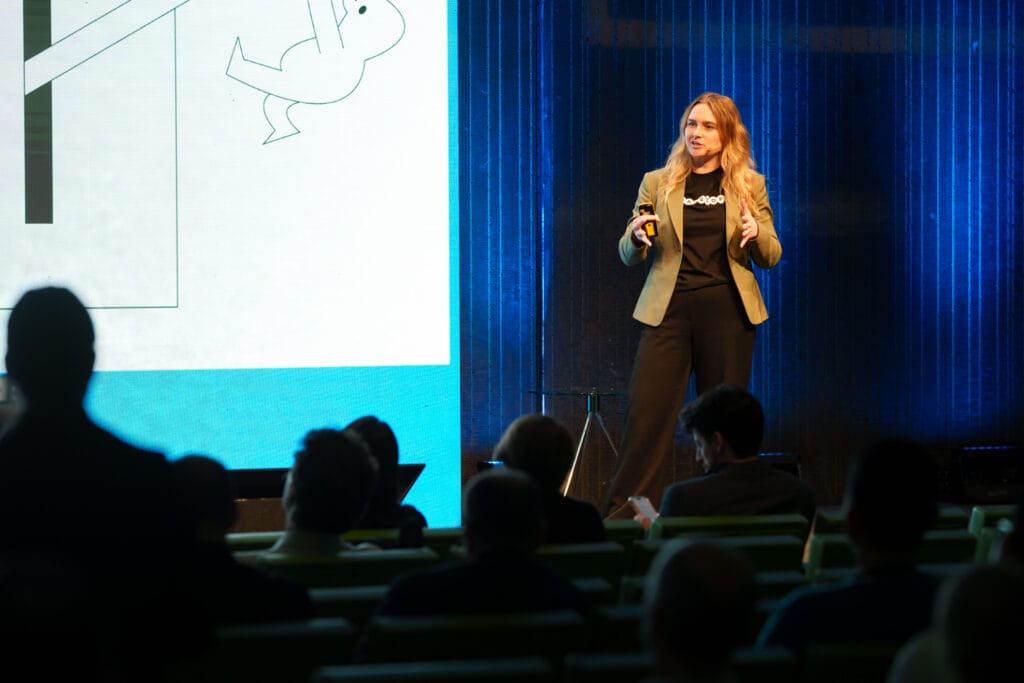
Sophie Bruusgaard Jewett, CEO of Morescope
Morescope: decarbonisation planning without the spreadsheet
Sophie Bruusgaard Jewett, CEO of Morescope, opened with a claim that landed as a provocation. The boom in sustainability reporting has stalled, and in her view that is good news for corporate decarbonisation, because it frees time and resources for actual climate action.
Her diagnosis was personal. Having spent her career in corporate decarbonisation, most recently as head of climate change at PwC, she described the work as painfully manual. It consumed time, demanded enormous data, required business expertise from every corner of a company and rested on serious spreadsheet modelling. The question that produced the company was simple: why is something this business-critical still out of reach?
Morescope runs a proprietary data model that tracks emissions across a company’s value chain, then generates contextualised, tailored suggestions for climate action based on that emissions profile. It also quantifies the impact of individual climate tech solutions, which means providers can be matched to customers and investors. The company therefore attacks the problem from both ends, reducing emissions and scaling the solutions that do the reducing.
The business model is straightforward SaaS, the team is predominantly technical, and traction has been concentrated in Norway before expanding across the Nordics.
Asked what she is proudest of, Jewett did not reach for a metric. She talked instead about having wanted a tool like this inside her previous job, so that companies could own decarbonisation themselves “rather than outsourcing it to consultants.”
Klimate: one contract for a portfolio of carbon removal
Mads Emil Dalsgaard, CEO of Klimate, opened by clearing up a misreading of the name. ApS is the Danish company form, not a product. He then set out the market position bluntly: most large corporates have accepted that they need carbon removal. “There is no net zero without carbon removal,” he said. “That’s where the net comes from.”
No single removal method does everything. Forestry is cheap, scalable and available now, but not very permanent. Direct air capture is expensive and scarce, yet highly permanent with few co-benefits. Biochar sits in between, and is having something of a goldilocks moment. Buyers therefore need a combination.
Assembling that combination is where the workload explodes. A buyer deals with registries, MRV providers and the projects themselves. Each project needs selection and due diligence. Credits must be retired in a registry, and data must be pulled from every party for reporting. Add more projects and a small sustainability team drowns.
Klimate bundles all of it into one platform without trying to become any of those parties. It is not a registry, not an MRV provider, and it does not do carbon accounting. Instead it sources projects, runs due diligence, writes multi-year contracts covering multiple assets, retires credits on the client’s behalf via APIs, and feeds the data into reporting. Partnerships with carbon accounting platforms, Morescope among them, bring in a share of its clients.
Solar Materials: recovering the silver inside the panel
Fridolin Franke, Co-founder and CGO of Solar Materials, pitched the least glamorous problem of the set. Solar panel waste is the fastest-growing electronic waste stream in the world, and the infrastructure to handle the coming volumes does not exist yet.
The technical failure is specific. Conventional recycling relies on shredding and sorting, which recovers glass, aluminium and copper. The functional materials in the cell, silicon and silver, are not recovered, and with them roughly half the raw material value disappears. Given that a fifth of global silver production goes into the solar industry, the scale of that loss is enormous. High recycling costs follow, which is one reason panels end up exported rather than properly processed.
Solar Materials recovers all the materials, which lifts raw material yield on the output side and lets the company undercut market recycling prices. Franke went further: with that yield, recycling could be offered free and still be profitable.
The Series B is earmarked for capacity. Two further lines in Germany would triple output there, and a first Italian plant would follow, with the ambition of becoming Europe’s largest solar panel recycler. Asked about competition, Franke named a German glass recycler using shredding and sorting, whose lower material yield forces it to charge a per-tonne recycling fee that Solar Materials can always undercut.
And the winner
After the jury deliberated, the title went to VEIR. The judgement is telling. Of everything pitched, VEIR addresses the constraint that now sits underneath most of the others: there is not enough deliverable power, and the physical infrastructure to move it has run out of room.
What the Energy Tech Challengers pitches had in common
Read across the seven and a pattern emerges. Almost none of these companies sell an emissions reduction. They sell a commercial problem being solved, with the climate outcome attached. Podero sells utilities a retention and revenue problem. VEIR sells data centre operators a capacity problem. Solar Materials sells a cheaper recycling price. Klimate and Morescope sell relief to overloaded teams.
The jury questions reinforced it. Nobody was asked about impact. They were asked about traction, defensibility, unit costs, competition and go-to-market. That is what a maturing sector sounds like.
Key takeaway
The Energy Tech Challengers superfinals work as a snapshot of where climate tech is commercially serious. The winning pitches were the ones that named a paying customer and an unglamorous operational pain, then attached the technology to it. Impact was assumed. The business case had to be argued.
Secure your pass
Energy Tech Summit Europe returns to Bilbao on 7–8 April 2027, where the next cohort of Energy Tech Challengers will pitch for the title.
Secure your pass and see them first.