
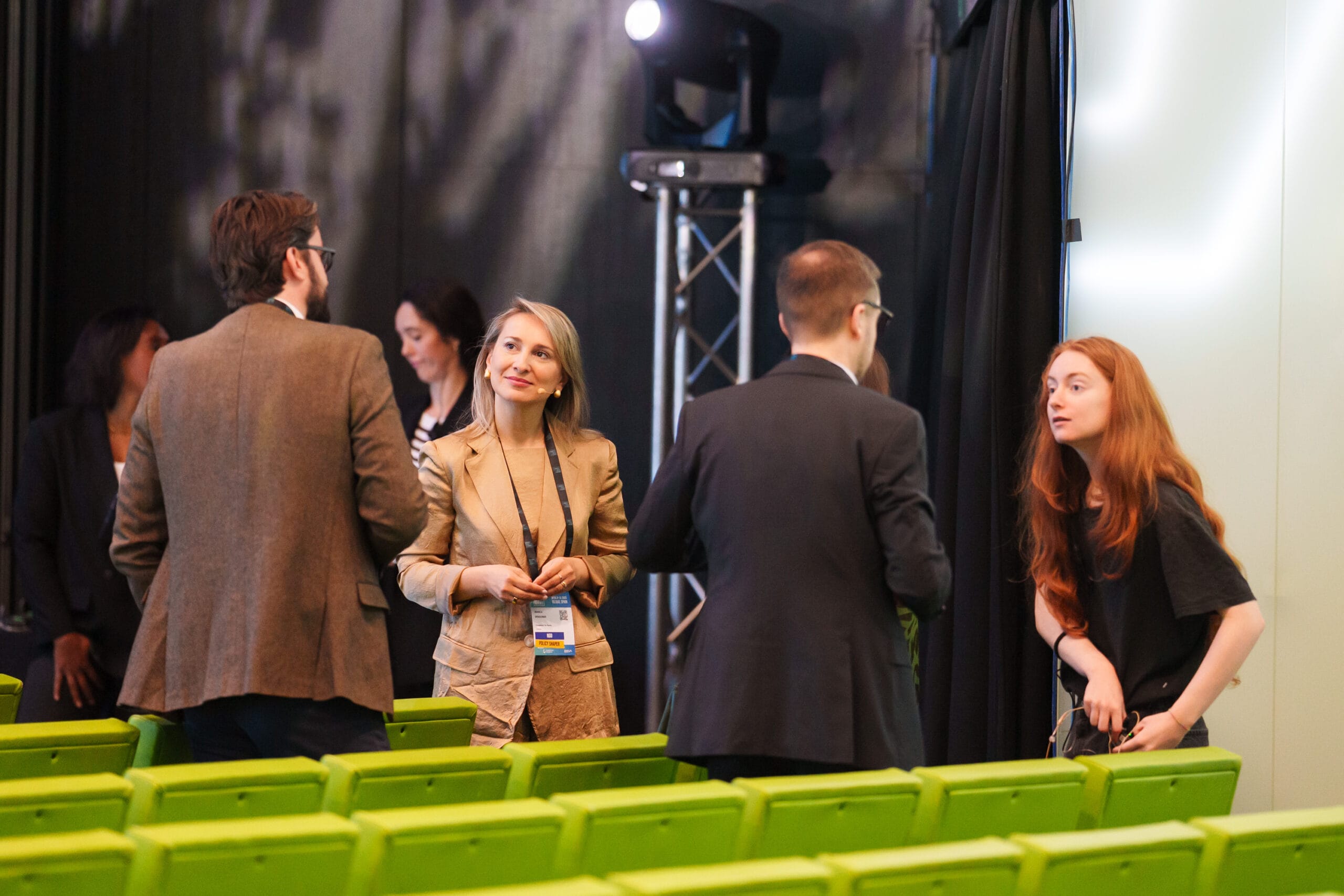
Europe funds first ideas well. It funds first factories badly. A panel of investors and public lenders at Energy Tech Summit took that gap apart, piece by piece.
Capital sits at the centre of the clean industrial debate. Yet the argument is rarely about how much capital exists. It is about which instruments are missing between a working prototype and a running plant. That is the question a panel at Energy Tech Summit set out to answer, and the cleantech capital stack turned out to have some very specific holes in it.
Bianca Dragomir, Director at Cleantech for Iberia, moderated. She was joined by Alejandra Manzanares, Senior Investment Officer in the cleantech equity and growth capital division at the European Investment Bank; Hector Delvaulx, Director of Operations at ENISA; Mark Hartney, Partner at Breakthrough Energy Ventures; and Joaquin Coronado, Chairman at Build to Zero.
Where the cleantech capital stack breaks
Dragomir opened by mapping the landscape. Europe deploys early-stage equity well, she argued, and it has the talent, the research and the patents to match. Growth equity and access to debt are the weak spots. As a result, innovators hit a funding gap precisely at the early industrialisation stage, where de-risking matters most.
The picture narrows further in the Iberian Peninsula. Public instruments and a growing base of private investors exist, but first-of-a-kind project finance remains thin. Venture debt, corporate funding and guarantees are thinner still. Capital, in short, stays concentrated and fragmented at the same time.
Hartney was blunt that this is not a European problem alone. Companies everywhere have to grow, validate the technology, raise money to the next inflection point, then win customers. “There’s a bunch of gaps along that stage that I think are identical in different places,” he said. What differs is temperament. American business plans lean towards hubris and ambition, he suggested, while European ones lean towards conservatism, and reality sits somewhere in between.
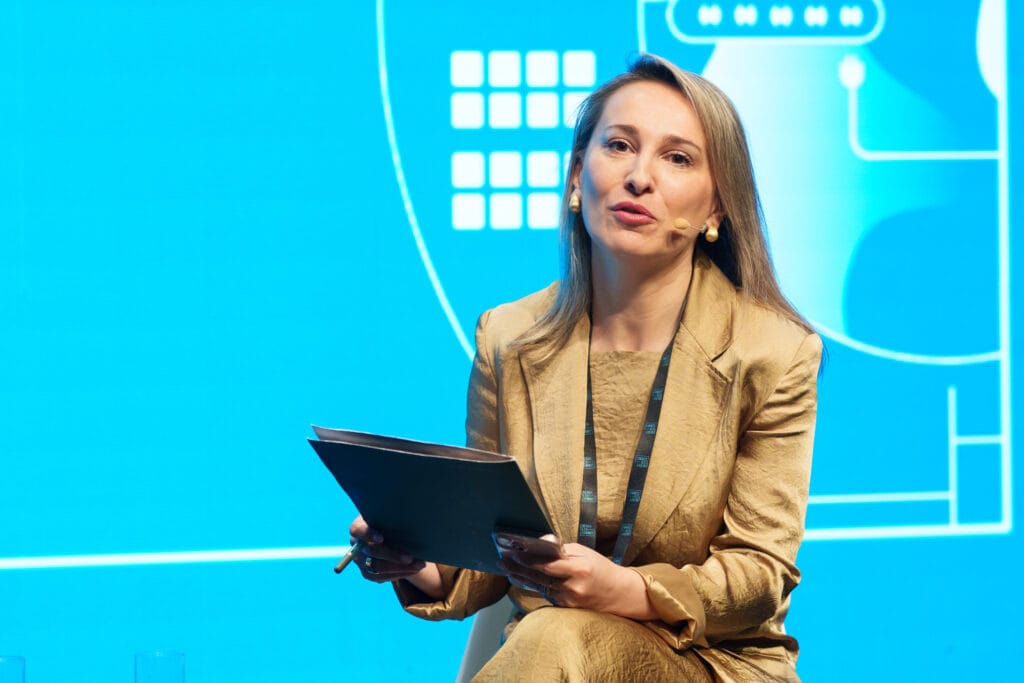
Bianca Dragomir, Director of Cleantech for Iberia
Four institutions, four entry points
Each panellist enters the stack at a different moment. The EIB invests directly, through corporate lending, project finance and venture debt. Manzanares explained that the bank has run venture debt in life sciences and deep tech for around a decade, and has accelerated it for cleantech. The product targets hardware companies at technology readiness level six and above, investing in Europe, Norway and Iceland.
Patience is the differentiator. Long tenors give companies time to build factories, commission them and ramp up, and then refinance with project finance debt once sales begin.
ENISA sits further upstream and closer to home. Delvaulx described it as a public company attached to Spain’s Ministry of Industry, financing Spanish SMEs and startups across every sector rather than cleantech alone. Growing its presence in the sector is an explicit goal.
Breakthrough Energy Ventures takes equity and describes itself as stage agnostic, from company creation through to later rounds. The filter is impact rather than stage. Hartney said the fund looks for technologies capable of removing roughly half a gigaton of CO2 equivalent a year once fully scaled. Its first funds were structured over twenty years, because replacing incumbent technologies takes that long.
Coronado occupies a fourth position entirely. He finds technical people who were not planning to start companies, then helps them become entrepreneurs, working with three teams at a time.
First of a kind starts with a client, not a cheque
Asked what innovators struggle with most, Coronado went straight to the hardest step: financing a first commercial plant. His answer had three parts, in strict order. First, a client willing to put skin in the game. “Without that, there’s no first of a kind,” he said.
The reasons a client commits vary. Build to Zero’s own first-of-a-kind came through a family-owned chlorine derivatives business that wanted to be the first fully decarbonised company in its field. Its owners judged that the value of the business would multiply, and the investment itself barely moved the needle for them.
Second comes equity, and Coronado was firm that nothing substitutes for it at this stage. Teams keep trying to reach for project finance, he noted, and project finance does not work on a first plant. Third comes public money. He singled out the European Innovation Council as a strong instrument with a demanding process, which becomes manageable once a team learns how to use it.
His warning was about sequence. Too many teams go looking for money before they have identified a customer willing to pay for the plant.
Manzanares broadened the frame. A first-of-a-kind facility is one business model among several, she pointed out, and some companies stay asset-light or outsource manufacturing until commercial traction is proven. Even so, the crunch arrives at the same place. Once orders start landing, companies must fund payables long before receivables arrive.
Delvaulx sees the same wall from the other side. Companies grow, their financing needs grow, and they become too big for ENISA before anything else has picked them up.
Guarantees would move more than grants
Ask this panel for one missing instrument and the answer is the same from both the private and public seats: guarantees.
Coronado made the arithmetic plain. A startup seeking a bank guarantee must post full collateral, because the bank will not lend against the company itself. So the company raises equity in order to park it in a bank account. That is, in his view, the most inefficient thing a company can do with expensive money. Scaling meaningfully needs guarantees in the tens of millions, and raising equity to cover them is not a serious answer.
His proposal was a second-loss structure. Company equity takes the first loss, and the public sector syndicates the layer above it, acting more like an insurer than a funder. He argued the economics work out anyway, since public money returned to a growing company comes back through taxes and social contributions within a few years. Where actual cash is deployed, he added, it should flow through VCs rather than directly.
The EIB is moving in that direction. Manzanares described a working capital facility and a power purchase agreement guarantee, both deployed through commercial banks. Those banks have a reach the EIB does not, and their participation is itself a test: if a commercial lender puts skin in the game, the company is worth backing.
Permitting is an equity problem in disguise
The panel converged hard on regulation. Manzanares noted that many valuable projects sit stuck before final investment decision, because permits and offtake agreements remain unsigned. The Clean Industrial Deal and the Critical Raw Materials Act both aim to give strategic projects a faster path, including quicker permits and tax credits, so that precious equity is not burned while waiting.
Delvaulx put the mechanism in one line. “Regulation is time consuming and time consuming is equity consuming,” he said. Companies facing long permitting delays need more money than competitors in the US or China simply to reach the same starting line.
Hartney supplied the case files. Projects he has worked on have been cancelled because a permit was never issued, and others were delayed by years. Idle years at a growing company burn equity for nothing. One carbon removal project waited a year for a class six well permit in Louisiana before it could reach a final investment decision, while offtakes sat waiting.
Coronado’s asks were correspondingly modest. “I typically ask more about deregulation,” he said, “rather than money.” He described a company staffed almost entirely by R&D PhDs that has spent two years failing to obtain the certificates needed for R&D tax deductions. Trust entrepreneurs first, he argued, and prosecute the ones who cheat afterwards.
Grid rules can change faster than grid capex
One of the sharpest points of the session cost nothing to implement. Coronado pointed to a Dutch tender that allocated a large volume of flexible capacity, equivalent to roughly 40% of national peak capacity, available for the large majority of hours in a year. Most of the companies he works with never need more than that. The capacity was unlocked by redefining what counts as firm and flexible, without a single euro of additional capex, while a long queue of connection applicants waits for capacity it does not actually need.
Hartney extended the argument to tariffs. New asset classes are arriving on the grid, including storage batteries, electrolysers and eventually direct air capture plants, and all of them can be dispatchable. Thermal storage batteries make the point best, since they are designed to charge for only a few hours a day and are therefore endlessly flexible. In some markets they are still charged outsized demand fees for helping the grid. Those barriers were designed for a grid that no longer exists.
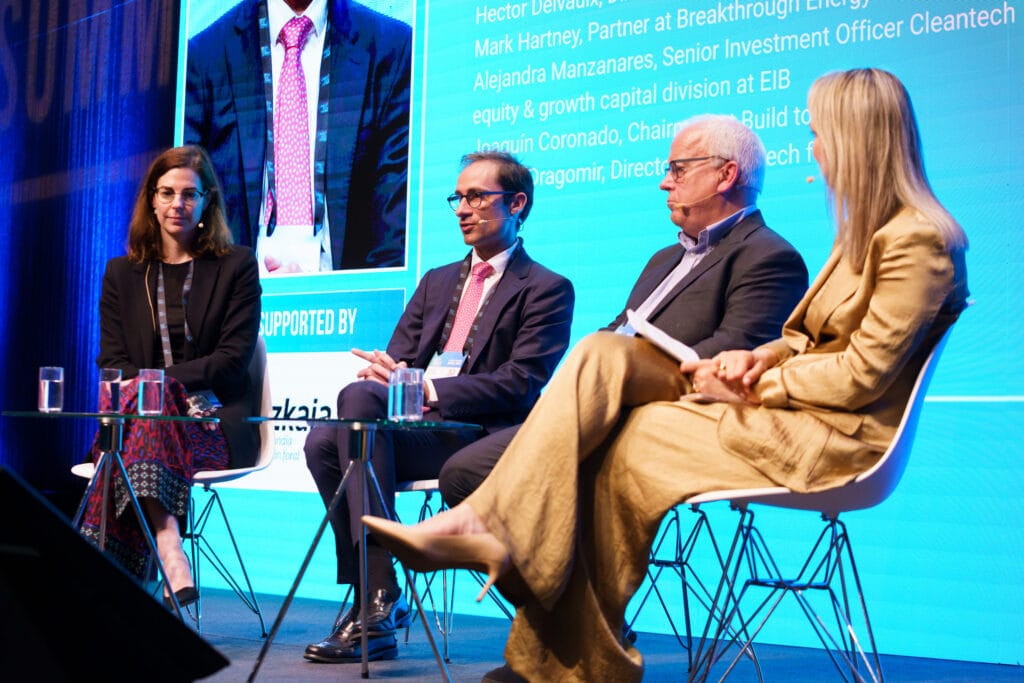
Panel discussion at Energy Tech Summit
The cost of energy sets the ceiling
Asked to name the single priority, Coronado did not hesitate: bring down the cost of energy. Europe cannot compete on manufacturing while paying a large multiple of what its competitors pay for power. Taxes are part of it, and levies are the part nobody discusses, imposed by municipalities and regional governments that have treated energy as a cash cow for years. Being the cheapest market inside an expensive continent, he added, is like being “the last one in the cemetery.”
Manzanares agreed and pointed to grids as the other half of the answer. The bank supports utilities through long-standing relationships, and increasingly backs innovative companies that add flexibility and capacity to the network.
The role philanthropy could play
Dragomir raised a source of capital that gets little airtime in Europe: family offices and philanthropy. Hartney noted that when public research funding in the US has been cut back, foundations have stepped in to sustain organisations and early-stage research. More interesting to him are the structures being built beyond that, including project finance backed by development grants and aggregated donor-advised funds. Catalyst itself raised substantial philanthropic funding.
The pitch to those funders is simple. “We don’t solve climate unless we cross those gaps,” he said, and explaining exactly where the gaps sit is what makes the case land.
Public money is a tool, not a driver
Delvaulx was careful about how he framed his own institution. “The drivers are the companies and we are just tools,” he said. “I hope they are useful tools.” The harder job, he added, is teaching politicians that financing companies without clean financial statements is a risk worth taking, because the alternative risk is that the businesses never exist at all.
Manzanares closed her side of the argument with an appeal rather than an instrument. Examples of European first-of-a-kind projects already exist, and member states are willing to support more. “I really invite those innovators to really be brave and courageous,” she said.
Key takeaway
The cleantech capital stack does not fail for lack of money. It fails at the joints. A first-of-a-kind plant needs a paying client before it needs a term sheet, guarantees rather than grants at the scale-up stage, and permitting timelines that do not quietly consume equity. Fix the joints, and the capital that already exists starts moving.
Secure your pass
Energy Tech Summit Europe returns to Bilbao on 7–8 April 2027, bringing together the investors, corporates and founders building the clean industrial base.
Secure your pass and join the conversation.