
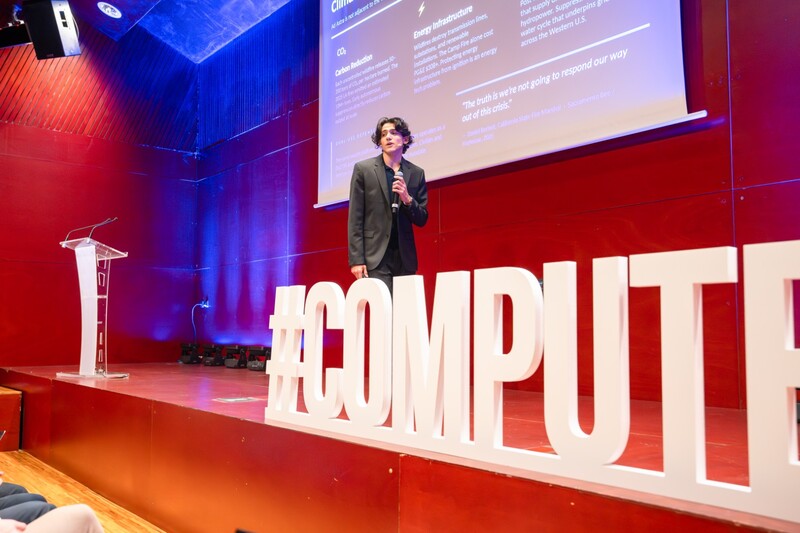
Firefighting drone swarms, ceramic circuit boards, superconducting wire and quantum computers that run at room temperature.
The Compute Challengers final gave fourteen startups three minutes each, followed by two minutes of jury questions, judged against seven benchmarks: problem, product, go-to-market, traction, team, financing and sustainability. What follows is what each company said, in pitching order.
AdAstra Defense
Gabriel Klein, Co-Founder and CEO, develops autonomous firefighting drone swarms that detect and suppress wildfires before they spread. His premise: the way to stop a large wildfire is to never let it get large.
He grounded that in the Palisades fire, which started near where he lives in California. It burned over 23,000 acres, destroyed around 6,800 structures and killed 12 people. Crucially, that was not for want of firefighters. By the time the first crew arrived, the fire had already won.
The company built its hardware and full software stack with no outside funding. Klein’s co-founder and CTO previously co-founded a company that exited at a substantial valuation and built autonomous drone swarms for DARPA. There are four co-founders and three advisers with defense, technology and data center backgrounds.
AdAstra was raising $3 million pre-seed on a safe note, targeting an 18-month runway, to fund hardware development and two to three paying agency pilots.
The energy relevance was explicit. Wildfires destroy transmission lines, substations and renewable installations, releasing up to 200 tons of CO2 per hectare. Early autonomous suppression protects the grid and preserves the watersheds feeding hydropower. “We are frontline infrastructure for it,” Klein said.
The jury pressed on market size. Klein described starting with local departments and agencies, of roughly 5,000 nationwide, targeting an addressable subset of around 10%. Swarms sell for one to 1.5 million each, with a 200 to 300,000 annual software service.
Asked whether customers are used to that hardware-plus-subscription model, he pointed to an existing autonomous suppression company that recently raised substantially and uses exactly that structure, though without comparable swarm capability.
Ainwater
Martín Concha Rubio, Co-Founder, CFO and CIO, works in the water utility sector, where treatment plants run on obsolete SCADA systems. Those systems cause operational problems and consume considerable energy.
A workforce problem compounds it: more than 50% of operators are expected to leave the sector within the next decade as they retire.
Ainwater merges data from online SCADA, manual records and lab results, then optimizes using AI models combined with chemical, biochemical and physicochemical modelling. Agents deliver predictive control recommendations, reducing operational cost and water footprint while improving quality to avoid fines. The roadmap moves toward agents automating control directly.
The business model is straightforward: an implementation fee plus an annual licence, with tickets around €20,000 a year. The company operates at over 100 sites across five markets, having recently entered Spain – Concha Rubio himself relocated from Chile to lead that expansion.
On impact, the company works with more than 50 rural communities, cutting water supply time by over 50%. In industrial pilots it delivers around 10% optimization in chemical and energy use on average. The company grew fivefold last year and was midway through a seed round.
Asked how one product stays relevant across very different industries, Concha Rubio credited agent technology, which the company has used since 2024, plus a methodology for building deep models that can run automatically for each new facility. Integration happens through local IoT partners in each region, which is how the company operates across several continents.
Martín Concha Rubio, Co-Founder, CFO and CIO of Ainwater pitching his technology at Compute Challengers during Energy Tech Summit 2026
AlumaPower
Rob Alexander, CEO and Co-Founder, deploys firm dispatchable power using scrap aluminium as fuel.
His framing started with a fact the room knew: build a data center today and you bring your own power. In most markets, diesel backup is permitted for emergencies only, which makes it dead weight capital.
AlumaPower meets the same tier 4 backup requirement as diesel. Because it produces zero emissions, however, it can also provide flexible dispatchability. The system is containerized and modular, built on over 16,000 hours of testing, scaling to gigawatt power nodes.
De-risking came through field demonstrations, starting with grid-independent power, followed by multiple military contracts. A demonstration with AI data loads was planned, specifically to prove the system handles the wide swings that AI compute produces.
The most compelling slide came from a customer model for a gigawatt facility in California. Optimizing with diesel backup forces enormous overbuild: 4.5 gigawatts of solar and 820 megawatt hours of storage. Adding AlumaPower to the mix produced a 42% smaller solar field, 64% less storage, and 37% lower total capital build for the same power module – which means faster permitting and more viable sites.
On fuel supply, Alexander said existing scrap oversupply could firm up 85 gigawatts of new capacity, with a partnership in place with one of the largest global providers.
Asked for performance comparisons, he was refreshingly direct with unfavourable numbers. That customer model priced AlumaPower at twice a diesel generator and 50% higher cost per kilowatt hour. Power density reaches parity with diesel by 2028 and roughly 50% better by 2030. Round-trip efficiency is around 30%, similar to an internal combustion engine.
The cost question drew out why that still works. In backup applications the equipment runs perhaps 100 hours a year, so capital cost dominates – and the saving comes not from the generator but from shrinking the solar field and the battery around it.
AssetCool
Niall Coogan, CEO, opened with the workforce arithmetic behind grid constraints: for every two and a half retirees, there is one new worker under 25. Combine that with unprecedented demand growth on an aging grid and you get inflating maintenance bills and record interconnection queues.
AssetCool upgrades the grid robotically, applying a spectrally selective coating to overhead power lines. The coating reflects sunlight and emits heat, lowering conductor temperature to yield up to 30% more power – a 50 to 200 megawatt uplift on certain circuits, delivered in months.
Robots currently get placed by humans, with one visible climbing a tower in his slides. The second generation is drones that take off, land on the line and deploy coating modules remotely, removing the need for large construction crews.
Traction is substantial: 30 robots operating across over 1,400 kilometers of conductor, with 20 utilities from Nepal to Canada, and extensive third-party validation.
The core value proposition is economic. A 20 to 40% uplift for around $60,000 per kilometer – roughly ten times cheaper per megawatt than reconductoring – and deliverable in months rather than the three to seven years rebuilding lines takes. Coogan described being contacted two weeks before mobilizing on a project in Georgia.
Asked about scaling bottlenecks, he named two. Lines must currently be de-energized to place robots, which is impractical where load is high – the live-line drone solves that. The second is labour, since linemen must climb towers to place the robots, which the drone also resolves.
On sales cycles, Coogan described building pipeline through pilots and full circuit deployments, with the fastest route being what he called putting a fire out: solving a utility problem nothing else can fix. That has produced meaningful revenue, with four million signed and ten million expected booked by September, while longer institutional and regulatory work proceeds toward network-wide deployments.
Asked how often lines need recoating, he said the coating is designed to last multiple decades and is intended to be maintenance-free, with surgical repairs possible if damage occurs.
Enline
Duarte Fleming builds digital twins of grid assets, delivering grid visibility to operators. Founded in 2020, the company now has solutions deployed across more than 10,000 kilometers of lines on five continents, working with major European grid operators.
He highlighted a project that had started that very day: what he described as the largest dynamic line rating project ever, covering 1,170 kilometers in Lithuania.
Dynamic line rating means calculating the real-time capacity of transmission lines – wind cools the cables, so more power can flow. The distinguishing feature of Enline’s approach is that lines need not be disconnected, because it is software only.
The team comes largely from a major industrial group, with Fleming previously heading AI products there. The product set includes line monitoring, digital twins extending to surrounding vegetation, and software modules complementing existing energy and distribution management systems.
Use cases have increased transmission capacity by 20 to 40%, with the Lithuanian customer now reporting a 52% capacity increase. For customers not yet ready to deploy, the company offers services including interconnection studies for data centers.
On sales cycles, Fleming was candid: large deployments with grid operators take 12 to 18 months, though dynamic line rating pilots can close in under three. European public procurement is what delays scaling.
The workaround is partnership. Enline supplies its technology to a major electrical equipment manufacturer, whose dynamic line rating product is Enline’s underneath, using that vendor as a channel. Consortium and research projects provide another route that avoids selling directly.
Asked what stops a utility building this in house, Fleming gave the most quotable answer of the session. Operators attempting sensorless dynamic line rating internally lack the capability to produce production-grade software, and – worse – struggle to integrate it into their existing systems. “They can do pilots, but they can’t scale.”
Flexiramics
Andy Wynn, CEO, opened by correcting a common assumption. Most people think AI and 5G devices are limited by chips. They are not – they are limited by the materials underneath them.
Every device sits on a printed circuit board reinforced with glass fibre. That worked for decades. With high-frequency devices, however, glass traps heat and causes signal loss, which Wynn said costs the industry $60 billion in wasted energy.
Flexiramics replaces glass fibre with a ceramic fibre fabric, claiming a 75% reduction in signal loss and five times better heat dissipation. Importantly, it is a drop-in replacement using the same manufacturing process.
Demand supports the timing. The device market grows 17% a year, and glass fibre cannot keep up, both on performance and because of a supply bottleneck. Consequently, the industry is actively seeking alternatives.
The company focuses on AI infrastructure, partnering with PCB manufacturers as a raw material supplier. It is already in pilot production, with a pipeline of over 360 customers in development and first revenues last year. Glass fibre in PCBs is a $5 billion market, with the high-frequency segment offering a $500 million entry point. Flexiramics was raising €16 million.
Asked for the killer use case, Wynn named AI hardware, with producers struggling to source the required grade of glass fibre against demand running at roughly twice supply.
The economics answer was the strongest part of his slot. Manufacturing costs run around 30% below glass fibre because the process uses less energy. A year ago the material priced at two or three times glass fibre – but monthly glass price increases of 10 to 15% have brought the two to parity, delivering benefit to the customer at no additional cost while preserving margin.
On why the material performs better, he named composition and structure. Ceramic has much higher thermal conductivity, and because glass fibre is woven it works in two dimensions, whereas the non-woven ceramic fabric works in three.
Grunuss
Amjad Anu Aisha, Founder and CEO, opened with transmission losses, claiming Europe’s grid wastes up to 30% of its electricity in transmission. The bottleneck, he argued, is materials rather than innovation.
He then used the stage for a broader argument. Watching energy become an instrument of political power in recent years prompted him to act.
The company develops quantum simulation to accelerate energy materials discovery across three verticals. Superconductors waste energy on cooling. Batteries lose capacity every cycle. Generators lose energy to heat. Classical systems have hit physical limits, and quantum precision offers a way past.
Scientists know this, he said, but the current approach means iterative laboratory trial and error, wasting time and money. Grunuss builds simulation to sense, simulate and manipulate quantum materials, unlocking room temperature superconductors, next generation batteries and superconductive generators.
His framing was that abundance defuses conflict: people no longer fight over food because it is abundant, and he wants energy to follow.
The first pilot applies the same simulation to predicting battery life cycles, since companies do not reliably know when their batteries will fail. He positioned the company as a first mover, noting the approach is already validated in drug discovery rather than energy. The team includes five professors across superconductivity, neural networks and numerical simulation.
Asked for concrete results, Aisha was honest that the simulation remains in development, which is why the company de-risked by addressing a current market problem first.
Pressed on architecture, he described physical neural networks encoding quantum physics equations, drawing a parallel with protein structure prediction. The follow-up was sharper still: that parallel rested on an enormous dataset, so where does the data come from? Aisha pointed to a consortium of five universities expanding toward ten, plus data gathered through solving customer problems.
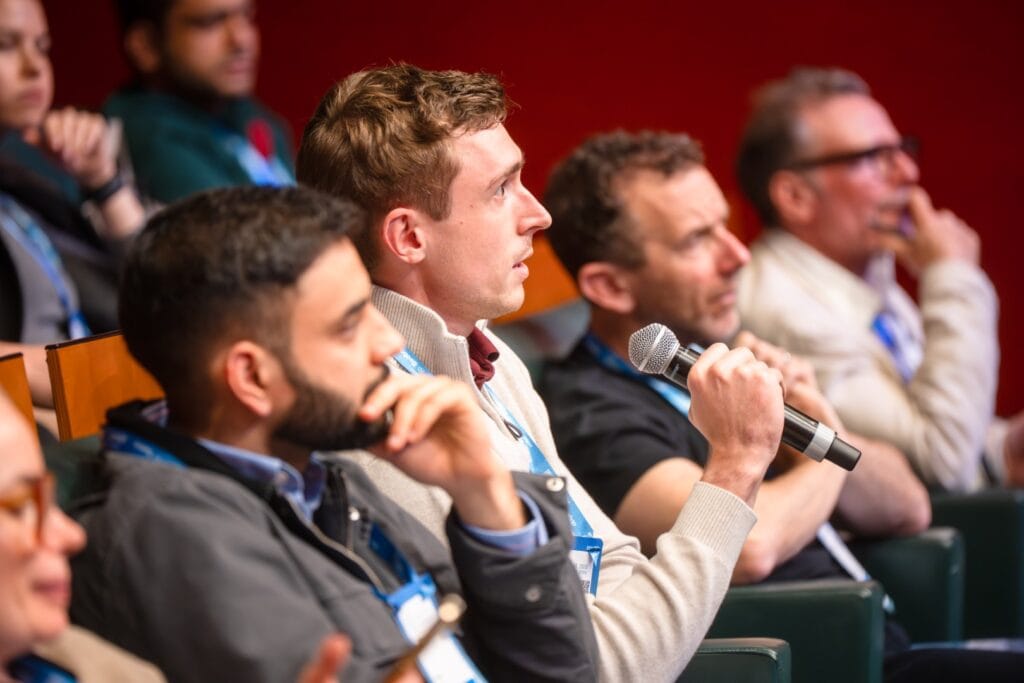
Compute Challengers jury asking questions during the startup competition at Energy Tech Summit 2026
IONATE
Rishabh Manjunatha, Chief of Staff, framed a mismatch. Innovation is accelerating from quantum computing to electrification. Yet the infrastructure powering it has not changed in over a century.
That causes inefficiencies, blackouts and hundreds of billions in losses. The larger cost, though, is opportunity cost. An aging system limits what can be built on top.
IONATE’s answer is the hybrid intelligent transformer. It looks and connects like a traditional transformer, but adds real-time visibility and power flow control. That turns a basic component into something far more versatile.
Data centers are the obvious application, since their power stack today is lossy, fragmented and maintenance-heavy. The company merges magnetic control with solid state electronics. That delivers the benefits of solid state transformers without the drawbacks: perfect power quality, with the reliability and efficiency of a traditional unit. It also improves power usage effectiveness by up to 5% and frees space for compute.
Individually each unit cleans up local power flows. Collectively they become real-time control nodes, coordinated by software into an adaptable network.
Manufacturing avoids gigafactories entirely. IONATE partners with established transformer manufacturers, who build the body while it supplies the brain. That gives it access to gigawatts of existing capacity, with delivery in months. Projects run on European grids and with large power users in the US.
Asked about manufacturing, Manjunatha explained where the advancement sits. It lies in the arrangement of the magnetics, plus added electronics built to specification. Using existing manufacturer supply chains is what makes the product available today.
Revenue is dual. Software sells direct as a subscription, unlocking capacity and coordinating fleets. Hardware runs through licensing, with a royalty plus a share of final customer cost.
Four market segments matter: utilities, renewables, industrial customers and data centers. The last is the current focus, because they move fastest. US interest is strong, though utility projects are already live in Europe.
MetOx International
Arthur “Bud” Vos, President and CEO, opened holding high temperature superconductor material. It measures 12 millimetres wide and 100 microns thick, carrying close to 800 amps. Doing that with copper would need a conductor the size of your arm.
The thesis is a collision between rising power density and copper availability. Substantial shortfalls are estimated by the mid-2030s, across generation and delivery alike.
The company’s wire transmits over 250 times the power of a traditional copper conductor in the same area.
MetOx serves six markets. Those cover anywhere involving high magnetics or power delivery, from aerospace and defense through power transmission to fusion. Vos put the addressable market above $30 billion, spread widely enough to avoid dependence on any single customer type.
The company is unusually mature. Its Houston facility produces a million meters of material annually. A further $120 million is secured for a second facility at five times the scale. Vos claimed production at roughly 48 times the scale of traditional approaches. The Houston plant, he noted, was built in under eleven months.
Asked about materials and supply chain maturity, Vos described a rare earth superconductor. Of the 100 micron stack, only two microns is the actual superconductor. Annual consumption of that material would fit in a five gallon bucket.
His fusion example conveyed the scale of demand. Of roughly 40 companies pursuing fusion, 23 use magnetic confinement, which requires this material for magnets and coils. A single 300 megawatt reactor requires 20,000 kilometers of material. That is 20 years of production from the Houston plant — for one reactor, in one of six segments.
Noumenal Labs
Patrick Huembeli presented in place of the CEO. He opened with a problem that is not the obvious one. Robotics is hard, and not only because building robots is hard. Nobody yet knows how to deploy a hundred or a thousand robots. Each one encounters moments outside its training distribution, and does not know what to do.
The company’s platform provides active intelligence for autonomous systems. A probabilistic stack signals to a human teleoperator when a robot is uncertain. It also does world modelling, anticipating confusing situations before they arrive.
That stack is computationally demanding and needs minimal inference time. So the architecture is being built with a global hardware partner, spanning edge devices, robots and near-edge servers on premises.
The first vertical is solar farm vegetation management, chosen for its difficulty. The work is outdoors and backbreaking. It requires fine control for trimming around poles. And it is GPS-denied beneath the panels.
First deployment tests were underway in Texas. The partner is what Huembeli described as the state’s largest solar vegetation management provider by gigawatts — motivated by an inability to staff the work at all. The company was raising 2 million and seeking European connections.
The best question identified an apparent split. Humanoid robotics training sat on one side, a far more tractable trimming task on the other. Was one a stepping stone to the other?
Definitely, Huembeli confirmed. The probabilistic stack for vegetation management is simpler than it will be for humanoids. Yet the principle is identical: signal to a human when the system is uncertain. The teleoperation platform stays constant, while the robotics underneath grow more complex.
Oriole Networks
Joshua Benjamin, Co-Founder and Network Architect, identified three elements determining AI system performance: compute, storage and network. The first two advance rapidly. Network performance is being left behind.
The consequence is stark. GPUs will complete computation instantly, then idle waiting for data. That is the bottleneck.
The cause is architectural. Data travels between racks through a series of hops across switches. When the network congests, those hops queue, which creates latency. The result is a network that is both power hungry and slow.
Oriole’s answer is what Benjamin called the world’s first pure photonic network. It removes the intermediate electronic switches entirely. Each GPU gets switching capability instead, selecting the colour of light and the route at the edge. Source GPU then talks directly to destination GPU.
Removing that core removes its power draw, cooling requirement and latency. The company supplies the whole platform rather than a component. That covers network offloading, the pluggable handling switching and wavelength selection, transport, and the passive router.
Oriole had raised $50 million. It was seeking $150 million in a Series B that opened that week.
One large technology company offers a comparable full solution. Asked how Oriole competes, Benjamin pointed to switching speed. That competitor’s optical circuit switches operate in milliseconds and microseconds. Oriole reconfigures an entire network in tens of nanoseconds, even at a million nodes.
On adoption, customers replace cluster by cluster rather than all at once, testing performance before scaling. A final question probed integration with modern GPU racks. Inside a tightly coupled rack, existing solutions work well. The problem arises when traffic leaves the rack — precisely where Oriole positions itself.
Qilimanjaro Quantum Tech
Elisabeth Ortega-Carrasco opened with the invisibility of AI’s cost. Using AI is easy. You type a prompt and something somewhere processes it, transparently to the user — though not to the planet.
As requests grow, so does infrastructure and power draw. She cited a projection that by 2030, a quarter of the world’s nuclear plants would be needed to power AI data centers. Her conclusion was simple: this does not scale.
Qilimanjaro is a full-stack quantum computing company in Barcelona. It offers analog quantum computers installed in data centers, and she stressed this is not aspirational. Three machines are installed at the Barcelona Supercomputing Center.
The company believes combining quantum computers with supercomputers will advance AI. That works both through the computational paradigm and through the compute power required. Notably, all three installed machines together draw about the same power as a single rack.
A quantum-as-a-service subscription was due for release. Ortega-Carrasco cited 20 million in accumulated revenue, and a team spanning chemists, computer engineers, MBAs and physicists. The growth plan runs in three phases: build the technology, put it in users’ hands, then industrialize quantum computers within data centers.
A 10 million seed round funded the headquarters quantum data center. A further round was close to completion.
Asked what still has to happen before industrialization, she was candid about the whole sector. Current quantum computers remain early stage and noisy. In her company’s case they are also still too small, because they are genuinely difficult to build. Her researchers, as she put it, are reinventing the physics daily.
On customers, she named universities and students alongside the real target: innovation departments at large companies. Those are served through exploratory services, where the company builds use cases alongside the customer.
QuiX Quantum
Caterina Taballione framed quantum computing as necessary for problems that would otherwise remain permanently unsolvable. Delivering practical advantage is harder. It requires scaling efficiently, while meeting the infrastructure requirements of today’s data centers.
Most quantum modalities need specialized environments — the familiar cryogenic chandeliers. That imposes an infrastructural burden, making them hard to deploy, scale, interconnect and maintain.
QuiX claims the lowest total cost of ownership through four advantages. Leveraging existing semiconductor fabs allows scaling with volume. Proprietary error correction with low qubit noise means less hardware for the same qubit count. The system works largely at room temperature, so it can live in the same conditions as conventional data centers. Finally, machines connect and scale by plugging in optical fibres using telecom-grade components.
The portfolio today serves research, academia and national programme testbeds. It runs from quantum processors through a cloud-available machine to what Taballione described as the world’s first universal quantum computer. The roadmap moves toward fault-tolerant architectures, funded by a 100 million Series B targeted to close that summer.
On traction she cited more than 15 systems in the field, a deal with the German Aerospace Center, and a signed backlog of 8 million. The team numbers over 50 across the Netherlands, Germany and Italy.
Asked about remaining technical challenges, she named losses — the main source of noise in a photonic system. Addressing it requires many iterations of the underlying material. That is partially solved for the current delivery, with further improvements needed to reach logical qubits. Her timeline was 2028.
With time remaining and no further questions, she explained the hardware. QuiX uses photonic integrated circuits with silicon nitride waveguides: glass chips a few centimetres across that generate, guide, manipulate and entangle light to compute.
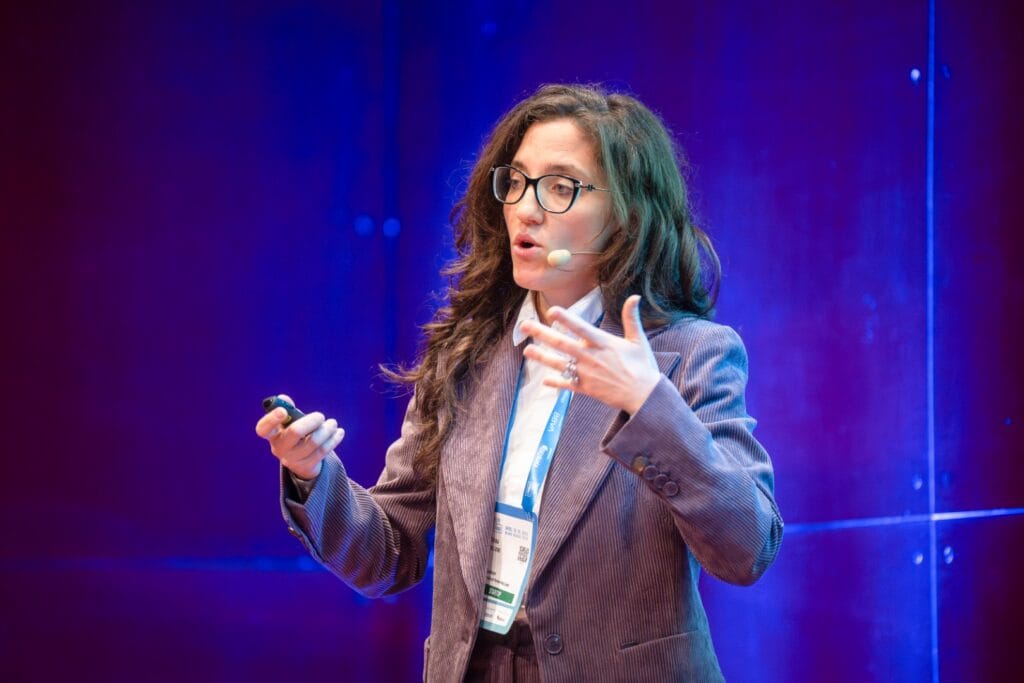
Caterina Taballione, Commercial and Partnership Lead of QuiX Quantum
Reverion
Stephan Hermann closed the session from the constraint everyone recognized: power is the biggest limit on data center deployment, across grid access, resilience and rising cost.
Reverion provides round-the-clock on-site generation from natural gas, hydrogen or biogas at very high efficiency. Units already run commercially at 74.2% power conversion efficiency, behind the meter, with carbon capture included by design.
He positioned that against alternatives. Primary deployments today are combined cycle gas turbines, if obtainable. A prominent competitor using solid oxide fuel cells converts around 60% of gas into power, modularly.
Over eleven years, Reverion developed an architecture reaching up to 80% power conversion. From 100 megawatts of gas input you get 80 megawatts of power, plus pure CO2 and pure water – the latter potentially useful for cooling.
Sites are operational in biogas in Germany rather than data centers, with over 70,000 operating hours. The company employs more than 200 people, holds a commercial pipeline exceeding two billion outside data centers, and had raised more than 100 million. What it lacks is scale, hence a Series B.
Asked about material bottlenecks, Hermann clarified that Reverion buys fuel cells rather than making them, from seven suppliers who face capacity constraints and must scale alongside it. Materials themselves are mostly steel and ceramics, none rare.
Pressed on how it achieves higher efficiency than its best-known competitor using the same type of fuel cells, his answer was process design – hundreds of architectural differences, the main one being more effective use of gas inside the unit, plus distinctive controls.
Asked whether biogas remains interesting, he confirmed it does, citing 800 megawatts a year in Germany alone for retrofitting existing installations, while noting the comparison that makes data centers compelling: 270 gigawatts to be commissioned in the US over the next few years. “That’s a bigger animal.”
Takeaway
What connects these compute startups is that almost none of them build compute. They build the things that constrain it: the fabric under the circuit board, the wire replacing copper, the coating on the transmission line, the network between racks, the transformer feeding the building, and the power plant behind that. Even the quantum companies pitched primarily on infrastructure terms – room temperature operation, rack-equivalent power draw, fitting inside existing data center conditions. Several also reached the same commercial conclusion independently: utilities and grid operators can run pilots but cannot scale them, which is why partnership and integration keep surfacing as the real product. The AI bottleneck has moved out of the chip and into everything surrounding it, and this session was a detailed survey of where exactly it now sits.
Compute Challengers returns at Compute Summit Stage 2027.