

“Everyone wants to be first to be second.” How guarantees, insurance and milestone structures are being borrowed from infrastructure finance.
Daniel Goldman, Co-Founder and Managing Partner at Clean Energy Ventures, convened this panel because of work his firm has been doing for over a year on what it calls structuring for scale.
The idea came from hearing constantly about the first-of-a-kind problem and the missing middle, with no solutions attached. So the firm ran deep research and interviews across the industry to identify approaches that might actually address it.
Why the framing matters
Goldman deliberately avoids talking about first-of-a-kind projects, because that describes a single point in time. Early commercialization instead describes a continuum: bench scale to pilot to demonstration to first commercial to second commercial.
Venture capital is an important part of that journey. However, it cannot be the whole of it – growth equity matters, and so, in his firm’s view, do the debt capital markets.
To explore that, Clean Energy Ventures brought together commercial lenders and private credit, the insurance industry, corporates, and catalytic and government capital. It then held convenings during climate weeks, bringing portfolio companies together with those groups to articulate their challenges and hear how each type of capital assesses the risk.
The solutions that emerged included technology and performance insurance, construction debt funds, pooled offtakes through hyperscalers and others, and further mechanisms at both project and portfolio level.
The overriding goal is bringing down the cost of capital for scaling early commercialization – both to compete with incumbents and to accelerate deployment. Goldman noted the stakes: roughly 30% of the technologies needed to address climate change have not yet been developed, so failing to scale new technologies means missing climate goals.
Who was on stage
Rajan Shah is a Principal at Morgan Stanley 1GT, bringing private credit and debt capital markets experience.
Jason Muehleck is Head of Ventures at Amrize, representing the corporate and cement industry perspective.
Daniel Stack is CEO of Electrified Thermal Solutions, which delivers electrified heat to industry – and, as Goldman disclosed, is a Clean Energy Ventures portfolio company.
Talia Rafaeli is a Partner at Kompas VC, investing at early technology readiness levels.
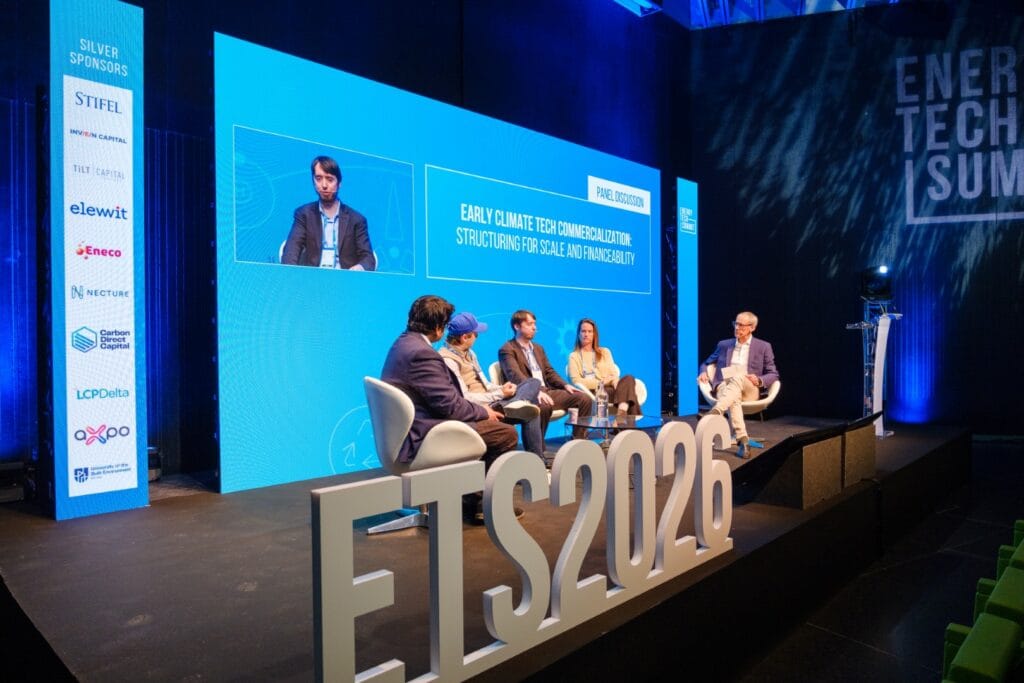
Panel discussion at Energy Tech Summit 2026
Lessons from financing genuinely difficult projects
Shah began by reframing what capital markets are capable of. Sophisticated capital markets have successfully financed high-risk projects in circumstances where risk was extremely difficult to price. The premise, therefore, is that it can be done.
The transferable lessons start with guarantees. Historically, project finance wrappers focused on performance rather than complete failure – they reduced underperformance risk. Structuring guarantees, protections and warranties across both the supply chain and asset performance is what brings the risk premium down.
Second come construction-side mechanisms familiar from infrastructure financing: milestone payments, structured draws and structured repayment profiles, whether that means an interest-free window or relaxed covenants in the early periods.
Third are loan performance guarantees, with first loss capital contributing meaningfully to the loss-given-default calculation.
Underneath all of it sits structuring. Project finance was historically bilateral, so customized packages of covenants and terms are entirely acceptable to debt capital markets – and should now be front of mind for founders and their investors.
Asked where guarantees come from, Shah’s short answer was that all sources are possible. Upstream suppliers and downstream corporate offtakers can both provide them, though these are difficult to obtain because extending a balance sheet is a risk decision for those parties too. Insurance products and various derivative products can serve as the guarantee instead.
What an early stage investor looks for
Rafaeli described what she assesses when a company sits at early technology readiness: the ecosystem of players already at the table, from potential offtake agreements and commercial partners through to suppliers.
What distinguishes smart early stage investing, in her view, is how you stack the commercial agreements. The more genuinely bought in a commercial partner is, the more the deal is de-risked going forward.
That commitment can take several forms. A partner may come in as an equity investor alongside the fund, which she said is happening across several of her current situations. Alternatively, an offtake agreement may arrive with vendor financing attached.
The role of early equity, therefore, is to understand the company’s whole journey: how to de-risk future financing, and what it will take to bring in debt facilities later.
Everyone wants to be first to be second
Goldman put the corporate question to Muehleck directly, noting that some large industrial players state publicly they will never do a first commercial project.
Muehleck’s answer began with the line that captured the whole dynamic: “Everyone wants to be first to be second.”
There is a balance sheet question underneath it. A corporate allocates capital across opportunities and must be a good steward of it.
Alignment becomes possible when something is strategically important and offers a large future commercial opportunity. Securing that opportunity early – by co-investing, or by securing commercial rights down the line – is how a corporate gets compensated for the risk it takes.
Structured properly, that tilts the risk-return balance in the corporate’s favour. If the first-of-a-kind project succeeds, the corporate has secured advantageous commercial positions against its competitors.
Goldman raised the obvious tension: first rights may accelerate the path to market while limiting the total market opportunity. Muehleck agreed that striking the balance is the work, and that being an equity investor early helps, because you then want the company to succeed on its own terms.
The principle he applies is that it must be a genuine win-win, with enough commercial benefit for the company and for the corporate partner. Beyond that, it becomes deal-by-deal negotiation.
Why small units change the financing problem
Stack described his technology plainly. A box arrives on site, electricity goes in, a thermal battery heats up, and hot gas comes out to run furnaces, boilers or kilns.
The scale detail matters commercially. Systems are around 5 megawatts each, while industrial sites need anywhere from a few megawatts to hundreds. Customers might start with a couple of units, though deep electrification usually requires a dozen or more.
That contrasts sharply with technologies requiring one massive plant to produce at scale. Because Electrified Thermal scales in few-megawatt increments, early projects need less total capital – which lets the company scaffold upward. As Stack put it, others whose minimum project is a $50 million build have to make capital markets comfortable with something considerably harder to fund with equity.
Three business models are in play. Direct equipment sale works early on where a customer will buy and own the asset, often because they anticipate process improvements and want to roll it out across sites. Those contracts include explicit language acknowledging this is a first deployment, with uptime expectations that ratchet up over time.
The second model is heat as a service, on or off balance sheet. For a first multi-unit project in northern France, the company has a project finance partner already comfortable at that level, with insurance around the project forming part of the discussion.
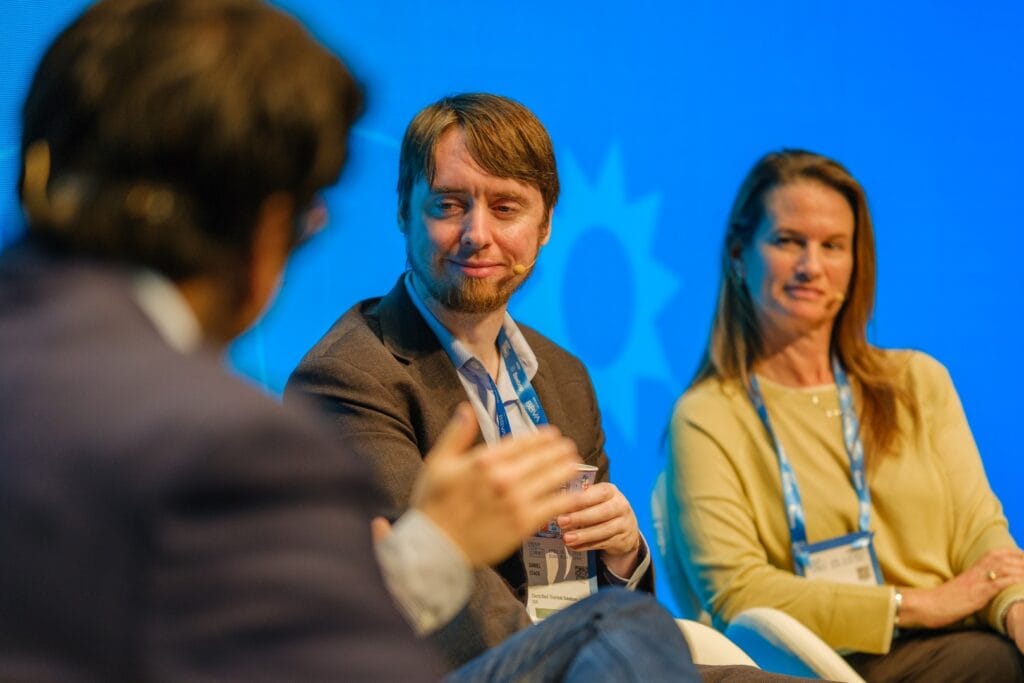
Daniel Stack, CEO of Electrified Thermal Solutions during the panel session at Energy Tech Summit 2026
Redundancy as a financing argument
Goldman asked whether redundancy helps financeability, given that a customer already has an existing heat supply.
Stack confirmed it does, and explained the structural reason. An industrial customer will not adopt technology that costs them all productivity if it fails. Electrified Thermal therefore installs in parallel with existing fossil fuel equipment, so the worst case is a temporary return to business as usual – which is precisely why early partners will stomach the risk.
Operating hours help too. The company has a 20 megawatt hour system running in Texas at full scale, so prospective customers can inspect it and review the data before committing.
How technology performance insurance actually works
Shah explained why insurance matters conceptually: somebody is vouching for the technology working. Whether that comes as technology performance insurance, a corporate guarantee, or upstream support with cash outlays, the effect is the same – reducing conceptual performance risk.
Most companies at this stage need both equity and some project or debt financing. Equity markets supply the initial capital partly because active investors add operational value, yet that is expensive money. Technology performance insurance therefore makes the bankability of an early commercialization story far more transparent.
The structuring details he gave were specific.
The insurance should be senior to any equity, with equity taking first loss. He suggested first loss capital of roughly 10 to 20% in the form of equity, which requires working across the cap table.
Tenor has to be short enough to be meaningful, which he put at three to five years typically.
Metrics matter most of all, because the whole instrument concerns underperformance. Defining what underperformance means – uptime, availability, yield, throughput, whichever is appropriate – has to be data-driven, and that ultimately affects pricing.
In practice, Shah sees this increasingly across his portfolio, both extending the balance sheets of manufacturing companies and enabling faster expansion than anticipated, since a new plant or manufacturing facility can be funded through equity plus insurance-backed debt.
To date, that insurance has come post-construction in his experience, though he sees no conceptual reason it could not come earlier – it is a question of risk transfer and pricing.
On market depth, he considers it deep enough to finance most early commercialization stories he sees. Part of his own role, he added, is educating equity investors that this form of financing exists at all.
Non-dilutive routes to scale
Rafaeli laid out a sequence for reducing dilution, framed around reducing four risks: technology, execution, operational and bankability.
Grants come first, and mapping which are available depends on where the company operates. That is the earliest non-dilutive capital available.
Mezzanine debt comes next, and it is supported by data – which is why collecting performance data early matters so much for setting a company up to access non-dilutive capital.
After that comes company structure, specifically separating the intellectual property from the assets, which opens the door to project finance and more extensive debt vehicles.
Her firm works by milestones, with each one unlocking a particular availability of non-dilutive capital.
Goldman pushed on the asymmetry of debt – you receive interest but no upside – and asked whether mezzanine offers more symmetry. Rafaeli confirmed that securitization and warrants are both options, with the right structure depending heavily on risk appetite, the specific technology, and regulatory and geopolitical factors.
What a corporate actually commits
Muehleck described what matters most in his industry: taking market risk off the table.
Because new materials often face genuine market risk – a material may not fall under an existing standard, and adoption may be unclear – growth capital and debt providers need a signal about who will buy the output and at what price.
So the company backstops offtake commitments up to substantial amounts using its own balance sheet, signalling to the market that a buyer exists at a knowable price.
Beyond capital, he described an unusual operational commitment. When the company makes an equity investment or enters a commercial partnership early, four or five full-time employees get involved from the engineering side.
The reasoning is that early stage companies often lack the engineering expertise to evaluate early engineering studies. Corporate expertise therefore has to flow to those companies for them to grow and execute faster. His message to other corporates was blunt: engagement does not end when you make the investment. You have to be ready to commit further resources.
What success looks like in ten years
Goldman closed with an unprepared question about what success would look like a decade out.
Shah answered from his derivatives background, where success meant standardized documentation becoming widespread. Templatizing these products would indicate a mature market that accepts the risk and knows how to price it. His version of success is early commercialization risk becoming as conventional as project finance is for infrastructure – so that the industry stops discussing commercialization risk as a category at all.
Muehleck went in the same direction. A company should be able to raise early commercialization financing the way it raises venture capital today, knowing exactly what to provide, what to look for, and what pricing to expect. From a corporate side, that would make mapping a company’s path to real commercialization considerably easier.
Stack’s answer was operational: in ten years his company will not need the early commercialization narrative at all, having moved well past it, with thermal batteries electrifying industry across multiple continents.
Rafaeli took the unconventional route with a figure. Around $41 billion went into climate financing in 2025, against an annual climate gap of $4.4 trillion – meaning roughly 1% of the need is currently covered on the early side. She wants that to change dramatically, which requires finding the vehicles to do it.
Goldman’s own answer echoed Shah’s. Venture capital has standard term sheets and documentation; he would like the same for commercialization, addressing all these risks in a standardized way.
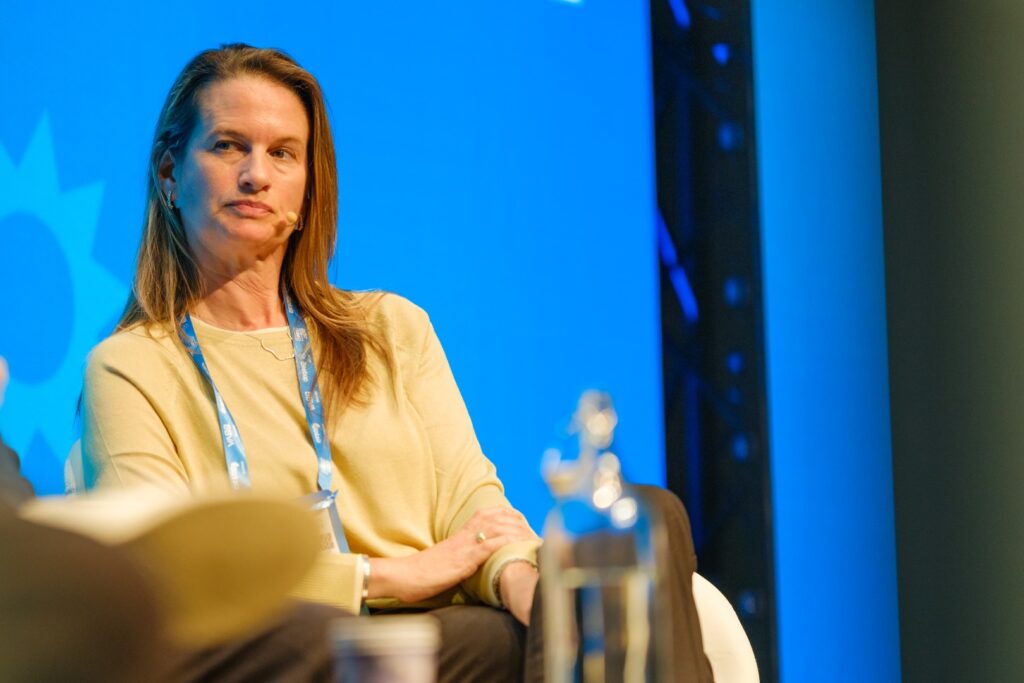
Talia Rafaeli, Partner at Kompas VC during the panel at Energy Tech Summit 2026
A worked example
With time remaining, Goldman asked Shah for a concrete case, and he described a German battery pack manufacturer whose products are used on construction sites and increasingly in defense applications – suitcase-sized units weighing around 20 kilograms that deliver continuous power for several hours.
As a high-volume manufacturer, its growth constraints are manufacturing capacity and offtake contracts through distributors. Debt financing proved particularly useful, because managing inventory and working capital is a second constraint on growth for any manufacturing business.
By unlocking favourable terms from local lending banks and venture debt providers, and negotiating those terms hard so they fit the company’s actual risk profile, the investors reduced the balance sheet constraints on growth. Importantly, that also created a template for expansion into further markets as conditions allow.
Shah added that a facility currently being explored for another portfolio company will include performance guarantees alongside warranties from both upstream suppliers and downstream users.
Takeaway
The most useful thing about this panel is that it treats early commercialization as a structuring problem rather than a capital shortage. The instruments already exist – performance guarantees, milestone draws, relaxed early covenants, first loss tranches, technology performance insurance – and infrastructure finance has used all of them to fund genuinely difficult projects. What is missing is standardization. Every panelist, asked what success looks like in ten years, described roughly the same thing: documentation and terms conventional enough that a founder could raise commercialization financing the way they raise a Series A. Until that exists, each deal gets negotiated from scratch, which is precisely why the missing middle stays missing.
Energy Tech Summit 2027 returns to Bilbao, April 7–8, with more conversations like this one.