
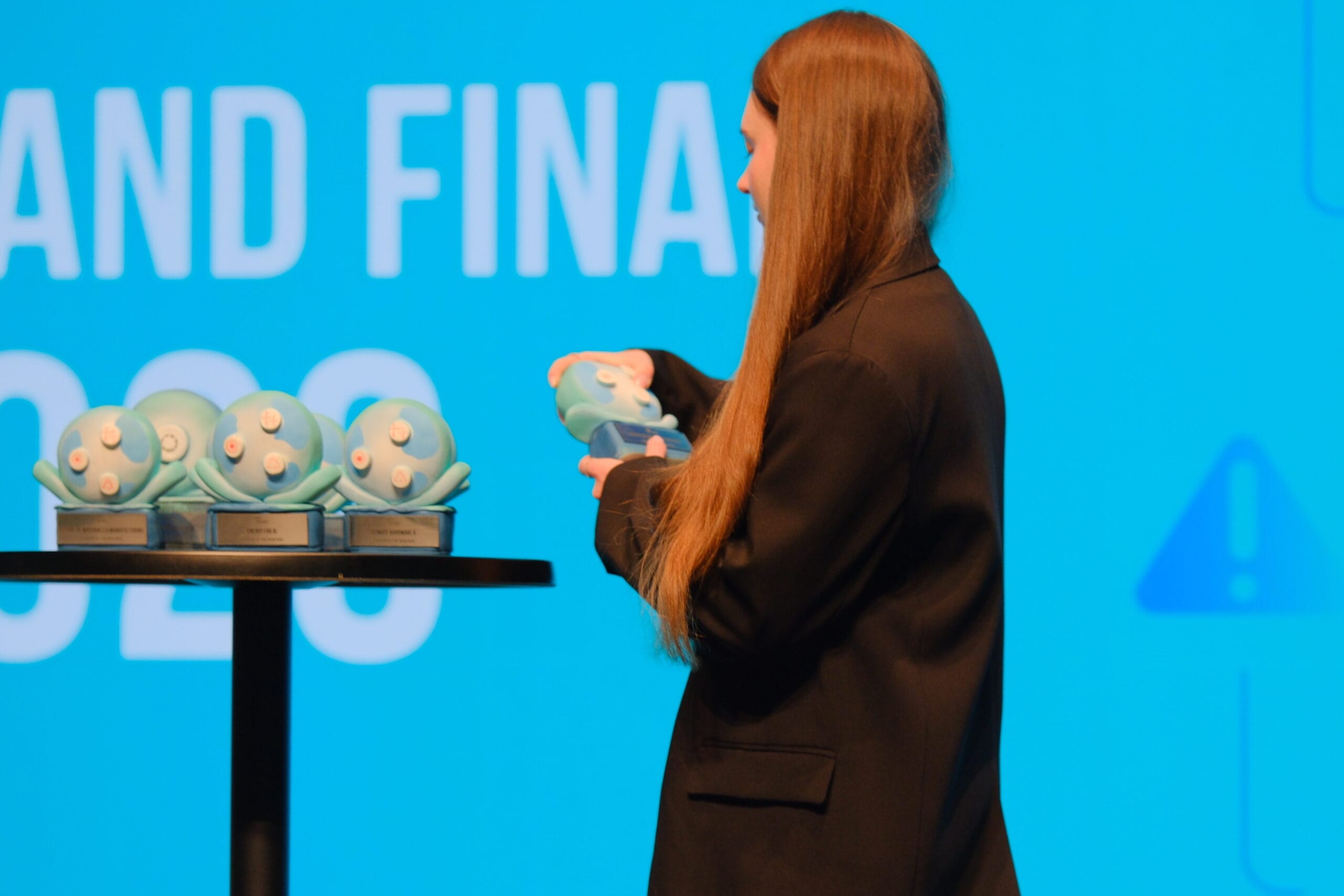
Weather balloons over the ocean. Sensors on high voltage lines. A nuclear fleet losing 1% of its output. Nine companies pitched, three minutes each.
The AI for energy track brought nine jury-selected startups building tools for energy systems optimization, intelligence and automation. The format was unforgiving. Each founder had three minutes to pitch, followed by two minutes of jury questions, with the host interrupting anyone who ran over. Here is what each company said, in pitching order.
Central EMS
Sonya Hofer, Co-Founder, pitched software that helps real estate companies preserve and grow asset value. It works by turning fragmented building energy data into automated, AI-optimized management.
The problem: a hidden cost of inaction
Her framing started with what usually goes unsaid. Everyone knows real estate consumes considerable energy and that prices have been punishing. Less discussed is the cost of inaction. Energy performance already affects achievable rent, time on market, net operating income and ultimately asset value. Yet owners still rely on overpriced, static systems.
The product and the market gap
Central EMS connects to a building’s entire energy ecosystem. It continuously optimizes when and how energy is consumed, stored or sold. Hofer put the results at 20 to 40% lower energy costs and an EPC score improvement of up to two bands. The financial argument follows from there. Every euro saved on energy adds to net operating income. At a 5% cap rate, that euro adds twenty to asset value.
The market gap she identified is specific. Existing building energy management systems focus almost exclusively on commercial offices. That leaves residential multifamily buildings virtually untouched by software. Two things explain that gap: technical complexity, and split incentives that leave stakeholders deadlocked over who pays.
Consequently, the company had to build two things: software flexible enough for the complexity, and a business model that realigns costs and benefits proportionately. Entering through residential brings almost no competition, fast ROI, low customer acquisition cost and high lifetime value. Expansion into other asset types follows from there.
Traction, team and funding
On traction, Central EMS is contracted to deploy across 500 assets by the end of the year. It reached 150 assets in Germany in just eight months. Hofer called that a data moat rather than a vanity metric, noting it took competitors eight years to get there. The company had raised 500k in an angel-led round and was raising 3.8 million.
Asked about the team, she described complementary backgrounds. Her co-founder was head of technology at a German energy service company. He spent 12 to 18 months searching for a solution before building one, because everything available was piecemeal. Her own background is fintech and financial startups. Together they cover energy, tech, real estate and investment decisions.
The revenue model is two-tier. Basic analytics and monitoring, needed for ESG compliance, costs €25 per building. Optimization features are tiered by energy consumption, structured as roughly 10% of savings but charged as a flat rate so clients get predictable costs.
On customer acquisition, Hofer credited close connections with some of Europe’s largest real estate companies. She also pointed to partnerships with energy service companies already embedded with those clients.
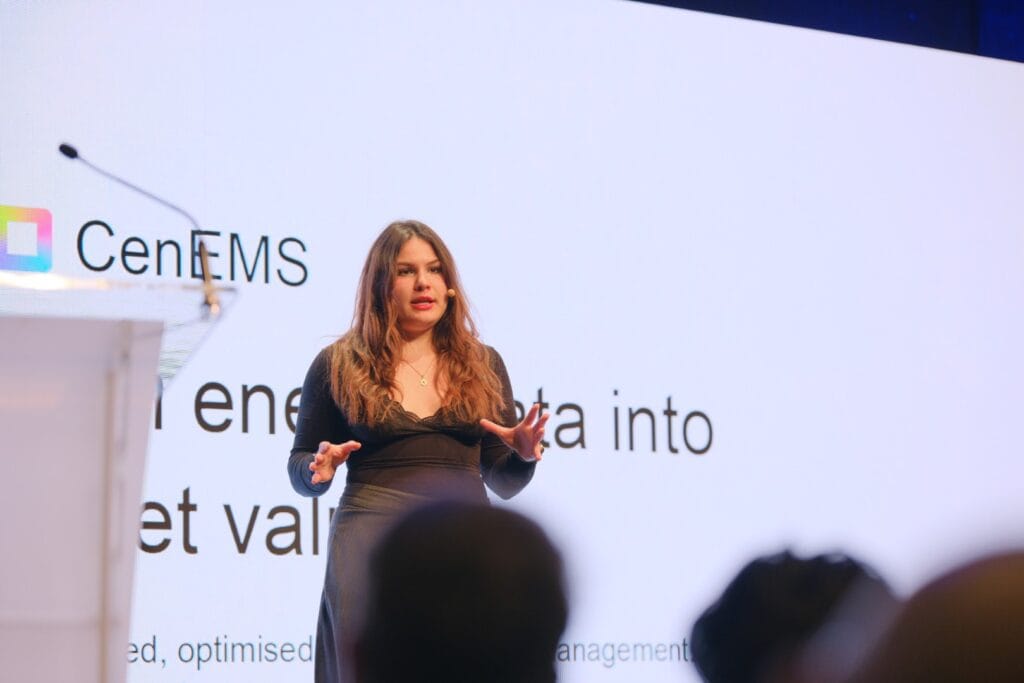
Sonya Hofer, Co-Founder of Central EMS pitching at Energy Tech Summit 2026
Decentral AI
Marouen Helali, CEO, started from an enterprise problem rather than an energy one. Companies want to adopt AI. Yet they fear regulation, carry heavy governance requirements, and need their language models fully private.
Routing tasks to the right model
The company’s answer is an algorithm that selects the right model for each task. A maths question routes to a maths model. A chemistry question routes to a chemistry model. That suits energy particularly well, given how much chemistry, physics and maths the sector involves.
Because specialized models are smaller, and because selection is handled automatically, Helali claimed the system benchmarks better than large general-purpose alternatives. Crucially, those alternatives are centralized. Using them means sending your data out.
Decentral AI instead runs behind the firewall. It brings the models into the customer’s own network for unlimited private reuse. That is also more energy efficient, Helali argued, since answering a basic question does not require an enormous model.
The business case and jury questions
The commercial insight is that enterprises will not experiment with different models themselves. So the company packages the selection as a software-as-a-service product that works out of the box.
On numbers, Helali said the company had just closed a deal taking it to 1 million in annual recurring revenue. It is cash flow positive, and raised 350k in its first two months without raising since. It now wants capital for a growth push.
Against the alternatives, he positioned open source tooling as do-it-yourself work requiring engineers. Hosted providers, meanwhile, require either your data or substantial money. The team is based in Las Vegas and came out of a Nevada energy accelerator programme.
The jury asked how on-premise deployment avoids token costs. Helali explained that open source models can be downloaded and run on your own hardware. The mainstream models require very expensive GPUs because of their size, which is what concentrates the market among a few providers. Smaller specialized models deliver equivalent results in your own environment. Once the hardware is running, there are no token costs at all.
Dyneo Technologies
Max Carrel, Co-Founder and CTO, opened with a photograph from his balcony in Geneva. He pointed past the mountains to the thousands of buildings pumping CO2 into the atmosphere to meet heating demand.
Old networks, new pressure
Geneva, like many European cities, plans to expand its district heating and cooling network to replace fossil boilers with clean energy. New construction can deliver low carbon intensity heat. However, networks already in operation remain vastly powered by fossil fuel.
Operators therefore face a difficult balance. They need to reduce that dependence while keeping energy prices competitive against fossil-based alternatives.
What the platform does
Dyneo provides software to those operators. It helps reduce heat loss across the infrastructure while increasing the renewable share in the energy mix. It also streamlines operation, cutting the time needed to run increasingly complex assets.
In practice, the platform collects and consolidates data on how the network operates. It then processes that data to detect and, more importantly, prioritize performance bottlenecks. Recommendations follow, which customers implement for lasting efficiency gains.
The company works with some of Europe’s largest operators, while remaining concentrated around its home region and looking to expand across Europe.
The team numbers seven, including two co-founders. Carrel comes from data engineering, his co-founder from building technology engineering, with most of the team focused on technology.
A juror asked him to explain the product again, and whether it acts or merely advises. Dyneo is specifically for district heating and cooling, and it operates in two modes. One is recommendations, used where physical intervention is needed, such as a broken pump. The other is automatic set point optimization, where it can act directly. Commercially, it is a subscription with an onboarding cost.
Heimdall Power
Jørgen Festervoll, CEO, opened with the company’s founding conviction: better grids mean better lives. The grid is not merely infrastructure but the backbone of hospitals, schools and homes. When it works, economies thrive.
A grid under unprecedented pressure
Right now the grid is under unprecedented pressure. Demand is exploding from electrification, industry and AI data centers. Meanwhile, thousands of gigawatts of renewables queue to connect to a grid built for a different era, one increasingly exposed to extreme weather.
His conclusion is that wires and poles cannot go into the ground fast enough to build a way out. Therefore the industry has to extract dramatically more from the grid it already has, starting by knowing how much capacity is there.
The core problem is that utilities operate a dynamic system using static assumptions. They do not know what a line can carry right now, at this location, under these conditions. Consequently they apply conservative margins, and significant capacity sits untapped.
“The real question isn’t whether capacity exists,” Festervoll said. “It’s whether we can see it, trust it, and unlock it.”
Sensors as an Apple Watch for the grid
His analogy was the Apple Watch for the power grid. Intelligent sensors mount directly onto high voltage lines using autonomous drones, in under a minute, without outages. Those sensors capture real-time conditions. Combined with AI software, they typically unlock 20 to 40% additional capacity on existing infrastructure. That is equivalent to a new transmission line delivered in hours rather than a decade, at a fraction of the cost.
The company has deployed with more than 50 utilities across 21 countries. Even so, Festervoll pointed out that 99% of high voltage overhead lines worldwide carry no sensor. That, he said, is where the opportunity lies.
Sales cycles and software-only rivals
Asked about utility sales cycles and whether software-only competitors threaten the business, he was direct on both. Cycles are long, but once you are in, you stay on their lines indefinitely, provided you do not fail them.
Heimdall does offer a software-only version. Yet he argued that congested lines need a sensor to verify the data. He described the company as hardware-enabled B2B software that is really a data play. More sensors mean more data, better products and better adoption. Software-only dynamic line rating, in his view, is difficult to defend, because it could be assembled from a weather service and an AI assistant. A sensor on the line cannot be replicated that way.
Inicio
Romain Batby, CTO and founder, uses AI to answer one deceptively simple question: where should an energy project be located?
Development is fragmented and slow
In an ideal world, projects would be built in the best locations rather than the easiest or fastest to permit. Today, however, development is fragmented, highly uncertain and difficult. Developers spend months navigating land constraints, regulations and grid connection risk.
Inicio applies AI at three levels: automated site analysis and optimization, understanding large-scale developments, and translating maps into GPS-level insights. The platform then brings every risk, from landowners to city councils, into a single workflow.
The company also uses AI internally, so developers integrate new data faster and projects get de-risked earlier.
Traction and the data question
Inicio works with 20 developers across France and Italy, with European expansion planned. The team of 15 combines AI, grid systems and energy expertise.
Asked where the data comes from and how hard new countries are, Batby acknowledged a real barrier to entry per country. The data itself comes from across the web: open data, easily accessible sources, and scarce documents that AI makes it possible to gather and interpret. The revenue model combines annual software licences with fees when projects are developed.
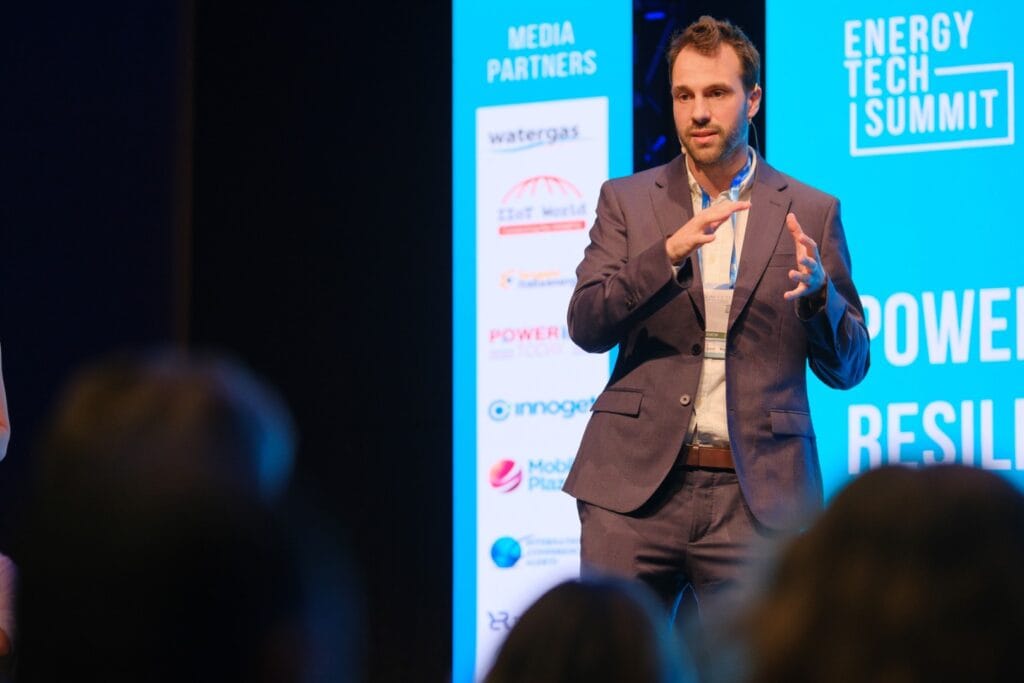
Romain Batby, CTO and founder of Inicio pitching at Energy Tech Summit 2026
Metroscope
Aurélien Schwartz, CEO and founder, is a former researcher on nuclear plant monitoring, and he addressed the audience as though they were nuclear operators.
Where nuclear plants lose energy
What such an operator cares about is maximum energy output with minimum maintenance, because maintenance is expensive. Showing a real pressurized water reactor case, he pointed to eight or nine simultaneous problems across the steam cycle causing actual losses.
The scale of that waste is the pitch. A plant might lose roughly 10 megawatts out of 1,000, with close to 1% of energy wasted at plant level across the world.
Physics-inspired AI and a spin-off from EDF
The technology is physics-inspired AI built on an inference engine. Schwartz said EDF uses Metroscope across its nuclear fleet and claims a substantial net gain in fleet production as a result.
He also mentioned a project he is particularly proud of: supporting Ukrainian operations during wartime to deliver electricity as safely and reliably as possible.
The closing number was environmental. In the previous year alone, he said, the company saved 350,000 tons of CO2 equivalent. It did this by displacing fossil generation through improved nuclear output and by increasing gas plant efficiency.
Asked how dependent the company is on EDF, Schwartz explained its origins as a spin-off from EDF R&D. The three co-founders were researchers there. Once the technology proved itself, they struck a deal to create a startup, with EDF providing seed investment.
A second juror asked about geography and about whether this is a frontier model. Metroscope has a US location alongside its Paris headquarters and operates in 12 countries, working with utilities across North America and Europe.
On the technology, his answer was hybrid. The company leverages years of second-by-second plant history to calibrate digital twins that combine machine learning with physics. Where a physical equation exists, they use it. Where it does not, they apply unsupervised and supervised machine learning and regression instead.
Splight
Cheikh Dramé, business developer, opened with a striking comparison. Imagine wasting enough electricity to power New York City for a year.
50 terawatt hours curtailed
That, he said, is roughly what happened in 2024. Around 50 terawatt hours of renewable energy were curtailed, equivalent to €1.5 billion in unearned revenue for generators.
The cause is capacity that exists but cannot be used. Because distribution and transmission lines operate at around 55% of capacity, renewables get curtailed.
Doubling usable grid capacity
Splight’s dynamic congestion manager addresses that with a proprietary algorithm. It moves the traditional thermal operating limit upward, doubling and sometimes tripling usable capacity when paired with dynamic line rating. That turns a static, congested grid into a dynamic, high-capacity network.
The benefits distribute across the grid. Generators reduce or eliminate curtailment. Batteries improve their economics. Large loads interconnect faster. Utilities gain a layer of reliability, since the system also acts as an automated control scheme.
Traction, regulation and a live deployment
On traction, Dramé cited over 30 customers worldwide and deployment across around 66 gigawatts of assets. He also pointed to roughly €50 million in additional revenue unlocked for generators, and about 850 kilotons of CO2 avoided. Founded in 2021, the company has raised 26 million.
Asked how the company handles regulation rather than physics, Dramé described engaging regulators directly. In the northeastern US, regulators are pushing performance-based ratemaking, which pushes utilities toward non-wires alternatives rather than simply building more transmission. The company recently passed the first phase of an application with a state public utility commission. Elsewhere, it works through generators losing money to curtailment, who then bring the solution to their utilities.
On a live deployment, he described work in Chile, where the company installs monitoring devices alongside the software. The congestion manager works with fast-responding assets: solar, wind, some combined cycle, and battery storage. It calculates set points so that when a contingency occurs, generation trips down progressively rather than shutting off entirely.
WindBorne Systems
Karen Ye, Director of Commercial Growth, opened with a storm that swept through Portugal and Spain earlier in the year, leaving a million homes without power and costing lives.
Only 15% of the atmosphere is observed
Her diagnosis was that forecast uncertainty drives disaster preparedness, and that uncertainty comes from the data feeding the models. Remarkably, only around 15% of the atmosphere is adequately observed today for weather purposes.
WindBorne closes that gap with long-duration smart weather balloons, operating what Ye described as the largest such constellation on the planet. Traditional weather balloons fly for two hours. These average over two weeks, continuously profiling the atmosphere and collecting data over oceans that currently go unobserved.
Because weather is a global system, that ocean data improves forecast accuracy everywhere. The company has launched over 7,000 balloons and has more than 300 aloft at any time, from over 15 launch sites.
From balloon data to utility decisions
That data feeds in-house AI models generating forecasts. Ye said the balloons have been validated as the most cost-effective method of improving forecast accuracy.
The new product is an end-to-end solution for utilities, translating those forecasts into decisions for disaster preparedness. Returning to the storm, she showed that the company’s models picked up its intensity three days ahead of leading global forecasting models. She then asked the room what a utility would do with that kind of foresight.
Revenue, margins and the data moat
On commercials, Ye reported over $15 million in revenue last year, primarily from US government work and energy hedge funds. The team of 70 in California spans engineers, designers and meteorologists.
Asked how capital intensive growth is, she said all-in balloon cost, including hardware and labour, is under $1,000. Because the company sells data rather than launches, longer flights mean more data, and gross margins currently run 60 to 70%.
On the path to a very large company, Ye noted that weather data is a substantial standalone industry, while weather itself influences a majority of GDP across many sectors. The company is starting with hedge funds and utilities, then expanding.
A juror pressed on where the value actually sits and who pays. Ye distinguished the two revenue streams: balloon data sold to government organizations, and weather forecasts sold to industries like hedge funds. Importantly, the company does not sell all its data, because that is the moat. As the constellation scales toward a target of 10,000 balloons, that differentiation grows.
Yuon
Kajo Krummenacher, Chief Product Officer, closed the track on district heating, which he called a cornerstone of Europe’s energy transition attracting billions in new network investment.
Peak demand limits existing infrastructure
The problem is that today’s networks operate with very limited intelligence. Operating costs are driven by peak demand, and that creates three issues: limited network capacity, preventable thermal losses, and higher CO2 emissions. Utilities investing heavily in infrastructure are therefore leaving value on the table.
Yuon addresses this with AI-powered network optimization. A typical district heating network shows a large morning load peak, and that peak is what limits an operator’s use of expensive infrastructure.
Software-only optimization, real-time results
The system learns how each network behaves, forecasts demand, and optimizes energy flow in real time to lower that limiting peak. Crucially, it integrates into existing systems: no hardware replacement, no infrastructure rebuild, software only.
Operations teams get a dashboard showing the optimization in real time. Krummenacher put the results at more than 20% lower operating costs, up to 60% lower peak loads and around 30% less CO2.
The company has traction in Switzerland and first commercial projects in Germany, working with leading utilities and holding strategic partnerships with major European industry partners. Its 2026 pipeline represents multi-million revenue potential in a growing European market.
The team combines AI expertise with thermal network industry experience and a sales function. Yuon was preparing a seed round within 12 months and had begun talking to investors.
Asked how invasive deployment is, Krummenacher said it depends on the operator’s existing setup. Where a guidance system and smart meters are already in place, it is software only. The work is getting the integration right, which is why the company is building libraries of compatible systems.
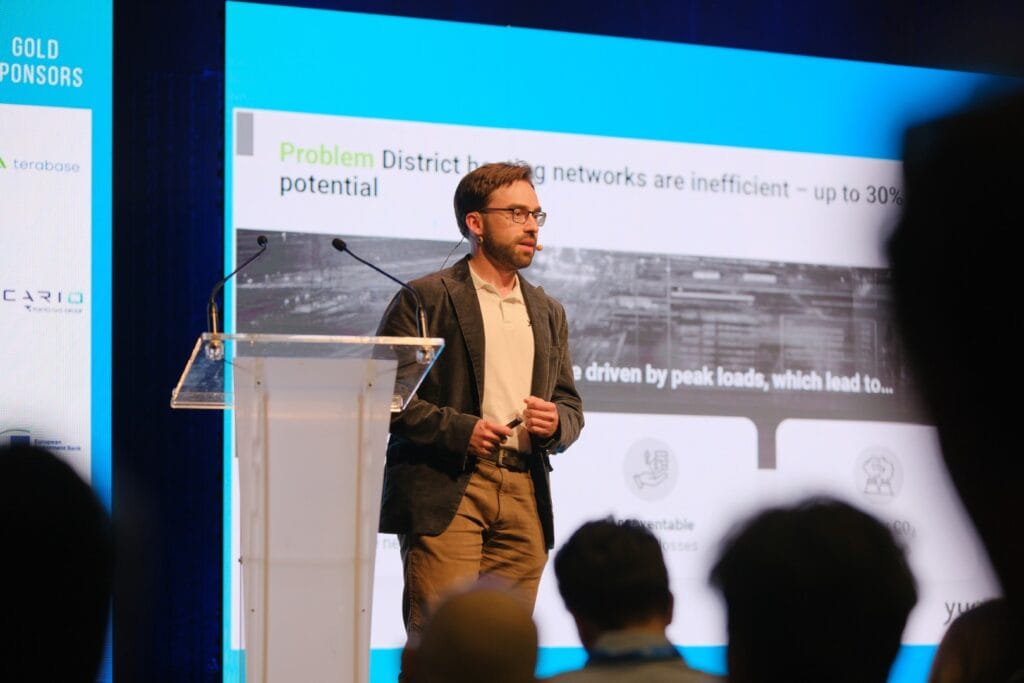
Kajo Krummenacher, Chief Product Officer of Yuon pitching at Energy Tech Summit 2026
Takeaway
Across nine pitches, the same insight kept reappearing in different clothing: the capacity is already there, and what is missing is the ability to see it. Heimdall and Splight both argue that transmission lines carry far more than operators dare use. Metroscope finds a lost percentage inside nuclear plants that are otherwise running fine. Yuon and Dyneo both target heating networks sized around a peak that better forecasting could flatten. WindBorne’s entire proposition is that most of the atmosphere goes unobserved. AI for energy, on this evidence, is less about building new infrastructure than about measuring what already exists precisely enough to stop wasting it.
Energy Tech Challengers returns at Energy Tech Summit 2027 in Bilbao, April 7–8. Do you want to watch the next generation of energy startups pitch live, or take the stage yourself?