

A floating wind turbine is visible from the plane. Some 120 suppliers sit within 100 kilometers. And a tax mechanism funded a fifth of a demonstration project.
Scaling green energy solutions requires more than innovation. It requires real industrial environments where technologies can be tested, validated and deployed. Ander Muñoz, Director of Strategic Initiatives at Beaz Bizkaia, opened the panel with that premise. His question was narrower: what actually makes the difference when scaling? And what does a regional ecosystem contribute to that journey?
The three panelists represented three different routes through the same territory. One was a corporate spin-off that grew into an offshore developer. Another was a research-centre spin-out scaling as a startup. The third was a public-private institution building infrastructure for entire sectors.
Who was on stage
Joseba Garcia Garaigordobil is Managing Director of the Energy Intelligence Center. It’s a private and public institution promoting decarbonization across the Basque economy. His framing carried a specific condition. The region has a strong industrial sector, and the energy transition has to happen while that sector stays competitive.
David Carrascosa is CEO of Saitec Offshore, which works on floating offshore wind. That means bringing wind energy to deep waters – an exercise in innovation by definition, as he put it. The company has a full-scale prototype running two kilometers off the Bizkaia coast. Passengers flying into Bilbao with a window seat can sometimes see the turbine turning.
Guillermo García-Miguel is Head of Product at H2SITE, which makes membranes for hydrogen purification. The company’s focus isn’t the familiar applications of producing or using hydrogen. Instead, it’s developing the market that will enable hydrogen to be transported over long distances.
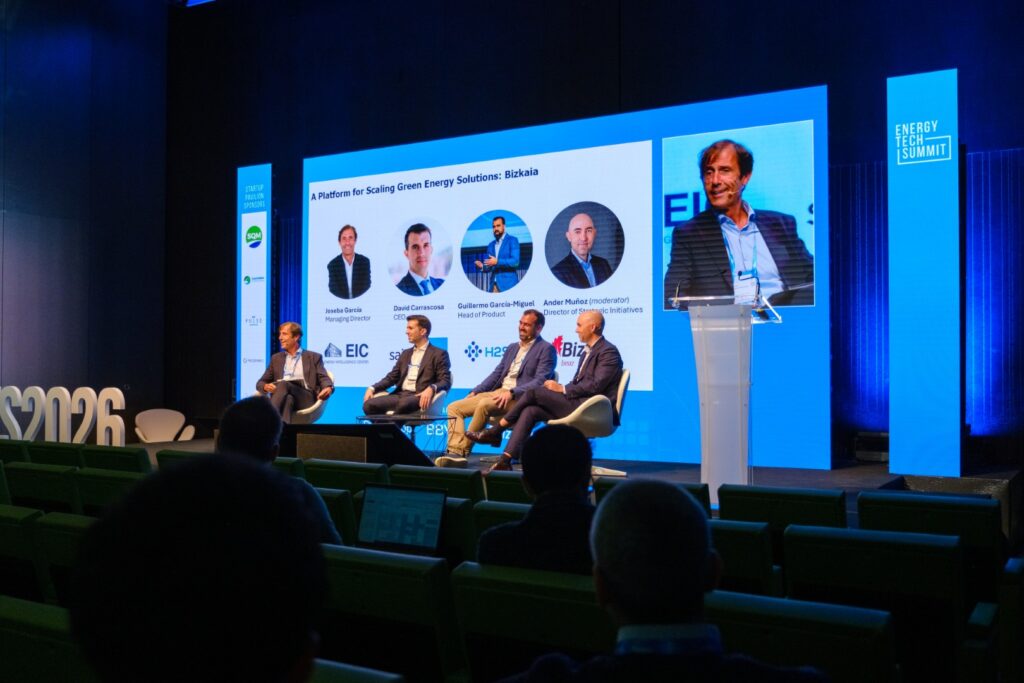
Panelists during the session at Energy Tech Summit 2026
Floating wind, built from concrete
Carrascosa traced Saitec Offshore back nearly 14 years, to an idea about making the broader offshore wind resource accessible. The company wasn’t the first into floating offshore wind. But it was among the first to approach the problem differently – from civil engineering rather than oil and gas. That’s why concrete is its main foundation material.
The journey from that initial patent to today produced what he called a lot of adventures and a lot of milestones. The result is a 2 megawatt full-scale demonstration now connected to the grid. By his account, it’s the first project in Spain to deliver electricity from floating offshore wind.
The financing structure mattered as much as the engineering. Saitec Group backs the project from the private side. It’s joined by investment partnerships with two major utilities, RWE and a Korean power corporation. On the public side, support came from regional agencies including the Basque energy entity and from Beaz itself.
The tax lease mechanism, and why it is unusual
The most practical part of the session concerned a financing tool Carrascosa said is considerably harder to use elsewhere.
In conversations with executives in other regions and countries, he has found tax lease difficult to manage. It often has to be structured through multiple special purpose vehicles, and the mechanisms are not always clear.
What Bizkaia did instead was regulate it. Companies with substantial tax liability are connected with startups that need investment. Those startups are generating tax lease capacity they can’t yet apply to their own balance sheets, because the profits aren’t there yet. Doing that inside a regulated framework gives companies security and comfort.
Asked whether the project could have moved at the same speed without it, his answer was direct: definitely not. Development elsewhere happens at a much slower pace. Without those incentives, the company would have struggled to assemble the financing structure at all. The reason is structural. Everyone involved is committing significant cash to a demonstration project that isn’t profitable in itself. It bridges the innovation gap toward the projects that eventually will be. That makes a tool like this fundamental rather than helpful.
Six years, seventy people, and 120 suppliers within 100 kilometers
García-Miguel began with a caution that the room recognized: developing this kind of technology is not something you do overnight. H2SITE has existed for almost six years, growing from two or three people to around 70. It still needs to scale through two or three further phases in the coming years.
Hydrogen, in his description, is a global race rather than a market developing steadily in isolation. Anything that happens elsewhere in the world affects how hydrogen develops. So the company has built strategies for navigating each phase.
He pushed back on the idea that the region’s progress reflects any lag. Six years isn’t the real length of the story. The technology centre began developing the underlying technologies roughly 12 years before the company existed. That work was done with government, on a bet that it might one day matter to the economy. Those steps were long, and full maturity is still some way off.
The concrete advantage he named is the one that would be hardest to replicate. H2SITE works with companies across the world and sees none of them with the same facilities or the same accompaniment. On a typical project the company uses around 120 suppliers. For deep tech in particular, he called that unique. Established companies with real market power also engage on the basis of proximity. They believe in a nearby company and choose to help it.
What support actually looks like on the ground
Asked which instruments mattered most, García-Miguel started with something not usually counted as support at all. That’s the number of research centres in the region. That is where H2SITE came from. The technology was invented locally, which meant it arrived not ready for market but ready to scale.
The second is a local funding horizon that does not constrain what you propose. You can present whatever you believe will be profitable, rather than fitting a predetermined theme. Support exists across the range, from very low technology readiness levels to much higher ones.
Beyond that come talent attraction incentives, which matter for a company bringing people in from abroad – García-Miguel came from the UK himself. Public participation in the capital stack matters too. Support also arrived when the company was smaller and opening conversations with customers. It arrived again when entering new markets and regions.
Three programmes at the Energy Intelligence Center
Garcia Garaigordobil described three initiatives, each aimed at a different part of the industrial base.
The first is a renewables hub, defining technological development according to what companies actually need. Its roadmap runs in three phases. First, identify the technological lines to work on, based closely on company needs. Second, work with the Basque science, technology and innovation network to build the capacity those lines require. Third, invest in the infrastructure needed to test the resulting developments.
The second programme concentrates on hard-to-abate sectors, which he called particularly important for this region. These sectors face genuine decarbonization difficulty: high dependence on fossil fuels and, in several cases, substantial CO2 emissions. The centre works with refining, petrochemicals, cement, steel and glass companies to define the infrastructure they will need. It has completed the first stage of that work.
The third is a decarbonized mobility ecosystem centred on hydrogen. A refuelling station is under construction next to the Energy Intelligence Center. It’s intended to let companies test the full hydrogen value chain, rather than a single link in it.
Why this region, and what makes scaling work
Muñoz closed by asking each panelist what matters most when scaling an energy solution. And why would a company choose Bizkaia to do it?
Garcia Garaigordobil listed four things. Strong energy companies genuinely involved in the transition, naming Petronor and Iberdrola. A strong industrial sector that needs this process and is focused on it. And, importantly for him, a public administration that is close to the companies it supports. Bizkaia adds one further capacity: fiscal autonomy. That allows the region to work with companies on the right structure for each situation.
Carrascosa agreed and added the funding point from his own experience. Blending private commitment with public support in different structures is highly relevant. Local administrations that genuinely back innovation are crucial, incubating ideas that return value to the region.
His second point was about market certainty, and it applies to hydrogen as much as to wind. Offshore wind depends heavily on government roadmaps, bidding structures and tenders. Understanding the technology early in a new phase of an industry matters. Overestimating or underestimating the market creates tension and uncertainty in private investment. Investors want certainty – a clear business plan founded on a comprehensible market size. That comes from strong government statements, roadmaps and clear regulation.
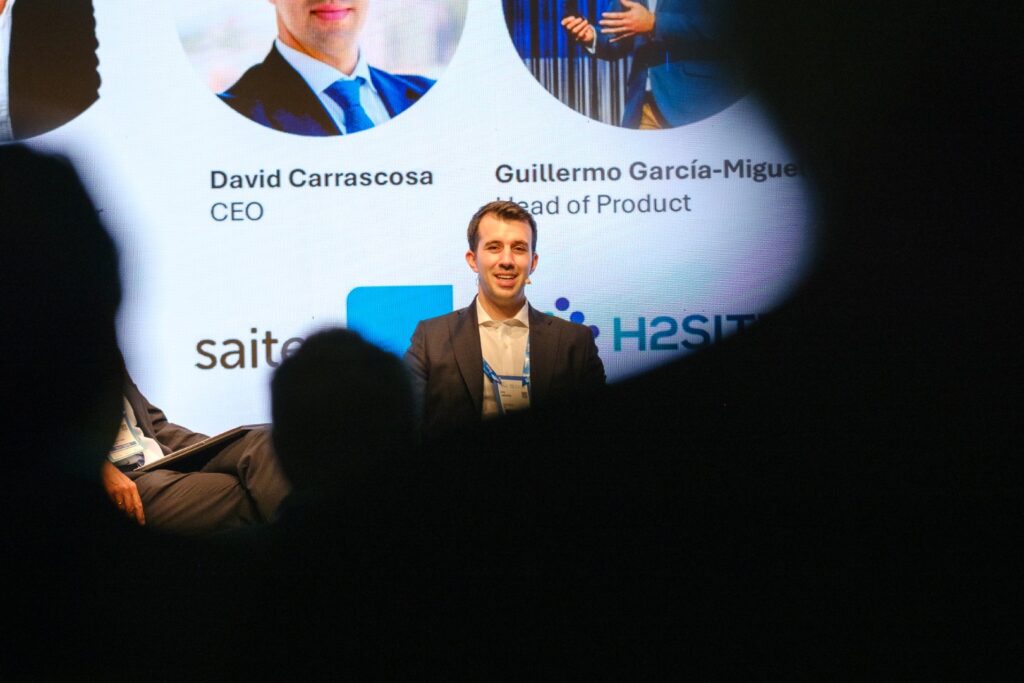
David Carrascosa, CEO of Saitec Offshore during the session at Energy Tech Summit 2026
Start with the business plan, not the incentives
García-Miguel gave the most practical answer of the session, and inverted the usual framing.
If you’re deciding whether to establish a deep tech startup in Bizkaia, he said, think first about your business plan. Don’t start with the region. You are the one with the needs, and the business plan is what reveals them. You will find you need a factory, or new components, or people.
Each of those maps onto something specific. Need a factory, and there is an agency for that. Want to meet other companies? There’s a cluster, or the Energy Intelligence Center, to connect you. Bringing people into the Basque Country? Talent attraction instruments exist for that. Working through successive technology readiness levels? The local funding horizon covers that too.
His warning concerned what support elsewhere often looks like. In many places, startup support is scattered rather than structured. That functions more as a way for a government to look good than as a way to help a company grow.
The alternative he described is a loop. You establish the company, you grow it, and those loops become virtuous when combined with government participation. Support creates value, value brings more people, more people pay taxes locally, and revenue is booked in the region. “That’s the two ways of winning this maths equation,” as he put it. The point: the arrangement has to pay for both sides.
Takeaway
The panel offered three different accounts of scaling green energy solutions, and they converged on something less glamorous than technology. What made the difference for a floating wind demonstration was a regulated tax mechanism. It covered a fifth of the cost of an unprofitable but necessary project. What made the difference for a hydrogen membrane company was different. It had 120 suppliers close enough to iterate with. And a research centre had been working on the technology a decade before the company even existed. Neither is a subsidy in the conventional sense. Both are the result of a region deciding, well in advance, what it wanted to be good at. That’s a slower and less visible form of industrial policy than most of the instruments the sector debates.
Energy Tech Summit 2027 returns to Bilbao on April 7–8, with more conversations like this one.