

Why Early Climate Projects Struggle to Get Funded
Early climate projects rarely fail on technology. Instead, they fail in the gap between a working pilot and a bankable asset. Four investors — from the EIB, J.P. Morgan, Siemens Energy Ventures, and Rondo Energy — explain why capital dries up, and what gets projects across the line.
The hardest money in climate tech isn’t the first venture round. It’s the first commercial plant — the “first of a kind,” or FOAK — and the second and third plants that follow. That was the premise of a panel at Energy Tech Summit, moderated by Kobi Weinberg of Adapt Nation Advisors. Four investors who fund exactly these projects came together to discuss it.
On the panel: Irene Gálvez Verdú, Head of Cleantech Equity & Growth Capital at the European Investment Bank; Nachiketa Sharma, Executive Director for Climate Tech Innovation & Investments at J.P. Morgan; Alex Fuiks, Investment Manager at Siemens Energy Ventures; and Alberto Toril Castro, Head of Iberia at Rondo Energy. Here’s what they argued.
The Real Risk Isn’t the Technology — It’s the Business Case
The panel opened by dismantling a common assumption. The challenge of financing a first-of-a-kind project isn’t that you’re testing the technology for the first time, Toril Castro argued. Instead, it’s that you’re testing the real business case for the first time. Construction, integration with the customer, and the revenue model — how all the pieces come together — is what’s hard to finance.
Moving to a second-of-a-kind doesn’t make the risks vanish, he added. It just makes them clearer. By then, you have a credible execution timeline, a view of the revenues, and the credibility of having done it once. The real shift, in his words, is moving from testing a technology to becoming “a financeable asset class in the market.”
Fuiks agreed and sharpened the point further: FOAK financing is about de-risking, meaning you build the data and the risk profile that lets you — and other investors — understand what could go wrong. That, he said, is one of the most integral parts of underwriting a first-of-a-kind project.

Alex Fuiks, Investment Manager at Siemens Energy Ventures speaking at Energy Tech Summit 2026
A Risk Problem, Amplified by Market Structure
Is this a risk problem, a return problem, or a market-structure problem? Weinberg put the question to the group, and a rough consensus formed: risk first, market structure second.
Fuiks described an “equity mismatch” in the market. Venture investors chasing 20–25% IRRs will take early-stage technology risk, but their mandate doesn’t fit a business that, operationally, looks like an infrastructure play. In fact, these businesses only release dividends at mature scale. Infrastructure investors, meanwhile, won’t touch the risk because it’s simply too high. The result is a gap in the middle.
Gálvez Verdú agreed completely, from the lender’s side. Without a track record of plants online, the level of risk is genuinely hard to quantify. So lenders err on caution, and end up unable to fund projects even when they show positive, if low, returns. She added a twist she’d seen often at Breakthrough Energy: some FOAK projects come to market at a deliberately suboptimal scale, shrinking simply to reduce funding needs. That, in turn, only reinforces the mismatch between risk and return.
Toril Castro tied it together: the risk is real — spanning technology, construction, integration, and revenue — but a market whose structures don’t fit amplifies it further. These projects are too big to finance on equity without crippling dilution, yet too new for traditional project finance. “Not really fit for purpose,” he said, “for the current money allocation that we have in the market.”
Sharma’s Counterpoint: The Market Is Catching Up
Sharma offered the optimistic dissent. J.P. Morgan sees this primarily as a risk problem, less a market-structure one. In his view, the market structure is already catching up fast, if it isn’t there already. Catalytic vehicles, government guarantees, and grant capital are filling in. So too are growth investors now raising dedicated project-equity and project-debt funds.
What can’t be manufactured, he admitted, is a track record. Some of these technologies simply aren’t ten years old yet, “and you can’t conjure up a 10-year track record just like that.” For a bank, he explained, that missing performance history is the biggest stumbling block.
How Rondo Got Funded: The Right Partners for the Risk
Weinberg pressed Toril Castro on Rondo Energy — a heat-battery company electrifying high-temperature industrial heat, and a genuine FOAK success story. What was the breakthrough?
Scaling a new technology means tapping into several distinct risks at once: technology, regulatory, and financial. The key, Toril Castro said, was finding partners who believed not just in the technology, but in the team’s ability to execute the first project. He credited the European Investment Bank directly, thanking Gálvez Verdú and her team, combined with Breakthrough Energy Catalyst. Its blended finance backed the technology at an expensive, ahead-of-the-curve moment. Together, that combination covered the full risk allocation and funded Rondo’s first three first-of-a-kind projects in Europe.
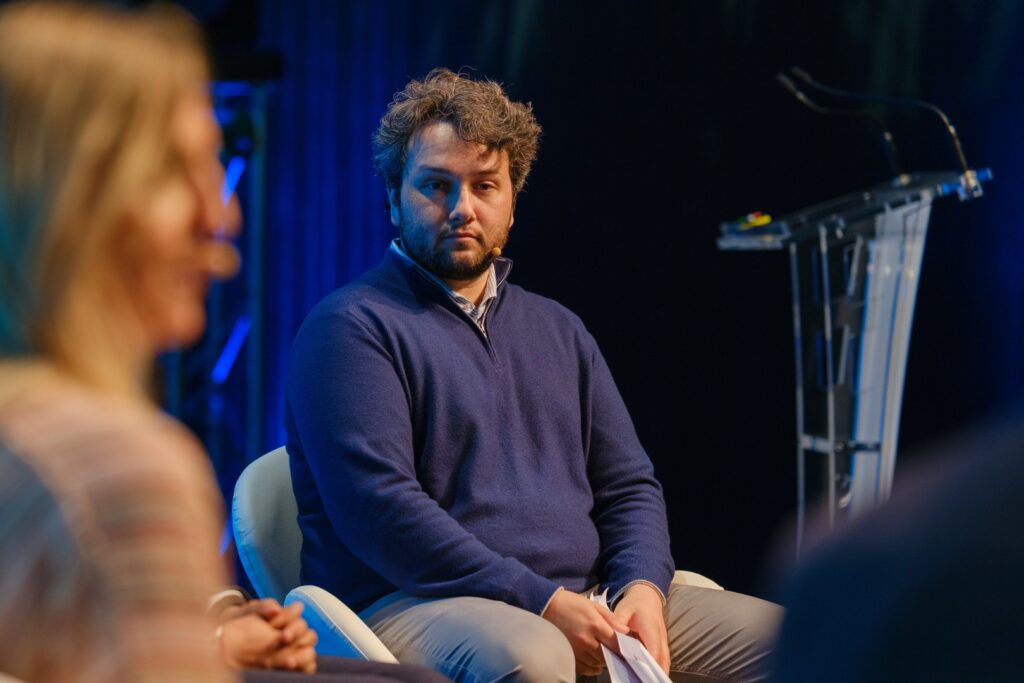
Kobi Weinberg, Managing Partner of Adapt Nation Advisors at Energy Tech Summit 2026
What Siemens Energy Brings Beyond a Check
As a strategic corporate investor, Siemens Energy Ventures offers more than capital, and Fuiks explained the model. The fund is a little under four years old, and it invests from Series A through growth. It always looks for strategic alignment: future collaboration, joint IP or product development, supply of parts or services, or a hedge against Siemens’ own internal development.
His example was Geopura, a UK company making mobile hydrogen power units for sites without easy grid access, such as construction, film, and event sites. Siemens Energy manufactures Geopura’s units at its Newcastle facility, once the historic Parsons works. That facility had faced an uncertain future due to underutilization. However, the Geopura partnership turned around its manufacturing throughput and operations, expanded into other divisions, and even spawned a hydrogen apprenticeship. Fuiks called it a “win-win”: revenue certainty and manufacturing scale for the startup, throughput and purpose for the corporate.
The Red Flags — And What Makes a Project Bankable
Gálvez Verdú offered three lessons on what raises red flags and what makes a project attractive, framed, she noted, against a backdrop of projects that mostly succeed.
First: at the FOAK stage, shift attention from technology to project development and the ability to deliver. Too many ventures still “talk the VC lingo,” she said, when lenders instead want to hear the mundane matters of execution. That’s because the upside beyond the first plant is a given; delivering the project is the hard part.
Second: economics will eventually make your FID — the final investment decision — or break it, not site development. She described teams pouring attention into sites and permits while offtakers won’t disclose price commitments and equity investors won’t disclose terms. Eventually, commercial and financial requirements simply stop aligning, and the FID collapses.
Third: project finance is harder than you think, and you can’t improvise it at the end of development. Either you plan for it from the start with the right experience on the team, or you turn to more flexible capital — like the growth capital her team provides — to bridge the way to bankability.
Sharma added the bank’s view. Getting funded is a journey, not a six- or twelve-month pitch. J.P. Morgan wasn’t in the room as the company grew, so it needs to see execution firsthand, and it won’t take on technology risk. Too many pitches, he said, dwell on upside returns and too little on “what could go wrong — and who is in the room” to take corrective action. His hard constraint: without insurance or sovereign guarantees, banks often rule out lending entirely, however good the project.
The Ultimate De-Risker: Grants, Guarantees, or Offtakes?
What’s the tip of the spear that makes projects bankable? The panel’s answers revealed how much the view depends on the seat.
Grants are by far the greatest de-risker when scaling technology, said Gálvez Verdú — “I’m a banker, right?” — but only as part of a capital stack that comes together as a whole. Notably, if loan guarantees come from the same pocket as public funds, she argued, grants end up more effective than guarantees. She also cautioned that offtakes, while essential for project finance, aren’t an operational risk-transfer instrument. If the technology underperforms or the market turns, the buyer simply walks away.
Sharma refined it further: it’s one thing to have offtakes, and another to have bankable ones. Companies often negotiate offtakes bilaterally behind closed doors, so lenders frequently find significant shortcomings. That’s why he welcomed industry work to standardize contracts and define what a good offtake actually looks like. Toril Castro summed up the founder’s reality: raising VC teaches you one skill, but project finance is “totally reverse engineering” — working backwards from what infrastructure investors and commercial banks will require.
What’s Crossing the Chasm From Venture to Bankable
In a closing lightning round, the panel named the technologies making the leap. Toril Castro pointed to heat: 50% of energy consumed in Europe goes toward heat, not electricity, so electrifying industrial heat is a huge market. Cost visibility and sovereignty concerns are driving it forward. Gálvez Verdú agreed, and added long-duration storage to the list.
Fuiks named electrification and energy storage too, crediting the ability to standardize future revenues. The more modular and standardized a technology becomes, the more predictable its cost and performance forecasting gets. Sharma added carbon removals, noting a shift he’s seeing away from tech-based CCUS and back toward nature-based approaches. He also flagged sustainable mining, where companies now sign offtakes before a shovel even hits the ground, with AI and robotics moving in alongside them.
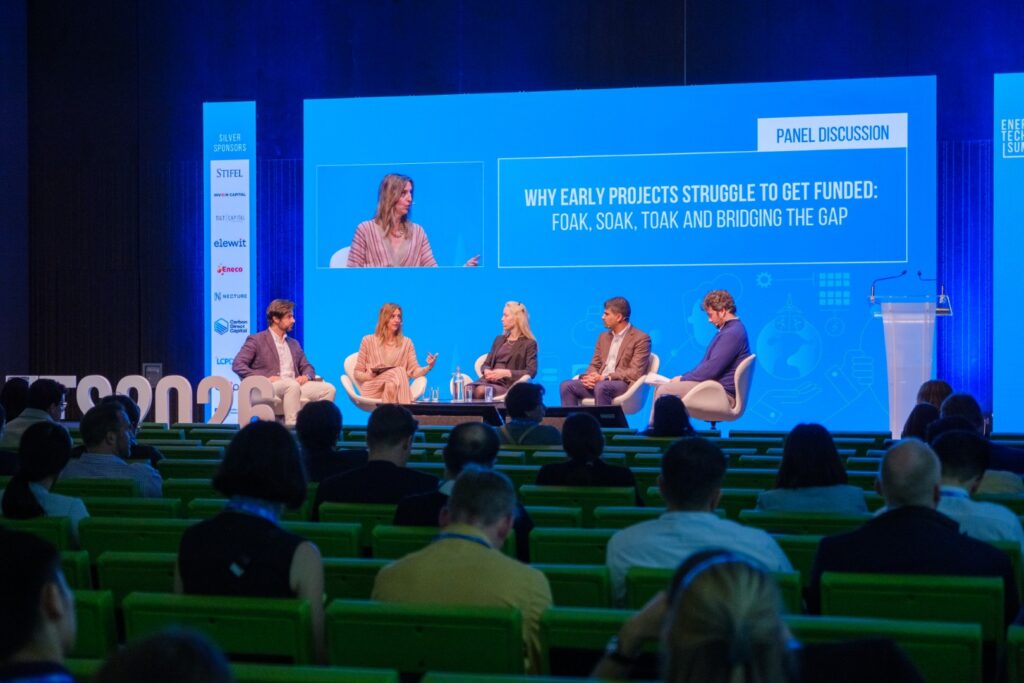
Speakers of the panel at Energy Tech Summit 2026
The Takeaway
The panel’s throughline was clear: early climate projects rarely die on the technology. Instead, they die in the missing middle — the gap between a proven pilot and a bankable asset, where venture money won’t follow and project finance won’t yet lead. Closing that gap takes the right capital stack, honest attention to what could go wrong, and offtakes solid enough for a lender to actually believe in.
Energy Tech Summit 2027 returns to Bilbao, April 7–8, with more conversations like this one.