
The planet is in code red. The global race for clean technologies has entered a new phase.
In a world of growing geopolitical volatility, economic capability increasingly translates into strategic power. What is at stake is no longer climate progress only. It is industrial leadership, economic resilience, and energy security.
Europe’s Innovation Paradox
Europe has never lacked cleantech innovation. The continent produces 27% of global cleantech patents, yet only 7% of the products that reach the global market. Europe excels at generating ideas. However, others are turning those ideas into factories, supply chains, and jobs.
Across the continent, startups are producing world-class technologies–from advanced batteries and hydrogen solutions to grid optimization and industrial electrification. Yet many of these innovations encounter the same barrier when they reach the next stage: scaling.
Clean technology has become a strategic asset. In an increasingly fragile world, the countries that lead in large-scale industrial deployment will ultimately lead the energy transition–and shape the balance of economic power that comes with it.
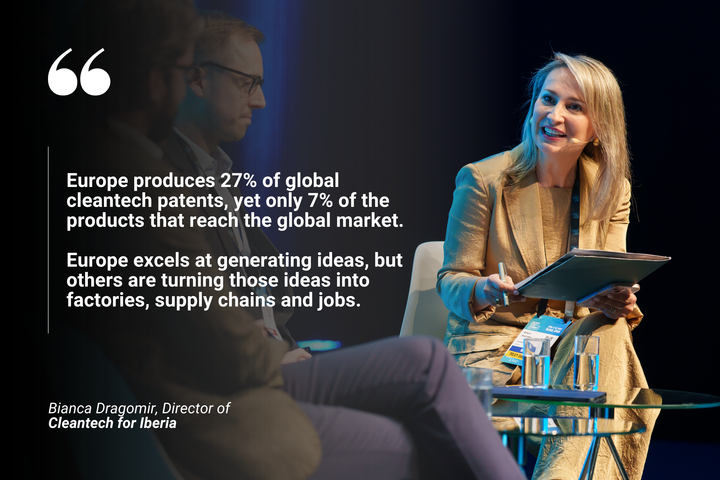
Bianca Dragomir at Energy Tech Summit 2025. This year, she will moderate the panel “A New Global Order: Make or Break in Europe’s Cleantech Policy” at Energy Tech Summit 2026 (April 15-16, Bilbao).
The “Made in Europe” Wake-Up Call
Europe’s emerging “Made in Europe” manufacturing strategy is a wake-up call. Recent initiatives such as the Net-Zero Industry Act, the Clean Industrial Deal, and the Industrial Accelerator Act all point in the same direction: strengthening Europe’s industrial base so that innovation can translate into manufacturing and deployment.
Yet one structural gap remains unresolved: the financing of first-of-a-kind projects.
These projects transform promising technologies into real industrial infrastructure–the first commercial hydrogen plants, large-scale energy storage facilities, industrial electrification projects, or advanced manufacturing lines. They prove that technologies work at scale, unlock private capital, and strengthen supply chains.
These are also the hardest projects to finance. First-of-a-kind projects sit in the difficult space between venture capital and traditional project finance. They require large amounts of capital while relying on technologies that lenders often consider too new. As a result, many promising European clean technologies stall just before reaching industrial deployment.
The Resilience Premium
Addressing this gap requires acknowledging a crystal clear reality: industrial resilience carries a cost.
Energy systems, supply chains, and critical technologies have become strategic priorities. Therefore, governments increasingly need to be willing to pay a resilience premium in order to secure domestic industrial capacity and reduce strategic dependencies.
This shift is already visible across many advanced economies. For instance, Australia has created a National Reconstruction Fund to support strategic industries and higher-risk industrial innovation. Around the world, governments are stepping in where markets hesitate to absorb early deployment risk.
However, the central challenge is not simply mobilizing more capital. It is ensuring that public and private finance work together to turn technological leadership into industrial leadership.
Beyond Technological Promise
Too often, public programs evaluate projects primarily on technological promise or emissions impact. Yet real deployment depends on additional key factors: engineering maturity, permitting clarity, credible execution plans, and bankable offtake agreements.
Without these elements, Europe risks falling into a familiar trap: death by pilot.
What Europe needs now is a shift from scattered pilots to scaling entire cleantech value chains.
Financial tools must evolve as well. Grants remain important, but capital-intensive industrial projects require a broader and more flexible set of instruments. Specifically, loans, guarantees, and blended finance structures can reduce risk, lower the cost of capital, and attract private investment that would otherwise remain on the sidelines.
Without such instruments, Europe risks remaining at a persistent disadvantage compared with regions where massive strategic “investments”–rarely called subsidies–actively support emerging technology champions.
From Commitment to Deployment
Time discipline also matters. Projects frequently receive funding commitments but struggle to reach Final Investment Decision because timelines drift or approval processes remain uncertain. Clear milestones and predictable pathways toward FID help ensure that announced capital becomes deployed capital.
Moreover, public institutions need clarity about the risks they are prepared to absorb. First-of-a-kind projects integrate technological, market, and execution risks. Public actors are often the only institutions able to take on part of that uncertainty, yet mandates are not always explicit. When risk tolerance remains ambiguous, projects stall even when funding exists.
Iberia Leading by Example
This shift from innovation to deployment is already visible in some regions. Spain and Portugal have started to lead by example.
The Iberian Peninsula combines abundant clean energy resources, strong industrial capabilities, and a rapidly expanding cleantech ecosystem. In 2025, cleantech investment in the region reached €768.8 million, the highest level ever recorded. This reflects growing investor confidence and ecosystem maturity.
Nevertheless, turning this momentum into industrial scale will require significantly larger investment. Estimates suggest Iberia will need up to €50 billion per year in additional public and private capital by 2030 in order to remain competitive in Europe’s clean industrial transition.
Policy momentum is beginning to reflect the scale of this challenge. In Spain, initiatives such as the España Crece sovereign fund aim to mobilize €120 billion in investment to accelerate industrial deployment and attract private capital into strategic clean technologies, with green reindustrialization at their core.
If aligned with Europe’s broader industrial strategy, initiatives like these could position Iberia as Europe’s hub for deploying and manufacturing the next generation of clean technologies.
Europe cleantech Policy at Energy Tech Summit 2026
These challenges–and the urgency of addressing them–will be central to Energy Tech Summit 2026 (April 15-16, Bilbao). The summit’s Climate Policy track brings together the policymakers, investors, and industrial leaders who are shaping Europe’s response to the cleantech scaling challenge.
Bianca Dragomir will moderate the panel “A New Global Order: Make or Break in Europe’s Cleantech Policy,”examining how European policy must evolve to turn innovation leadership into industrial leadership. The session will address the financing gaps, regulatory frameworks, and strategic decisions that will determine whether Europe scales cleantech domestically or continues to watch others build the factories of the future.
Energy Tech Summit 2026 convenes the stakeholders driving this transformation–from cleantech investors and startup founders to utilities, corporates, and government officials. For those working to bridge Europe’s innovation-to-deployment gap, tickets are available.
About the Author
Bianca Dragomir is Director of Cleantech for Iberia, a coalition of leading cleantech investors, innovators, incubators, banks, universities, and philanthropies working to make the Iberian Peninsula Europe’s next cleantech industrial leader. The initiative is powered by Cleantech Group and supported by Bill Gates-founded Breakthrough Energy.
She has advised the European Commission’s High-Level Industrial Roundtables and was the first woman named ‘European Cluster Manager of the Year.’ Prior to Cleantech for Iberia, Bianca was CEO of the Valencian Clean Technologies Cluster for over a decade, where she launched Spain’s first cleantech startup accelerator.
Bianca was recently included in the Forbes 100 Most Creative People in Business.