
Investors and a cement founder debated whether venture capital fits climate hardware, what growth really means, and how founders should pick their backers.
Energy tech has become one of the hottest areas in venture capital. However, building climate hardware takes more time, more capital and a different kind of patience than software. At Energy Tech Summit, a panel of climate tech investors and a founder debated whether venture capital is the right fuel for climate innovation – and what kind of investor founders really need.
Tomer Strikovsky, Partner at ETF Partners, moderated the discussion. He was joined by Alexis Houssou, Founder and Managing Partner at HCVC, Nigel McCleave, Partner at Lightrock, Paul Eisenberg, Investor at Kiko Ventures, and Elizabeth Gilligan, CEO of Material Evolution.
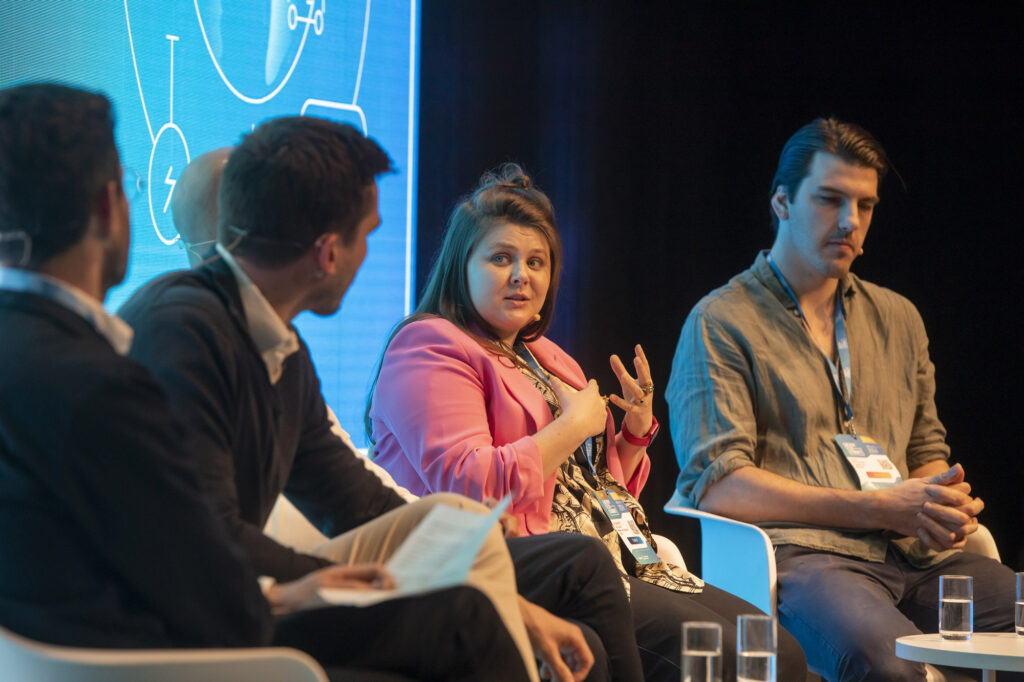
A moment from panel session with Elizabeth Gilligan, CEO at Material Evolution, discussing climate tech investments at ETS2024.
The overlooked opportunities
Strikovsky asked each panelist which innovation deserves more attention. McCleave pointed to operations and maintenance for large renewables. Wind turbine technicians are among the fastest-growing jobs in the developed world, he noted, and OEMs face a huge service backlog. In his view, innovation in monitoring and repairs will be essential if wind and solar are to stay sustainable.
Gilligan focused on building materials. “How we build the world has to be how we decarbonize it,” she said. Software has a role, but “VCs need to be putting their money where their mouth is in terms of investing in hardtech.”
Houssou, whose firm grew out of a community of hardware founders, highlighted nuclear energy. Despite its reputation, “it’s actually very safe,” he said, and there is plenty of innovation still to come. HCVC has backed a fusion company in France and Transmutex, a Swiss company working on the transmutation of nuclear waste.
Eisenberg chose policy innovation. Policies such as the European Green Deal and the US Inflation Reduction Act act as “experimentation labs,” and much of the difference between regions comes down to policy. For that reason, Kiko Ventures stays close to policymakers.
Can generalist VCs succeed in energy?
Many generalist funds are now piling into energy tech. Can they replicate their software success in such a complex industry?
Houssou is skeptical. Many generalists say they love climate, he said, but quickly back away from hardware. Even specialists struggle with one key question: is a company truly venture-fundable? Capital intensity is fine early on, while a company builds its IP. The problem arises when a company must raise hundreds of millions without a clear path to billions in revenue. Some of those projects have huge impact, but may not suit venture capital.
What “growth” really means
McCleave argued that growth investing covers a very wide range. It can mean a modest investment in a profitable bootstrapped company or a huge bet on a moonshot with negative gross margins.
Valuations reflect that. Climate software companies with proven unit economics command very high prices because demand for them is strong. Ironically, profitable bootstrapped companies are often valued lower than VC-backed peers, since early investors need high marks to follow the power law.
Valuations haven’t returned to 2021 levels, and growth investors are more disciplined. Above all, McCleave urged founders to understand how each investor builds its portfolio – and to choose the right type of investor for their business.
A founder’s view on fundraising
Material Evolution makes cement using alkali fusion, a process that doesn’t require heat and cuts emissions by up to 85%, according to the company. Gilligan believes there won’t be one single material that saves the world. Instead, success will come from many feedstocks and a combination of hardware and software, at industrial scale.
She was candid about investors. In her view, “there is limited value VCs can bring to early stage companies.” They are good at pattern recognition and introductions, but founders and technology ultimately drive success.
Fundraising involved more due diligence than before, yet Material Evolution still raised more money. It helped that the company had signed offtake contracts before earning revenue, which matters when a first plant requires millions in capex. Above all, founders and investors need to be “really mission aligned,” she said, and that takes time. Material Evolution has since launched a pilot with CRH and Tarmac for its ultra-low carbon cement.
Is the venture model right for climate tech investors?
Eisenberg explained why hard tech needs different funding. First, these companies take longer to mature, which strains the standard ten-year fund life. Second, the so-called valley of death hits when a company needs to finance its first-of-a-kind plant, which suits neither early-stage nor growth investors.
Kiko Ventures addresses both issues with an evergreen model backed by a listed balance sheet. As a result, it can be more patient. By investing across many stages, it also reduces the information gaps that arise when a company passes from one investor to the next.
Houssou defended the traditional model. Raising money from LPs without a clear return timeline would be hard, he joked. Moreover, PitchBook data suggests deep tech companies don’t take much longer to exit than other startups, although they need somewhat more capital. HCVC has also achieved early exits by selling IP-rich companies to corporates with existing distribution.
So which should founders prefer? Houssou’s answer was simple: “which fund do you like the most who do you want to work with.” An evergreen structure is just one of several factors to weigh.
Do founders need specialist investors?
Many large growth funds now target climate. Does that require specialist knowledge? McCleave said it depends. Investing heavily in a pre-product technology demands deep expertise. By contrast, assessing a company with product-market fit and revenue is easier for generalists, since “growth investors like to put a ruler on a page.”
He also warned about the downside of the wrong investors. “I’ve seen VCs be very value destructive,” he said, especially software-only investors on hardware boards who push for growth before unit economics are proven. In those cases, companies can go bankrupt. Climate has many businesses that share similar patterns, so specialist experience can help.
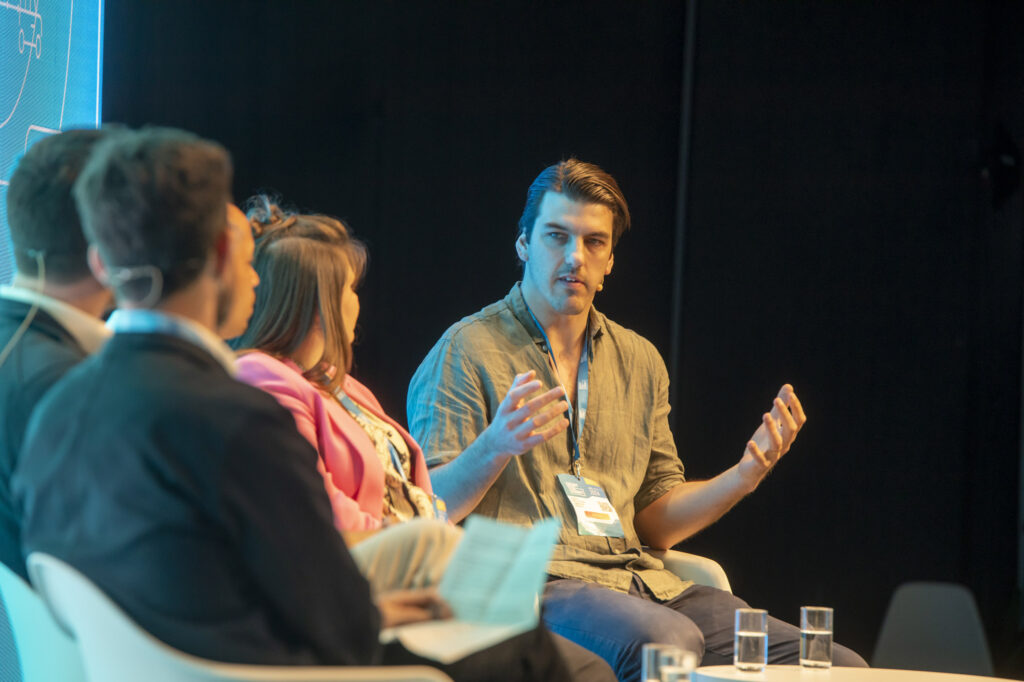
Nigel McCleave, Partner at Lightrock, delivering expert insights on VC and startup cooperation in climate tech sector at Energy Tech Summit 2024.
Is climate a hardware problem?
Finally, Strikovsky asked whether climate is fundamentally a hardware problem. Gilligan didn’t hesitate. “I curse myself for starting a hardware business sometimes,” she admitted. Still, “I don’t understand how we get to where we need to be without it being a hardware problem.”
Eisenberg largely agreed: climate is “to a large extent an atom and not a bit problem.” Much of what’s needed already exists and must be rolled out, which requires both hardware and software, as well as business models that make deployment work.
McCleave pointed to companies such as Nvidia, Tesla and Apple. Hardware businesses scale differently, but “they don’t need to be smaller long term.” With the right founders and investors, they can become very large companies.
Takeaway
Venture capital is a powerful tool for climate innovation, but it isn’t a perfect fit for every company. Hardware-heavy businesses need investors who understand their timelines, capital needs and growth patterns.
For founders, the message is clear: choose investors who share your mission and understand your business model. For climate tech investors, it is time to back more hardware – because that is where much of the decarbonization challenge lies.
Secure your pass
Want to meet climate tech investors and founders face to face? Join us at Energy Tech Summit Europe 2027, the 8th edition, on 7–8 April in Bilbao, Spain.
Passes cost €1,399 until 30 November, then €1,599 from 1 December, €1,799 from 1 February 2027 and €1,999 from 1 March 2027.
Founders can join with the Founder’s Pass for €699. Use code ETS100 for €100 off.