

Investors, data providers and a ratings agency explained why carbon and nature markets will only scale if measurement, integrity and regulation catch up.
Carbon has a price, and nature may be next. At Energy Tech Summit, a panel explored how carbon credits and biodiversity credits could become the currencies of a net-zero economy – and what it will take to make those markets credible.
Michelle Capiod, Co-Founding Partner at Blume Equity, moderated the discussion. She was joined by Alexander Domin, Partner and Co-Head of Impact Ventures at Trill Impact, Ronan Carr, Lead Analytical Officer at BeZero Carbon, Dimple Patel, CEO of NatureMetrics, and Kristian Rönn, CEO and Co-Founder of Normative.
Why carbon markets still matter
The panel covered the full spectrum, from carbon accounting and ratings to biodiversity data and impact investing. Capiod opened with a stark reminder: the world is not on track for its net-zero goals.
Carr was clear that cutting emissions comes first. Still, “carbon markets do have a role to play,” he argued. By 2050, the world could still face around 10 gigatons of emissions that are hard to abate, and the infrastructure to remove them has to be built now.
Buying carbon credits also puts a price on emissions and embeds that cost in a company’s P&L. Moreover, it channels finance to the Global South, to nature conservation and to new technologies. In Carr’s words, “it’s not the most important thing maybe but I think it’s got a key role to play.”
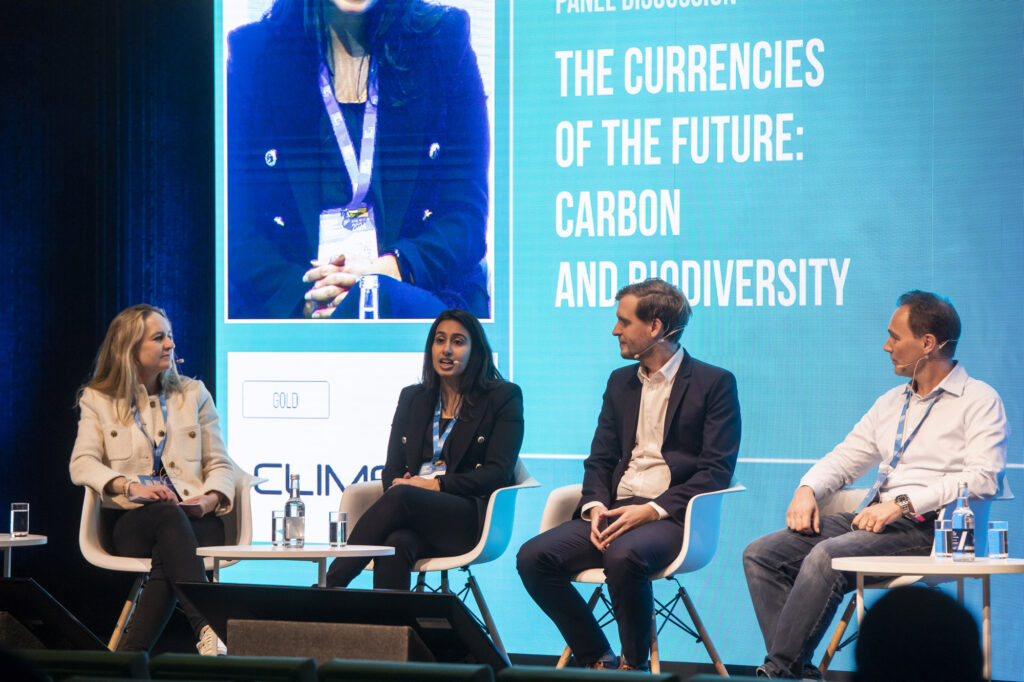
Michelle Capiod, Co-Founding Partner at Blume Equity, moderated the discussion. She was joined by Alexander Domin, Partner and Co-Head of Impact Ventures at Trill Impact, Ronan Carr, Lead Analytical Officer at BeZero Carbon, Dimple Patel, CEO of NatureMetrics, and Kristian Rönn, CEO and Co-Founder of Normative.
You can’t manage what you don’t measure
Rönn approached the topic from carbon accounting. “In order to manage your emissions you first need to measure them,” he said.
Normative studied 1,000 companies with net-zero commitments. If they and their value chains succeeded, Rönn said, around 80% of global emissions would be cut. Yet “every single company on the planet are failing with their net zero targets right now,” mainly because they lack transparency across their supply chains.
That is why Normative focuses on value chain data. Buyers need to see where emissions occur, whether in electricity, vehicle fleets or agriculture, to decide what to invest in.
Domin added an investor’s view. “We are an impact investor but we’re still driven by returns,” he said. After 15 years in the space, he has watched emissions keep rising year after year. As a result, Trill Impact is also betting on solutions that draw carbon out of the atmosphere.
Biodiversity: the missing half of climate action
Patel argued that biodiversity can’t be an afterthought. Regulation such as the TNFD framework has brought it onto the agenda. Indeed, “you can’t meet your net zero targets without considering biodiversity,” she said.
The financing gap for restoring nature is enormous, at around $700 billion a year. Yet the basic questions remain hard: “how do you measure one unit of biodiversity how do you value it?” For Patel, companies must first measure and account for their nature impact before acting on it. Biodiversity credits are only one tool within that.
Rönn strongly agreed. “I don’t care about carbon emissions and global warming on Venus,” he said. What matters are the consequences – for biodiversity, human health and global stability.
How carbon markets are converging
Capiod then turned to market structure: avoidance versus removal, nature-based versus engineered, voluntary versus compliance. Carr sees those lines breaking down.
The voluntary market went through a wobble in 2023. Even so, many companies buy credits because of public commitments, so their purchases are only partly voluntary. Meanwhile, governments are folding carbon credits into regulated schemes. Singapore, for example, lets companies use international credits to cover part of their carbon tax. Countries are also trading credits with each other under the Paris Agreement.
If regulated demand arrives quickly, Carr believes it could outstrip today’s supply of credits. That convergence could eventually push prices closer to compliance markets.
Insetting and the case for nature-based solutions
Domin is focused on insetting – reducing scope 3 emissions within a company’s own supply chain, rather than buying unrelated offsets. For food companies, that often means regenerative agriculture.
The benefits go well beyond carbon. Regenerative farming stores carbon, increases biodiversity and improves water retention. It also reduces the need for fertilizers and pesticides.
One due diligence call stood out for him. A large European bakery chain told Domin that degraded soils had lowered protein content in its grain. Consequently, its croissants were no longer rising properly – a reminder that nature loss hits business directly.
Building biodiversity credits on solid foundations
Patel sees biodiversity credits as an early market that can learn from carbon’s mistakes, particularly around integrity and measurement. Robust MRV is essential, since biodiversity is far more complex than carbon.
The Paris Agreement details carbon market mechanisms closely, while the Global Biodiversity Framework leaves governance largely open. That makes it a chance to build the right structures early. However, “given the finite nature of biodiversity we don’t have a lot of time to get it wrong.”
Should carbon and biodiversity be bundled? Carr noted that buyers already care about co-benefits. A diverse natural reforestation project is better than a monoculture plantation, and it is more resilient over time.
Rönn pointed out that life cycle assessment already links carbon to biodiversity and human health through conversion factors. However, those models mostly stay within academia. In his view, bringing them into the market could consolidate the approach.
Restoring trust in carbon markets
Carbon markets took a heavy credibility hit in 2023. For Rönn, that was predictable. “I’m a big fan of markets,” he said, but wherever there is money to be made from gaming assumptions, someone will try.
Rigorous accounting therefore needs real supply chain data with an audit trail, not spend-based estimates. Offsetting and insetting are harder, because they compare against a scenario that never happened. That is why he values frameworks like the Oxford Principles: “something like the Oxford principles are so freaking good.”
Carr explained that this is why BeZero exists. Every carbon credit carries uncertainty, so “it’s a risk asset we need to accept that.” BeZero’s ratings assess how likely a credit is to deliver a ton of carbon, from AAA down to D.
That changes incentives. Historically, the market “rewarded volume” rather than quality. According to Carr, each notch on BeZero’s rating scale was worth 25–30% in price at the time, with credits rated above BBB trading at 100–200% premiums. As a result, quality is starting to be priced.
Ratings agencies don’t always agree, Carr admitted, but they align on around two-thirds of projects. He expects more convergence as the market matures.
Getting the baseline right for nature
Patel stressed that biodiversity’s biggest weakness today is the baseline. Many companies and projects set poor, patchy baselines, which makes it hard to track change over time.
Equivalence matters too. In her view, “if you’re having a nature impact in one ecosystem you shouldn’t really be offsetting that in a completely different ecosystem.” Otherwise, some regions could become concrete jungles while restoration concentrates elsewhere.
Regulation as a catalyst
All panelists agreed that regulation drives adoption. For Rönn, the CSRD made a huge difference to Normative’s growth, although it only requires measurement, not reduction. He hoped due diligence rules would add transition planning. More broadly, “we need to have a carbon tax as well,” so that companies investing in decarbonization aren’t left at a disadvantage.
Since then, the EU’s Omnibus package has narrowed both the CSRD and CSDDD and removed the CSDDD’s climate transition plan obligation.
Carr welcomed regulators’ growing interest in carbon markets as a sign of maturity. BeZero has built its business on principles similar to regulated credit rating agencies, expecting oversight sooner or later.
Domin compared it to solar, where feed-in tariffs drove costs down. In his view, the scrutiny of 2023 was ultimately healthy, because it weeded out projects that did little for the environment.
For Patel, regulation such as the CSRD and TNFD changed corporate mindsets on biodiversity almost overnight. Without that shift, she doubts the space would have progressed as far.
What’s holding back scale
On the biodiversity side, Patel said credits are still in the methodology phase. Even “nature positive,” she noted, “is not even defined.” Indeed, “every layer that you peel back there’s a new definition challenge.” Once standards exist, though, biodiversity markets can borrow much of carbon’s infrastructure.
For Domin, the main bottleneck is data. Satellites and AI are making nature-based solutions easier to verify, which should unlock more investment.
Looking five years ahead
Asked about the most exciting innovations, Carr pointed to MRV tools, from geospatial data to soil probes and eDNA, plus insurance and portfolio products. Domin highlighted new business models emerging as banks, insurers and governments enter the market.
Rönn is excited by standardized data exchange, such as the EU’s digital product passport. Patel looks forward to robust MRV that turns ecological complexity into a single, trusted metric.
Their predictions followed suit. Patel hopes to see ratings for biodiversity credits within five years, a sign of real market maturity. Rönn wants carbon and biodiversity data to become as comparable as financial statements, and Domin expects legislation to give investors clearer frameworks. Finally, Carr hopes stronger markets will push up carbon prices – because “that’s the whole point of having a carbon market.”
Takeaway
Carbon and biodiversity are on their way to becoming real economic currencies. However, both markets live or die by trust.
Robust data, independent ratings, clear baselines and proportionate regulation will decide whether carbon credits and biodiversity credits deliver real impact – or repeat the mistakes of the past.
Secure your pass
Want to meet the investors and founders building the markets of the future? Join us at Energy Tech Summit Europe 2027, the 8th edition, on 7–8 April in Bilbao, Spain.
Passes cost €1,399 until 30 November, then €1,599 from 1 December, €1,799 from 1 February 2027 and €1,999 from 1 March 2027.
Founders can join with the Founder’s Pass for €699. Use code ETS100 for €100 off.