

Corinex and E.ON DynamiX showed how broadband over powerline can turn crowded local networks into a source of new grid capacity.
Grid flexibility is usually discussed at high and medium voltage. Yet on stage at Energy Tech Summit in Bilbao, two speakers argued that the real bottleneck sits much closer to home.
Peter Sobotka, CEO and Founder of Corinex, and Denver Rumney, Senior Consultant at E.ON DynamiX, focused on the low-voltage grid. After all, that is where electric vehicles, heat pumps and rooftop solar plug in – and where the strain builds up first.
Why grid flexibility has to start at low voltage
Sobotka opened with the scale of the challenge. Tens of millions of electric vehicles are heading for the grid, alongside a growing fleet of distributed energy resources. Flexibility keeps the system in balance, but most solutions work at high or medium voltage.
Corinex, a Vancouver-based company, targets the layer below. As Sobotka put it, “the key part of the problem is happening on the low voltage.” He added that “we are the first company, according to my knowledge, which is creating that balance on the low voltage.”
In his view, the cost of inaction is already visible. Investors have put billions into low-carbon products that, in many countries, sit idle because the grid cannot take them. Consequently, he urged the audience to ask what else the industry might be missing.

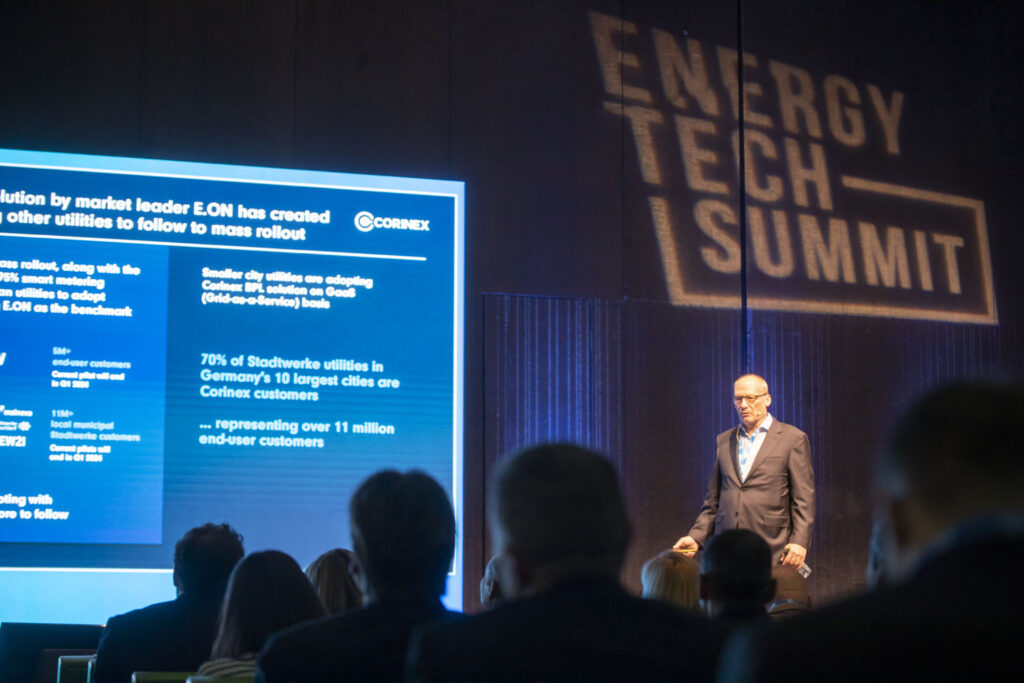
Peter Sobotka, CEO and Founder of Corinex
Location: the grid’s missing communication layer
There is no shortage of communication technologies, from 5G and LTE to fiber. However, Sobotka argued that “what we are missing is location.” Broadband over powerline (BPL) runs directly on the electricity network, so it adds a data layer that maps exactly onto the grid.
He then sketched the numbers behind the idea. Across four low-carbon technologies, including electric vehicles, storage and photovoltaics, a saturated market could mean around 100 million connections at low voltage.
Sending every one of those signals to the cloud and back is too slow when the grid needs a response within seconds. For that reason, every Corinex BPL chip has edge computing built in. The company, in turn, focuses on the operating system that runs on top.
From German rollouts to Spain
Germany was the first major market for Corinex’s low-voltage solution. At the time of the session, E.ON was in the second phase of a rollout across four German DSOs. Around 10 German utilities, representing roughly 11 million customers, were also working with Corinex. Commercialization had also begun in Spain, including with Iberdrola in the Basque Country.
Since then, the company has kept growing. In April 2025, Corinex raised $30 million to scale its deployments in Germany, Spain and the UK.
At its core, the solution collects voltage data and reports imbalances in the grid. These imbalances often come from PV systems and EV chargers connected to a single phase. Without enough voltage, the result can be brownouts.
Before handing over, Sobotka drew a firm line. Smart metering and grid flexibility are different things, he stressed, and Corinex is a flexibility company. Its technology can also be retrofitted to existing systems.
A real-world problem in Scotland
Rumney then explained what E.ON built on top of that communication layer. “Like any good solution, it requires a real world problem,” he said.
That problem surfaced in Scotland, where changing building regulations had real consequences for new-build developers. Photovoltaic arrays, EV chargers and heat pumps were becoming standard, and they were already causing trouble for developers.
Together with Corinex, Rumney and his colleagues took on the challenge. SP Energy Networks (SPEN), the local distribution network operator, was also closely involved. Each development had to connect to SPEN’s 11kV line without exceeding its capacity.
In other words, the team needed real-time flexibility at the substation. SPEN insisted on something “secure, responsive and resilient.” Given those demands, Rumney said BPL was the only option that fit.
Peter Sobotka, CEO and Founder of Corinex
How DynamiX works, from substation to home
The system starts at the secondary substation. There, a DynamiX concentrator from Corinex sits next to the existing meter and reads real-time power flows. Rumney called it the heart of the system.
From the substation, the concentrator builds a BPL network to every home in the development. Inside each home, a DynamiX control module relays commands to the low-carbon technologies over Ethernet or an optional ONT module.
Crucially, Rumney echoed Sobotka’s point: “this is not smart metering.” A separate smart meter still serves each UK home, while the control module exists purely for flexibility.
In practice, the logic is simple. On a sunny summer day with high solar yield but low collective self-consumption, the concentrator spots the pressure at the substation. It then tells exporting PV arrays to turn down generation. Similarly, it manages heat pumps and EV chargers against the import limit.
As a result, every party gains. Developers can build, the network operator can approve the connections, and “the homeowners are happy because they get a shiny new house with all the shiny new technologies.”
Turning homes into a local flexibility resource
The bigger opportunity emerged almost by accident. “We didn’t realize it at the time,” Rumney admitted. Still, the team had built an architecture that protects grid integrity from low voltage up to 11kV.
Once every home behind a secondary substation is connected, those homes form a flexible resource. In the UK, that flexibility can feed several revenue pools: the wholesale market, the balancing market and, increasingly, DSO flexibility markets. Meanwhile, the UK’s G100 standard gives the approach a route to scale.
For Rumney, “acting as this local flexibility aggregator is an interesting new role.” Controlling every low-carbon device behind one substation lets an aggregator flex those assets for the energy system, the network operator and residents alike.
Why DSO markets need low-voltage flexibility
Network operators have traditionally looked for flexibility at high and medium voltage. However, Rumney argued that “the DNOs cannot get enough flexibility out of higher voltage connections.”
Recent procurement data shows the size of that gap. SP Electricity North West reported tendering for 1,588MW of flexibility in the 2025/26 regulatory year. By contrast, its two main tender rounds produced contracts for around 8MW.
That shortfall is exactly where low voltage comes in. “Low voltage has an incredible value there,” Rumney said. By flexing low-voltage assets, a local aggregator can supply the DNO and send revenue back to consumers. In his words, “that’s a good story for everybody.”
Takeaway
The session made a clear case: the next gains in grid capacity may come from the bottom of the network, not the top. Corinex supplies the communication layer and edge intelligence. E.ON DynamiX, in turn, turns it into a working flexibility service for new homes.
Together, they show how low-voltage visibility can unlock connections today and open new flexibility revenue for consumers and operators alike.
Secure your pass
Want to meet the founders, investors and utilities working on challenges like these? Join us at Energy Tech Summit Europe 2027, the 8th edition, on 7–8 April in Bilbao, Spain.
Passes cost €1,399 until 30 November, then €1,599 from 1 December, €1,799 from 1 February 2027 and €1,999 from 1 March 2027.
Founders can join with the Founder’s Pass for €699. Use code ETS100 for €100 off.