
A corporate that began as an energy tech startup explains how it invests in, incubates and builds with startups – and one founder shares what the partnership looks like from the other side.
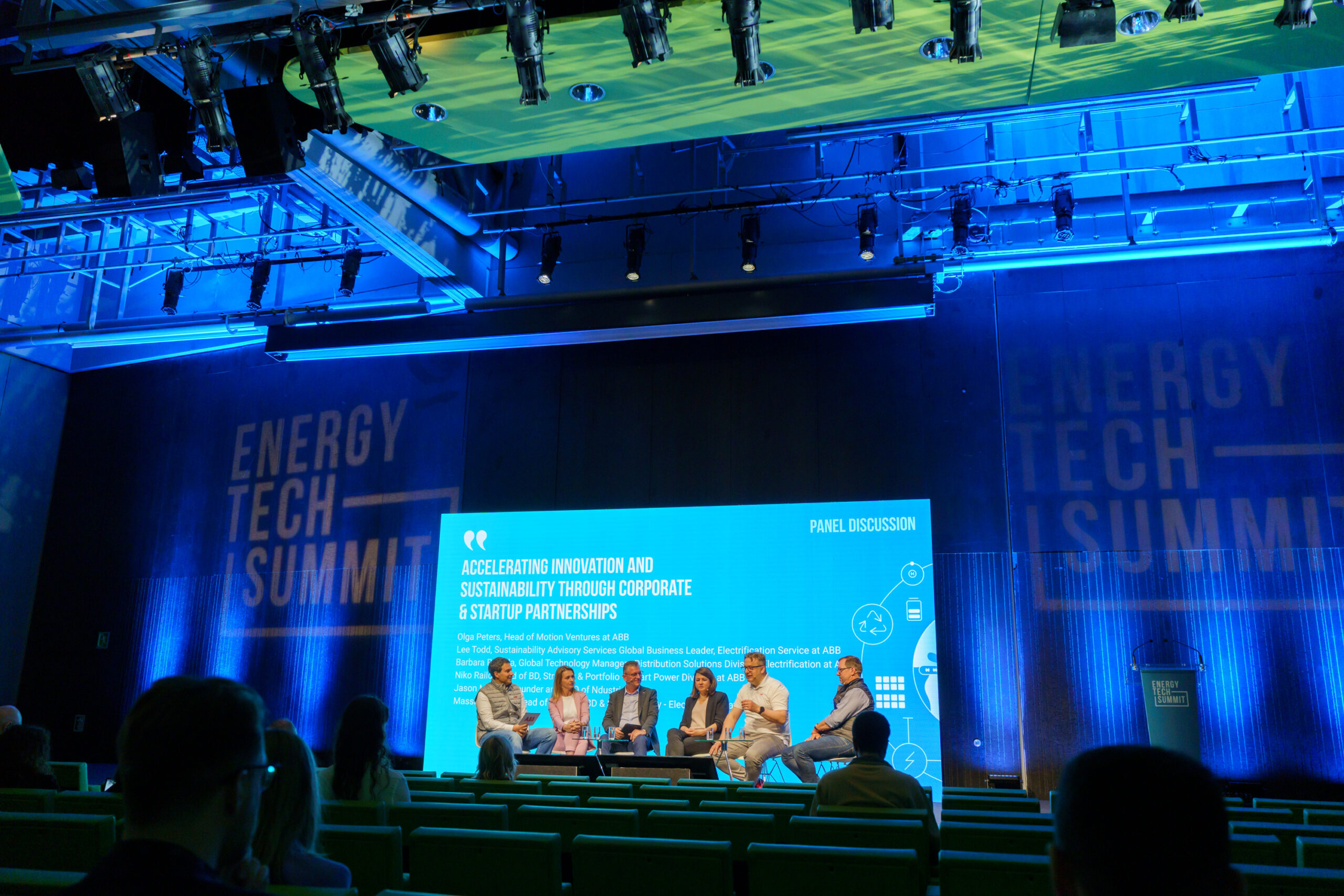
Can a large corporate move at startup speed? At Energy Tech Summit, a panel explored how corporate startup partnerships accelerate digitalization, AI and energy efficiency. Massimo Muzzi, Head of Strategy, BD & Sustainability – Electrification at ABB, moderated. He was joined by ABB’s Olga Peters, Head of Motion Ventures, Lee Todd, Sustainability Advisory Services Global Business Leader, Barbara Panella, Global Technology Manager – Distribution Solutions, and Niko Railo, Head of BD, Strategy & Portfolio – Smart Power. Jason Massey, Founder and CEO at Ndustrial, completed the panel.
A corporate with startup roots
ABB works with startups in many ways: as a collaborator, co-developer, incubator, customer and investor. The company has invested around half a billion dollars in startups over more than a decade. For Muzzi, the reason is simple. The energy transition “is a too large of a challenge for a corporate to solve alone”.
It also runs in the company’s DNA. Roughly 140 years ago, engineer Charles Brown and salesman Walter Boveri – the two Bs in ABB – left their employer after it rejected their idea for distributing high voltage more efficiently. With no VCs or angels to turn to, they faced rejection after rejection. Eventually, Boveri’s father-in-law backed the venture. Their product proved so successful that, according to Muzzi, they later bought the very company they had left.
How decentralized ventures create value
Peters explained the ABB Way, a model that makes each division accountable for its own operations, resources and investments. Venture teams are decentralized too, so they sit close to the businesses that know what customers need. In practice, the ventures team asks each division about capability gaps, then finds startups to fill them.
That approach goes far beyond financial returns. “It’s actually much more for building value together,” Peters said. Startups gain access to ABB’s channels, labs and expertise, and joint products reach the market at greater scale. Because investments come from each division’s balance sheet, accountability and patience both increase. “So it’s really a win-win.”
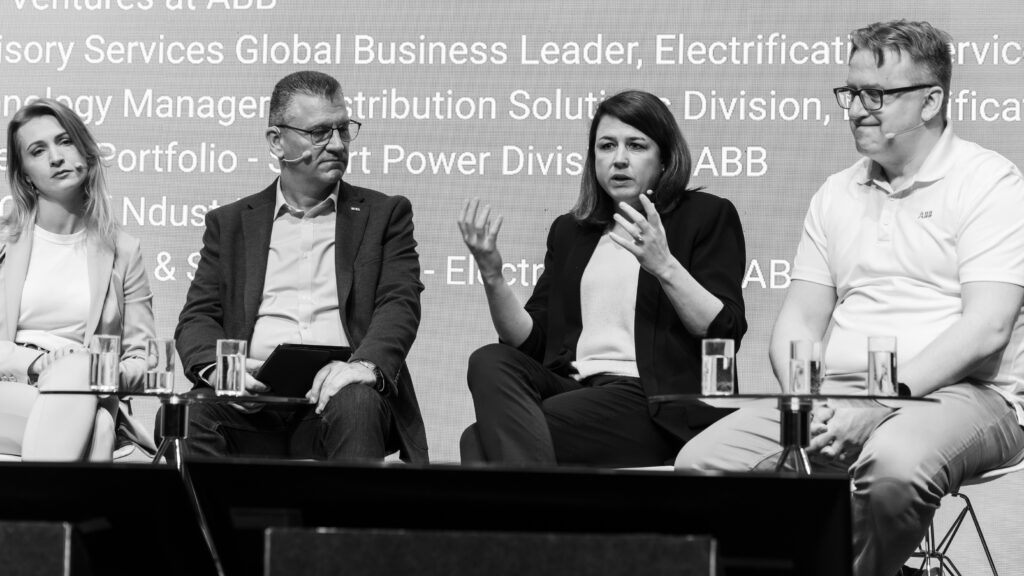
A panel featuring: Olga Peters, Head of Motion Ventures at ABB; Lee Todd, Sustainability Advisory Services Global Business Leader, Electrification Service at ABB; Barbara Panella, Global Technology Manager – Distribution Solutions Division, Electrification at ABB; Niko Railo, Head of BD, Strategy & Portfolio – Smart Power Division at ABB; Jason Massey, Founder and CEO at Ndustrial; Moderator: Massimo Muzzi, Head of Strategy, BD &Sustainability – Electrification at ABB
Build, buy or partner
Todd described how ABB’s advisory services business began as an internal incubator. It rests on clear, agnostic advice across reliability, safety, cybersecurity, and energy and carbon. As he put it, “we do well as a business when we do good as a business”.
Moving customers from reactive to proactive and interactive operations requires skills ABB didn’t fully have. So the team asked a pragmatic question: make it, buy it or partner for it? In the end, the answer was all three. The incubator gave the team a sandbox to act entrepreneurially. Moves included an investment in GridBeyond, whose AI optimizes energy decisions, a stake in a cybersecurity assessment startup, the acquisition of SEAM Group and an investment in Ndustrial.
Why data comes first in corporate startup partnerships
Massey joked that “the fact that Lee can pitch my company better than I can is a good indication that the partnership is working”. Ndustrial focuses on energy intensity per unit of output. That is hard to measure, because in industrial manufacturing “every facility is a unique snowflake”. Getting there means combining warehouse systems, refrigeration controls, meters and sensors. After all, “AI is only as good as the data that you provide it”.
Notably, ABB put three of its own factories forward for testing before any commercial agreement. At one US site, new metering exposed air compressors running unnecessarily on weekends and raised questions about HVAC loads. Just as importantly, the pilots revealed practical scaling issues, such as how IoT devices connect on site.
For Massey, scale is the biggest benefit. “I think it’s naive any startup especially in the energy and clean tech space to believe that they’re going to be able to do this alone,” he said. ABB opens new verticals, such as food and beverage, and new markets, including India.
Digitalizing the grid – and the engineering behind it
Panella outlined the trends driving ABB’s distribution business. Demand keeps rising as data centers, buildings, transport and industry electrify. Meanwhile, generation is decentralizing as renewables grow. The grid must stay reliable while becoming more flexible, which, in her view, is only possible through digitalization.
That is where startups come in. One example is a Chalmers University spin-off whose AI-based fault prediction ABB is integrating into its protection and control products. Such tools help utilities and industrial customers avoid outages and plan maintenance. Panella always brings customers into these projects, creating a triangle of ABB, startup and customer. Another priority is automating product engineering and configuration, so new products reach the market faster.
Software, hardware and new ways of manufacturing
Railo shared examples from ABB’s Smart Power division. Edgecom Energy, a Toronto-based startup and former ABB startup challenge winner, uses AI to reduce peak power for industrial and commercial customers and is integrating with ABB’s IoT data. ABB also acquired Sensorfact, whose self-installed sensors help small and medium manufacturers cut energy waste, while keeping it running as a separate company. On the hardware side, DG Matrix, a US startup backed by ABB from seed stage, is developing a power router that could become the core of future power distribution networks.
Peters added two examples from the Motion business. Molg is helping ABB rethink how drives are made, using robotic microfactories that support circularity and local production. Uptime AI, meanwhile, uses advanced algorithms to predict failures in rotating machinery. As Muzzi noted, corporates often partner to improve products, but improving manufacturing processes can deliver just as much impact.
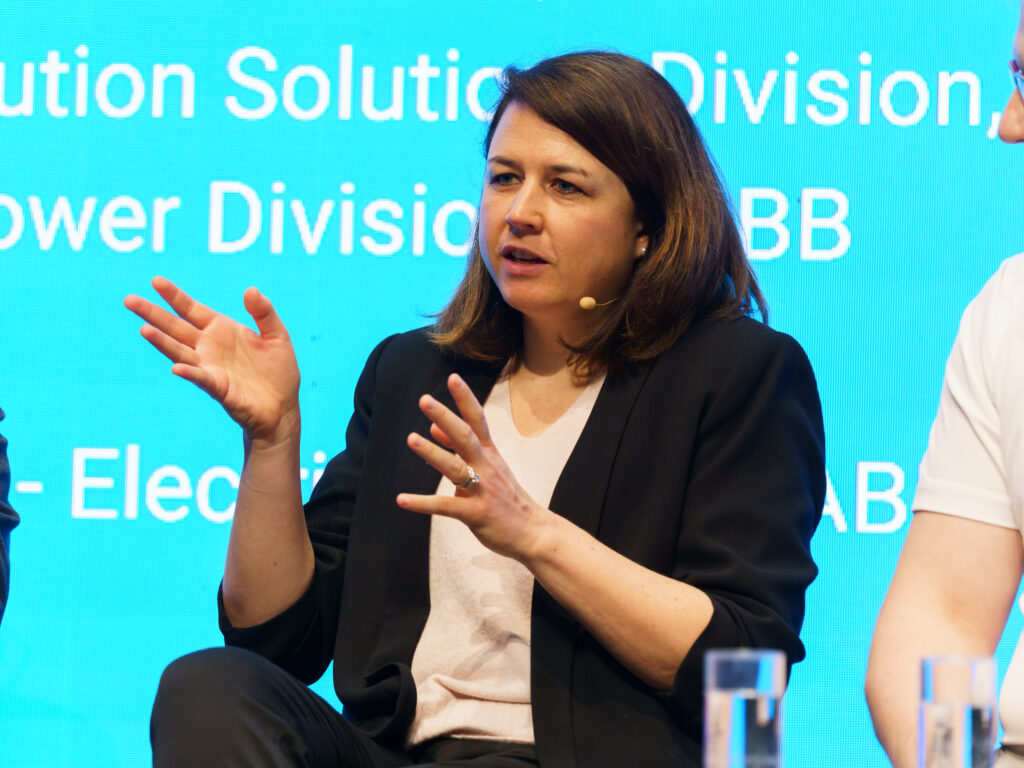
Barbara Panella, Global Technology Manager – Distribution Solutions Division, Electrification at ABB
Advice for founders
Massey’s message to startups was clear: “Don’t be scared.” As a former Silicon Valley VC, he used to warn founders away from corporate venture arms. “They were too slow. They wanted weird exclusivity.” However, traditional VC has changed, with longer gestation periods and pressure for liquidity. In Ndustrial’s case, ABB moved fastest among potential investors, drove its Series B and agreed fair, balanced commercial terms.
His key advice applies to any corporate partner: “make sure they’ve got a vision for an ecosystem that fits with how you want to grow up as a company”. For instance, ABB brought GridBeyond to the table, helping Ndustrial build broader solutions for warehouses facing fleet electrification.
ABB’s panelists shared lessons too. Todd highlighted the speed, agility and innovation startups bring to joint solutions. Panella stressed complementary skills, a shared go-to-market plan and the need to fail fast: “we want to succeed but if we don’t succeed we want to fail fast”. Finally, Peters praised startups’ perseverance, proving that “everything is impossible until it’s done”.
Takeaway
Successful corporate startup partnerships go well beyond writing checks. They combine startup speed with corporate scale, real test sites, shared data and a clear ecosystem vision. For founders, the right corporate partner can open markets and customers that would take years to reach alone. For corporates, startups offer the agility the energy transition demands.
Secure your pass
Want to meet the corporates and startups building partnerships for the energy transition? Join founders, investors and corporates at Energy Tech Summit Europe 2027 in Bilbao, April 7–8. Founder’s Pass: €699.