
Sixteen gigawatts slated for this year, five actually under construction. What companies are doing to get to the front of the queue.
Mark Taylor, Co-Founder and CPO of Sightline Climate, opened the inaugural Compute Summit Stage with a framework rather than a forecast. His talk described how he and his company see the world, and he invited the room to test it against their own view through the day’s discussions.
The starting premise was historical. Every global crisis reshapes our relationship with energy – and the current one is no exception.
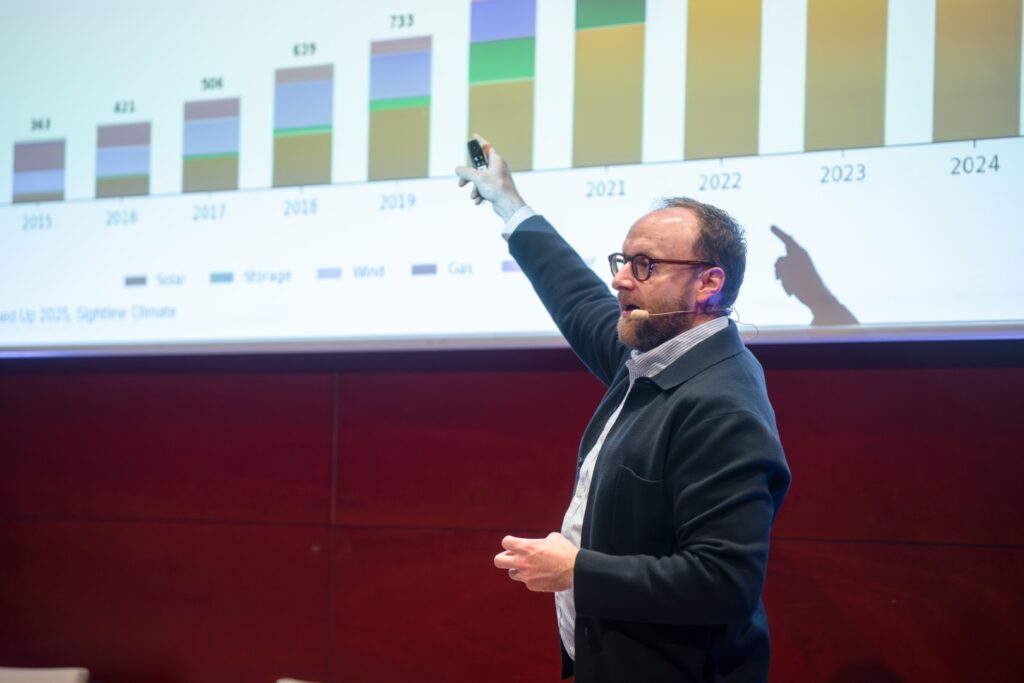
Mark Taylor, Co-Founder and CPO of Sightline Climate speaking at Compute Stage during Energy Tech Summit 2026
What energy crises have produced before
Taylor traced the pattern back through decades. The 1973 oil embargo pushed France toward energy independence, producing the Messmer plan that put 46 gigawatts of nuclear online in just under a decade. To a much smaller degree, it also produced the first geothermal boom in the US, adding around 2 gigawatts of capacity in the late 1970s and early 1980s.
That pattern is repeating now. The difference lies in what the system can actually deliver in response.
The triple threat
Taylor described three pressures arriving together.
The first is unpredictability. He showed a run of contradictory headlines – directives to buy more coal electricity, halted coal plant shutdowns, blockades stalling hundreds of wind and solar projects nationwide, then a reversal reinstating offshore wind projects the previous day. The result is a market where nobody can be confident what the rules will be.
The second is demand, and the room answered before he did: AI.
The third is supply disruption, currently working through the system on a delay. He showed a map of oil cargoes at sea alongside their expected arrival times, which effectively maps when shortages hit each market. Shortages were already being reported in Southeast Asia and elsewhere.
Consequently, the industry is entering what he called a security phase. Energy security sits at the base of the hierarchy of needs, and the market is back at square one, with everyone simply trying to get what they need.
Why building more is harder than it was
Historically the response to crisis was to build – as with French nuclear and US geothermal. Broken structures now make that considerably harder.
Taylor showed the US interconnection queue against total installed capacity. Putting a project online in 2014 was a substantially easier proposition than doing so in 2024, let alone today.
Permitting and procurement then extend lead times further, and his data center chart made that concrete. It was not a forecast but a project pipeline: what developers themselves expect to bring online.
The rest are held up in power procurement, permitting and similar obstacles. So 2026 capacity slips into 2027, then 2028, and the delay compounds.
Importantly, Taylor stressed this is not a partisan story. He cited a US administration halting LNG exports and blocking a major pipeline, and a German chancellor concluding that reversing the nuclear phase-out is now too difficult because the plants have been demolished. The structural difficulties predate any single government.
Energy hoarding, and the new gold rush
What that permitting and procurement whiplash produces, in Taylor’s reading, is an anxious state – and anxious actors hoard.
People stop cooperating and start securing supply for themselves. Procurement gives way to strategic positioning. He called it the new gold rush, noting with some amusement that this has been his social media handle since 2010.
That plays out at country level and at company level. He focused on the latter, walking through three strategies companies are using to get power before someone else does.
Strategy one: just use gas
The first strategy is hyperscalers deciding to build gas rather than wait. Taylor showed how much announced capacity is grid-connected, how much is dedicated gas, how much is nuclear, and how much remains unclear – then how much new gas has been announced this year alone, which was substantially more.
In Sightline’s view, however, this is a sugar high, and Taylor gave three reasons.
First, emissions, with local jurisdictions beginning to object.
Second, and more structurally, much of this capacity sits behind the meter. Every gas turbine that goes to a hyperscaler off-grid is one that does not go to a utility supplying the rest of the market – a crowding out problem. The consequence is that hyperscalers effectively become utilities themselves, at which point system operators start telling them they must take responsibility for flexibility and reliability, since they have taken the turbines.
Third, equipment lead times are long and lengthening, so the strategy gets harder to execute. The window for doing it at all, he suggested, is closing.
The second strategy was the most detailed, and Taylor was careful to lay out the arithmetic.
A Louisiana utility operates a generation fleet of around 14 gigawatts. For comparison, the city of New Orleans draws roughly 1.1 gigawatts.
A proposal last year would have seen a hyperscaler supplied with about 2.5 gigawatts of dedicated gas, built by the utility and delivered via private transmission line.
Commentary tends to note that such a plan still requires approval from the public utilities commission. That, Taylor argued, is where the strategy lies. The commission’s voting history on these matters has consistently favoured approval, and it fast-tracked the earlier iteration. He treated the outcome as close to a foregone conclusion.
His anecdote made the point better than the data did. His wife previously worked representing public utility commissions. Mentioning the scenario on a walk without naming the state, he was met with an immediate: “Oh, was it Louisiana?”
This window is also closing. Ohio, Michigan, Illinois and Georgia are putting regulations or laws in place to prohibit arrangements that push costs onto the rate base and ultimately the consumer.
Strategy three: buy the platform
The third strategy skips the queue entirely by acquiring companies that are already through it.
Taylor cited a hyperscaler acquiring a power developer for its California and Texas pipeline, then a much larger transaction the previous week: infrastructure investors taking a major independent power producer private.
The target holds roughly 7.6 gigawatts with signed power purchase agreements already safe harbored. Safe harbor means a project has hit the construction milestone required to qualify for tax credits that are now being sunset. So those projects will receive the credits.
The implication for site selection is direct. A data center developer, utility or hyperscaler looking for secure bets on where to build might reasonably look at where that company’s safe harbored projects are under construction.
Beyond that sits a further backlog without PPAs, of which 4.4 gigawatts is already safe harbored, with another three or four expected to qualify before the deadline passes.
Rather than chase projects one at a time through the interconnection queue, in other words, large players are buying their way to the front. Taylor expects more transactions like it, in the US and elsewhere.
Where this leaves the market
Gas is the current strategy, and it may prove a sugar high. Other routes exist to the capacity the market badly wants, and the industry is in a power super cycle.
In the short term, that means genuine difficulty bringing capacity online. Taylor’s read, though, is that the field is open: nobody has an obvious lock on who gets capacity to market fastest.
The evidence is in the deal flow. Two days before the summit, a fuel cell company signed a gigawatt agreement with a major cloud provider – a solution that has existed for 25 years and is only now accelerating. Geothermal is signing deals. So is almost everything else. What decides the winner is who can be fastest and cheapest.
On the data center pipeline specifically, Sightline’s current forecast puts roughly 40% of it as safe, de-risked or otherwise likely to proceed. The remainder depends on getting power to market.
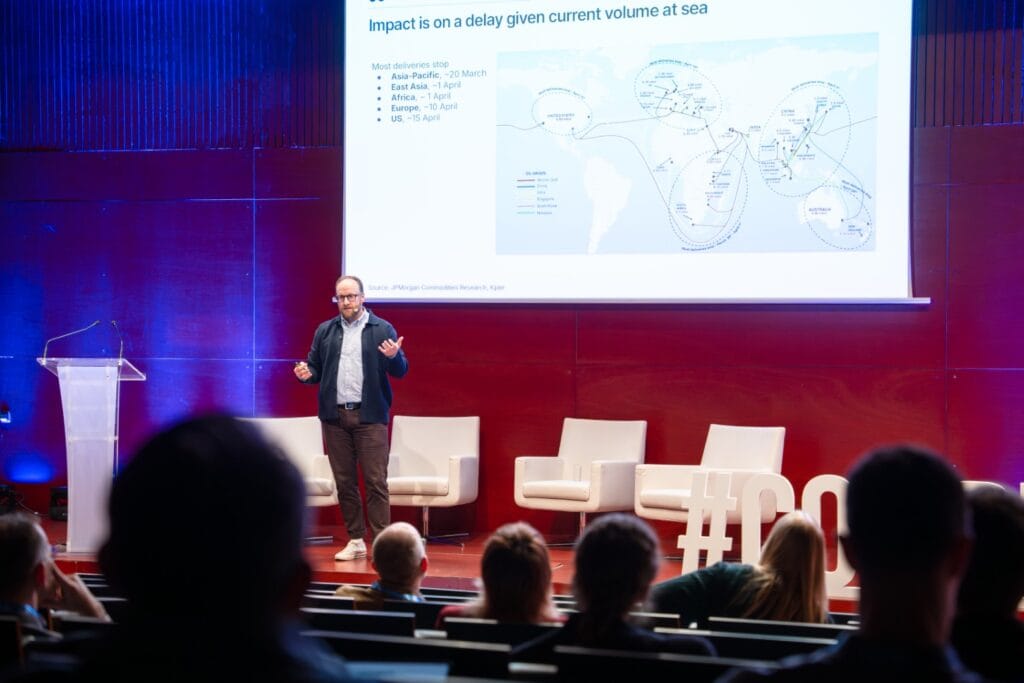
Mark Taylor delivering his keynote at Compute Stage during Energy Tech Summit 2026
Takeaway
Taylor closed on the metaphor he had been building toward all along. In the new gold rush, the winners are the picks and shovels – whoever supplies what the miners need. The gap between announced and delivered data center capacity is not a forecasting error, on this account. It is the visible result of a market where securing power has become adversarial, and where the three dominant strategies for doing so – building gas, capturing regulators, and buying platforms outright – each have a closing window. That is what makes the question of who supplies power, rather than who announces capacity, the one worth watching.
Compute Summit Stage 2027 returns with more conversations like this one.
Find out more at www.energytechsummit.com