
“We’ve seen agentic AI systems appear underwhelmingly, because this isn’t being thought through.” Dell’s CTO on making AI yours.
Marc O’Regan is Chief Technology Officer at Dell Technologies for Europe, the Middle East and Africa, where his role is to examine forward-thinking strategy so the organization does not miss an inflection point. His keynote covered the evolution of compute architecture, models and service delivery – and what each of those means for energy consumption.
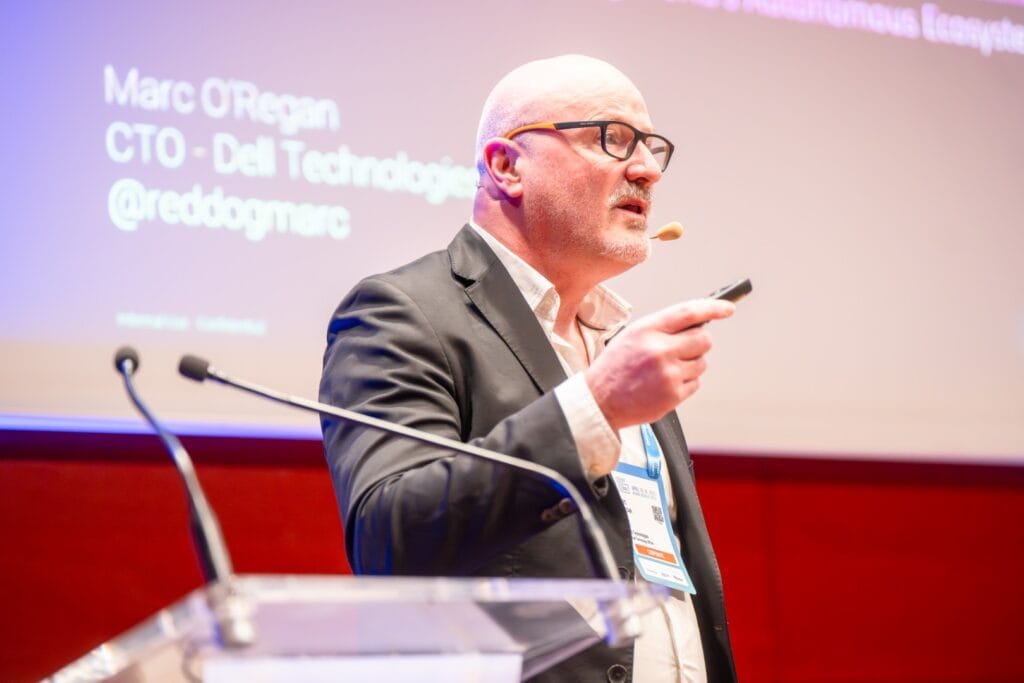
Marc O’Regan, Chief Technology Officer at Dell Technologies delivering his keynote at Energy Tech Summit, Compute Stage
Marc O’Regan is Chief Technology Officer at Dell Technologies for Europe, the Middle East and Africa. His role is to examine forward-thinking strategy, so the organization does not miss an inflection point. His keynote covered compute architecture, models and service delivery. Each of those, in turn, shapes energy consumption.
A correction, and why Dublin happened
O’Regan opened by correcting a point from an earlier panel. The moratorium on data center builds in Dublin has been lifted. Strict rules now govern what is required to build there. Those include modern technology and on-grid access, meaning generators capable of supplying energy back to the grid.
He spoke from direct experience, having worked on major cloud infrastructure builds in Dublin. The problem arose for a simple reason: how much power those data centers drew off the Irish grid. And that was for what we would now consider regular cloud workloads.
Today those same companies, and others including Dell, are building for a different category of service entirely.
Where you put the data center matters
The siting question drew O’Regan’s sharpest example. It came from his own region.
In South Africa, he pointed out, nightly power interruptions occur without any AI infrastructure present. He has experienced them himself while in restaurants there.
So what happens when AI capability arrives in that context? That question requires careful thought. So does the kind of energy built to support it.
Who owns AI?
O’Regan posed a question he considers underexamined. AI is around 70 years old. Yet it exploded into general use only a few years ago. So who owns it?
Not any one company, in his answer — including his own. What matters is that ownership and responsibility run through the entire AI stack.
That stack starts with the layer he called most important: ethics, bias and responsibility. It runs down through compute architecture, and where that architecture is physically placed. It covers where data and the patterns derived from it are exposed. Finally, it reaches how much energy a data engine consumes.
Underneath all of it sits a choice. Do you want a relationship with somebody else’s AI? Or do you want to create a specific relationship with your own?
What Dell knows about water and silicon
Dell operates 27 data centers of varying tiers worldwide. All are for its own use, hosting services including its main website. That gives the company two decades of practical experience with energy.
It also knows why you might not want water near a computer. O’Regan illustrated it with something that had happened minutes earlier. He tried to set his water glass on the sound engineer’s laptop, and the alarm that provoked made the point.
Now scale that fear appropriately. Imagine thousands of tons of water exposed to hundreds of thousands of pieces of silicon.
So while water is genuinely helping, the company is examining alternatives. Those span liquid cooling, direct-to-chip approaches, and free air or fresh air cooling.
The more interesting approach is building compute that operates optimally at higher temperatures. Dell has spent 15 years on this. The result is data centers running at ambient temperatures of 45 to 53 degrees Celsius, held there consistently. That means shutting down the chillers and cooling systems that consume enormous energy. O’Regan called it an inside-out way of handling energy, starting from the compute rather than the building.
The case for and against data centers in space
Dell is involved in design work on space-based data centers. O’Regan was even-handed about them. He can give ten good reasons to consider them, and ten or fifteen reasons not to.
The arguments in favour involve locality and data sovereignty — things that cannot currently be governed on the ground. The arguments against start with space debris damaging the facility. Then comes a specific energy problem. In space, the compute cannot use free air cooling, so the heat you generate is heat you must deal with in a contained environment.
Human in the loop, human on the loop
O’Regan then described the current AI landscape. It spans large language models, small language models, world models, and agentic architectures. In the last of those, agents act autonomously, converse with each other, and take the next step.
Those agents execute against a task, then recommend the next best action. In some cases they execute that too. He called the capability extraordinarily powerful. It can take thinking tasks away from the workforce and lift people to a higher level of consideration.
Importantly, he framed that as humans and machines working together rather than replacement. The shift is from a human in the loop, watching what happens in an ecosystem, to a human on the loop. In the second case, machines make some decisions based on the knowledge they gather.
That distinction sets up his central warning.
Why agentic systems are underwhelming
“We’re seeing underwhelmingly agentic AI systems appear,” O’Regan said. His explanation was blunt: this is not being thought through carefully enough.
Let something like this run unchecked across your ecosystem and you will end up in serious trouble. These systems think for themselves. So they need control and governance, which is what keeps it your AI rather than somebody else’s.
His comparison was with social media, and he was scathing about the failure to learn from it. Society has seen polarization, effects on young people, and algorithms deciding what everyone consumes daily. There has been little or no governance over any of it. Apply that lesson to AI, he argued, and the need for governance multiplies enormously.
Technically, he sees slowing performance improvements and scaling risk from current foundation models. Large language models are powerful. Yet they demand huge compute to deliver that power, which leads to what he called gross misuse of energy.
He also identified a fundamental limitation. Current AI is confined to language, language models and the neural networks driving natural language processing. Those lack the generalization capacity to exist contextually in the real world. Work is happening on that in robotics and elsewhere. Even so, there is considerably more to learn about accuracy and context. These systems, he noted plainly, sometimes tell lies. Sometimes they shut down. Sometimes they give you a number that is simply wrong.
Make the AI yours
O’Regan was careful that none of this amounts to a warning against AI. His prescription is about ownership instead.
Understand what you want to do with AI. Identify the foundation models that make sense for your organization. Pull them behind your firewall and privatize them. Then feed in information contextual to you, your organization and your ecosystem.
Do that, he argued, and the result is a considerably more secure, powerful and sovereign model. It will also be more current than the base model was when published — essentially overnight.
The memory problem, and what fixing it costs
One limitation O’Regan highlighted is memory. Create a relationship with an AI and it remembers you. Then somebody else engages it, and that conversation is forgotten. A continuing conversation may well not survive to the next day.
Work is underway on this through nested learning, which addresses continual memory capacity at the compute layer. If it succeeds, he called it a genuine game changer.
There is a cost, however, and it is the recurring theme of the keynote. Solving memory dramatically increases the computations required. That, in turn, increases the energy needed to feed the compute.
He illustrated it with a test he had read that morning. Pointing data at GPUs produced very little performance increase at first. Once the data was actually fed through, computations multiplied and performance rose enormously. The GPUs had simply been starved of data. Energy consumption rose with it.
Smaller models, different models
Against that, O’Regan sees genuine promise in small language models. He cited a comparison in which a model with a few billion parameters outperformed a model with trillions. Small language models keep getting smaller and less energy aggressive, while doing as much with the information.
He also noted a resurgence in numerical models. These handle the simulation data that language models struggle with, such as computational fluid dynamics code for building simulation engines.
Beyond those sit world foundation models. They have contextual understanding of the ecosystem they are placed into. They achieve that through agents that learn the processes specific to that environment, not just the data. That environment might be a bank, a healthcare organization or a manufacturing plant. Those agents converse, then offload what they learn to a knowledge engine, which feeds back to the master model.
What a context engine actually does
O’Regan showed a blueprint he cheerfully described as horrible to get your head around. Agents operate in relation to the real world, with context captured in knowledge engines invoking knowledge graphs.
His example used his own name. The system finds him, then identifies another person with the same name and maps between the two. As a result, the profile it presents contains nothing pulled from the wrong person.
That, in essence, is what handling context means. It also addresses a range of problems currently visible in AI, hallucination among them.
Where compute architecture goes next
The closing section covered what Dell is testing. Each item was framed by its energy implications.
Neuromorphic architecture would have substantial impact if successful. It is an entirely different approach to semiconductors, modelled on how the brain works. Crucially, it collapses the separation between compute architecture and storage. Removing that offload, O’Regan said, dramatically reduces the energy draw the industry experiences today.
Quantum computing has similar implications, and photonics sits alongside it. That means three-dimensional optical computing, using light rather than electronics to transmit data, with a major impact on energy conservation.
Finally, he returned to where the talk began: modern battery design and deployment in data centers worldwide.
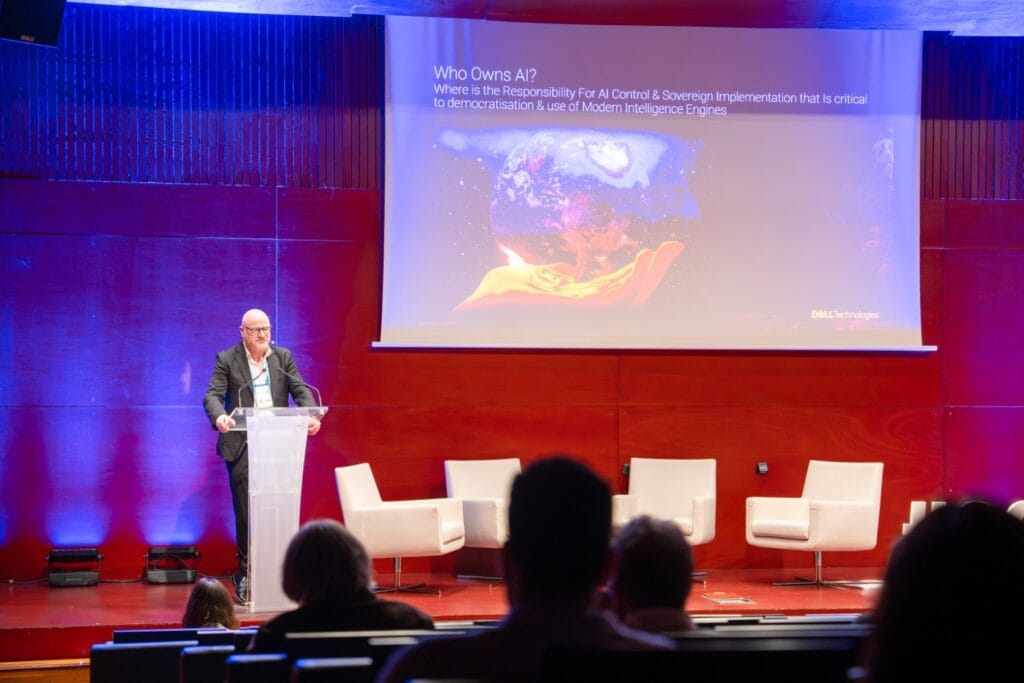
Marc O’Regan, Chief Technology Officer at Dell Technologies taking the stage at Energy Tech Summit 2026
Takeaway
O’Regan’s summary was a question about placement. Do you want AI outside your community and your ecosystem, or inside it, built in a way that makes sense for your organization? The energy argument running underneath is what makes that more than a governance preference. Every improvement he described – solving memory, feeding GPUs properly, running agents that genuinely understand context – increases computation, and therefore energy. That is why the same keynote covers 53-degree data centers, neuromorphic chips and photonics: if agentic architecture is going to demand more compute, the compute has to cost less energy. Otherwise the governance question becomes academic, because the power will not be there.
Want to hear more keynotes like this?