
Energy Tech Summit 2026 keynote
Distributed chemical production could upend a century-old model. For a hundred years, fertilizer has come from giant plants sited next to cheap gas.
But Yara Growth Ventures’ Stian Nygaard says the next supply might come from shipping containers next to solar farms instead — and that shift reveals something bigger about future commodity markets.
Stian Nygaard, Investment Director at Yara Growth Ventures, took the stage with an unusual disclosure: he was presenting for someone else. He was standing in for the CEO of Plasma Leap Technology, an Australian company he’s joining as a board director. Nygaard used the keynote to argue that the way the world makes fertilizer is about to fracture.
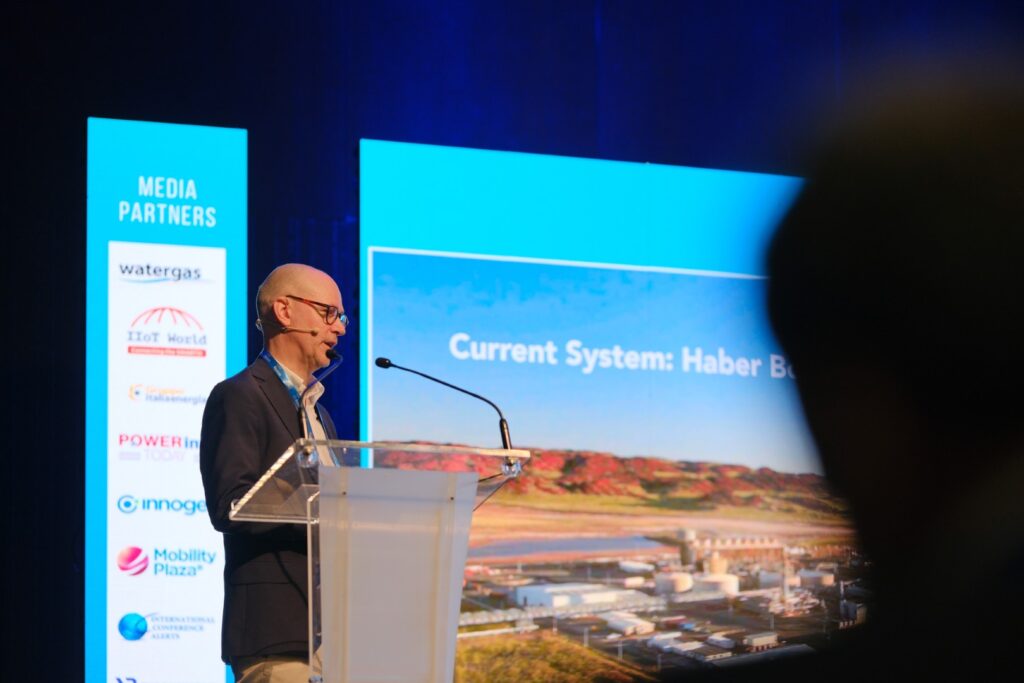
Stian Nygaard, Investment Director of Yara Growth Ventures presenting at Energy Tech Summit
A Century of Haber-Bosch
The world’s nitrogen production runs on one technology, Nygaard explained: Haber-Bosch, developed shortly after World War I. These plants are large and centralized, and they run on natural gas. The industry hopes they’ll eventually run on green hydrogen once it’s affordable. For now, they sit next to cheap energy and plug into global supply chains stretching from the US to Europe, the Middle East and Asia.
Over the past century, these plants have been optimized for three things, Nygaard said: economies of scale for the lowest production cost, continuous operation to maximize the asset, and global distribution along major shipping routes. So the system still works well at scale. However, it stretches at the edges.
The Constraints Breaking the Model at the Edge
Nygaard listed the pressures pulling at that century-old logic. First, decarbonization, as offtakers demand cleaner inputs. Second, geopolitics and a push for sovereignty over critical resources like fertilizer. Third, growing stress on global trade routes from conflict and weather. And finally, the emergence of smaller, distributed pockets of demand far from any central plant.
Australia, where Plasma Leap is based, is his example of the edge. Because it sits so far from the main logistics routes, centrally produced fertilizer costs far more there than in the core markets.
What Distributed Chemical Production Would Look Like
The picture Nygaard put up for the structural shift was Neom, the Saudi megaproject. It represents a move away from centralized production and global logistics, and toward distributed production, local consumption, and renewable feedstocks. So what would nitrogen production look like if it were designed for that world?
His answer: decentralized chemical plants that run on renewable feedstocks and electricity, with no need to sit next to gas reserves. They’re containerized, modular, and manufacturable — more like data centers than traditional chemical plants. As a result, the whole industry gets reframed: new supply is no longer constrained by geology. Instead, it’s constrained by factory output.
The Real Bottleneck in the Energy Transition
This led to Nygaard’s broadest point. Everyone talks about the energy transition as gigawatts of renewables deployed, he said. But few talk about the actual constraint, which isn’t power. Instead, it’s the ability to manufacture the power electronics, control systems and industrial hardware that make distributed production possible.
Nygaard’s argument is that distributed chemical production shifts the constraint from geology to manufacturing capacity. In his framing, the next commodity supercycle will be driven by who can manufacture. Consequently, sovereignty over critical inputs will rest on a country’s ability to build, deploy and operate that hardware among trusted partners. For Plasma Leap, he argued, that manufacturing capability combined with Yara’s deep industry knowledge and networks is a winning combination.
Plasma Leap: Air, Water, Electricity – and a Cucumber Harvest
Plasma Leap designs and builds what Nygaard called the world’s most advanced reactors: modular, decentralized, rapidly deployable chemical plants that use only air, water and electricity to produce fertilizer.
The technology has already been field-tested. In an Australian pilot, a container was set up feeding on solar electricity and air, with limestone added, to produce a calcium-based mixture. That mixture then grew a full harvest of cucumbers. According to Nygaard, the result was a product just as good as the control sample.
Next come first-of-a-kind fertilizer hubs in Australia — in New South Wales and Tasmania — connected directly to a solar farm. With a PPA from a solar company, Nygaard said, Plasma Leap can offer a farmer a fixed fertilizer price for 15 to 20 years.
Plasma Leap is building the infrastructure for decentralized chemical production, Nygaard concluded. The goal is to push production to the edge of the local supply chain, complementing rather than replacing the global fertilizer system. Plasma Leap is betting that distributed chemical production will complement, not replace, the global fertilizer system. Still, the deeper claim is the one worth sitting with: in the commodity markets of the future, pricing power may belong less to whoever controls the gas fields, and more to whoever can build the factories.
The keynote stage returns at Energy Tech Summit 2027 in Bilbao, April 7–8. Secure your pass.