

Artificial intelligence is reshaping the energy industry at an unprecedented pace. The technology optimizes grid operations, accelerates renewable integration, and revolutionizes energy trading. However, it also presents a paradox: these solutions are critical to decarbonization, yet AI itself is one of the fastest-growing energy consumers globally.
According to the World Economic Forum, AI-driven energy efficiency measures could generate up to $1.3 trillion in economic value by 2030. Furthermore, artificial intelligence in energy has the potential to reduce global greenhouse gas emissions by 5-10%–equivalent to the annual emissions of the entire European Union. In this article, we explore how it is transforming operations across grid management, renewable integration, and market trading–and why the technology’s own energy demands are driving innovation in both directions.
Grid Optimization: AI Applications in Energy Infrastructure
The power grid is aging and increasingly complex. Traditional grid management cannot keep pace with the rapid integration of distributed energy resources, electric vehicles, and renewable generation. Therefore, artificial intelligence applications in energy infrastructure are becoming essential for stability and reliability.
AI-powered predictive tools anticipate grid disruptions caused by extreme weather or equipment failures. Specifically, machine learning models analyze sensor data in near real-time to detect anomalies before they cascade into outages. As a result, operators can reduce downtime by up to 15% and cut operational costs significantly.
Load forecasting is another critical application. AI improves demand prediction accuracy even with limited or missing data. This allows utilities to optimize generation dispatch and minimize the need for expensive peaking plants. Additionally, predictive maintenance powered by AI in the power industry identifies optimal times for equipment servicing. This minimizes costs and prevents failures that could destabilize the network.
Renewable Energy Integration
Integrating solar and wind power presents unique challenges. Generation from these sources varies with weather conditions, making grid balancing difficult. However, artificial intelligence in renewable energy is solving this problem through advanced forecasting and real-time optimization.
Machine learning models analyze weather data, historical generation patterns, and grid conditions to predict renewable output hours or days in advance. Consequently, grid operators can adjust conventional generation and storage dispatch to accommodate variable supply. This reduces curtailment–the practice of turning off renewable generators when supply exceeds demand–and maximizes clean energy utilization.
Furthermore, it extends to battery storage systems. AI algorithms optimize charging and discharging schedules based on price signals, grid conditions, and renewable availability. For instance, systems can store excess solar generation during midday and discharge during evening peak demand. This improves both economics and grid stability.
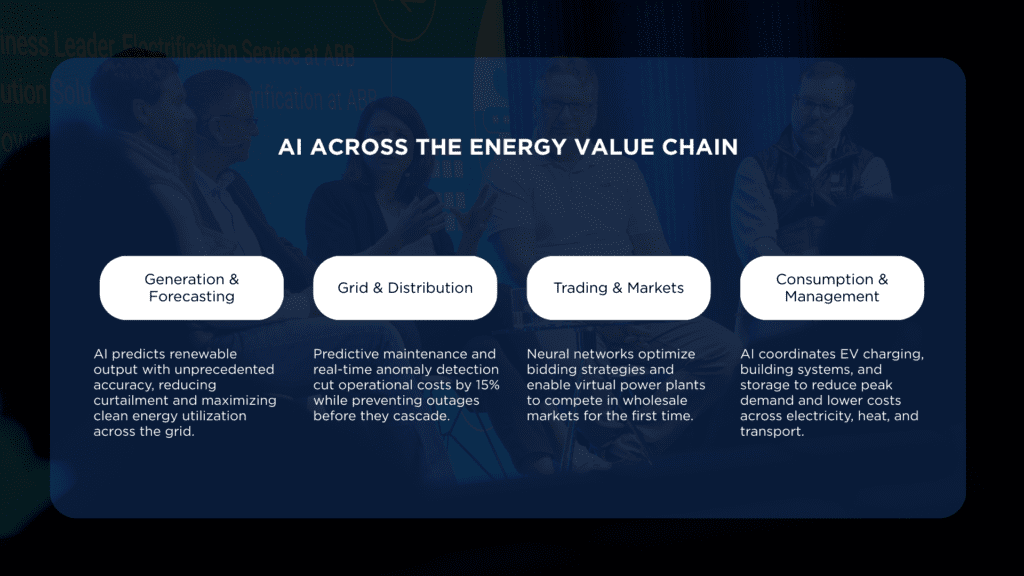
AI applications span the entire energy value chain—from predicting renewable output to optimizing market trading and coordinating consumption across electricity, heat, and transport.
How AI Is Rewriting Power Markets
Energy and AI convergence is particularly visible in power trading. Energy markets generate vast amounts of data–weather forecasts, historical prices, generation schedules, and consumption patterns. Artificial intelligence excels at processing this information to improve trading strategies and market efficiency.
Neural networks and machine learning models analyze historical data to forecast price movements and demand fluctuations. As a result, traders can optimize bidding strategies and reduce exposure to price volatility. Additionally, AI helps utilities manage demand response programs. Systems can predict when consumers will adjust usage in response to price signals or grid conditions.
Moreover, AI is enabling new market participants. Virtual power plants–aggregations of distributed energy resources–use artificial intelligence to coordinate generation, storage, and demand across thousands of small assets. This creates a single, dispatchable resource that can participate in wholesale markets. Consequently, smaller players can access revenue streams previously available only to large utilities.
The evolution of AI-powered trading will be central to Energy Tech Summit 2026 (April 15-16, Bilbao). The panel “Trading the transition: how AI is rewriting power market models and creating a new wave of energy traders” brings together practitioners navigating this shift. Speakers include Helena Chao from Bank of America, Michel Hunsicker from EDF, and innovators working at the intersection of markets and technology.
The Paradox: Data Centers and Power Demand
Here’s the challenge: while artificial intelligence in the energy sector optimizes grids and reduces waste, it itself consumes enormous amounts of power. A single AI-powered query uses approximately 10 times the energy of a traditional Google search. As AI adoption accelerates, this creates unprecedented demand.
By 2030, global power demand from data centers–primarily driven by AI–could increase by 18-20% annually, reaching over 1,000 terawatt-hours (TWh). This is nearly a quarter of current U.S. power demand. Consequently, the energy industry faces a dual mandate: meet AI’s growing power needs while simultaneously decarbonizing the grid.
Energy Tech Summit 2026 addresses this directly. The panel “Powering giga-scale data centers: centralized vs. decentralized approaches and hardware and software innovations” features Hussein Shel from AWS, Troy Harvey from PassiveLogic, and Paul Bogers from GE Vernova. They will examine infrastructure strategies that balance AI’s computational needs with grid constraints and sustainability goals.
Startups are responding with innovation. Energy Tech Challengers 2026 features two dedicated tracks reflecting this bidirectional relationship. The “AI for Energy” track includes finalists like Boson Energy, CarbonForge, LAVA, Noon Energy, and Oriole–companies using AI to optimize energy systems. Meanwhile, the “Energy for AI” track showcases Heimdall Power, Splight, Decentral AI, Dyneo Technologies, and others developing solutions to power AI infrastructure sustainably.
Why AI x Energy Is Centre Stage at Energy Tech Summit 2026
The complexity of integrating AI across the energy value chain requires cross-sector expertise. Therefore, Energy Tech Summit 2026 has made AI x Energy a central theme. Three dedicated panels bring together the practitioners, investors, and innovators shaping this convergence.
Beyond the trading and data center panels, “Simulate to decarbonize: scaling physics-informed AI for energy and industry” explores how AI can model complex energy systems before physical deployment. Speakers include James Lockyer from Microsoft’s Climate Innovation Fund, Andreas Aepli from Reverion, and Irena Spazzapan from Systemiq Capital. The session examines how simulation accelerates the transition while reducing capital risk.
The summit brings together the full spectrum of stakeholders driving AI applications in energy–from technology providers like AWS and Microsoft to utilities like EDF, financial institutions like Bank of America, and industrial players like GE Vernova. Additionally, the Energy Tech Challengers competition connects emerging innovators with the capital and partnerships needed to scale their solutions.
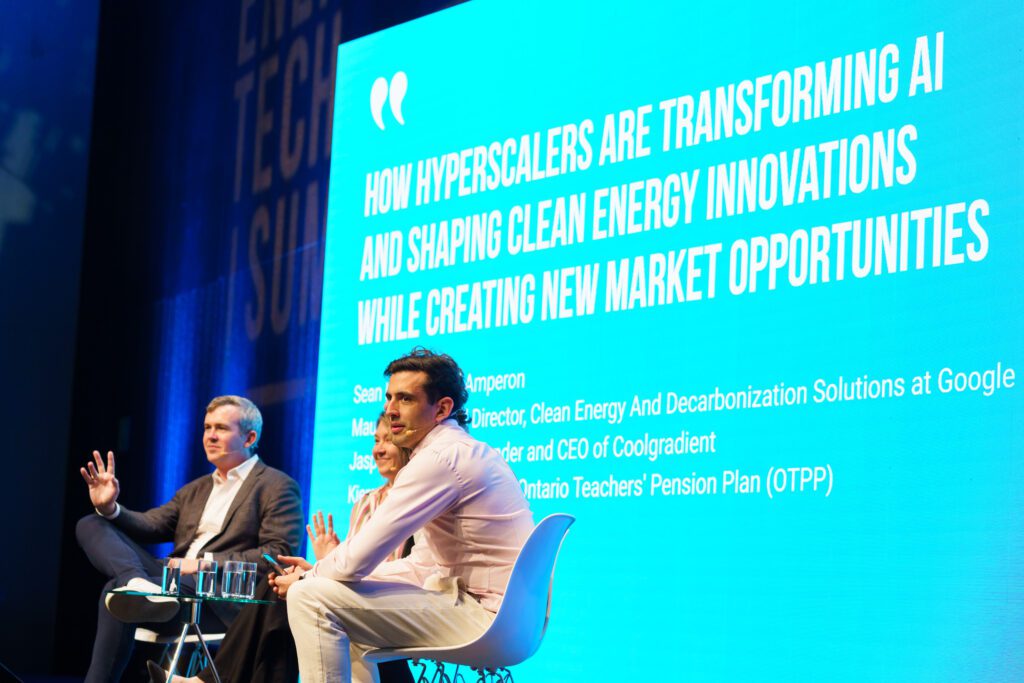
A panel from Energy Tech Summit 2025 exploring how hyperscalers like Google are leveraging AI to accelerate clean energy innovation and unlock new market opportunities—a preview of the conversations coming to ETS 2026 in Bilbao.
Challenges of AI in Energy Industry
Despite rapid progress, significant barriers remain. Challenges of artificial intelligence in energy industry include data fragmentation, integration costs, cybersecurity risks, and workforce skill gaps.
Many energy systems operate on legacy infrastructure with limited data interoperability. For instance, grid operators, utilities, and market participants often use incompatible data formats. This makes it difficult to deploy AI solutions that require comprehensive, real-time information flows. Furthermore, integrating artificial intelligence into existing energy infrastructure requires substantial upfront investment. Smaller utilities and developing markets may lack the capital or technical expertise to adopt these technologies at scale.
Cybersecurity presents another challenge. AI systems rely on vast networks of connected devices and sensors. Each connection point represents a potential vulnerability. As energy grids become more digitalized and AI-dependent, protecting against cyberattacks becomes increasingly critical.
However, these challenges are driving collaboration. Industry forums, standardization efforts, and public-private partnerships are developing shared frameworks for data exchange and security protocols. Energy Tech Summit 2026 provides a platform for these conversations–connecting utilities, technology providers, regulators, and innovators to address implementation barriers collectively.
The Road Ahead
The future of AI in energy sector lies in physics-informed models, sector coupling, and real-time optimization at unprecedented scale. Physics-informed AI combines machine learning with established scientific principles. This approach improves model accuracy while reducing data requirements–particularly valuable in energy systems where physical laws constrain outcomes.
Sector coupling represents another frontier. How artificial intelligence is used increasingly spans electricity, heat, and transportation. AI can optimize across these domains simultaneously. For example, systems can coordinate electric vehicle charging with building heating schedules and renewable generation forecasts. This creates efficiencies impossible to achieve when managing sectors independently.
The economic opportunity is substantial. AI-driven energy solutions could generate $1.3 trillion in value by 2030 through improved efficiency, reduced waste, and optimized resource allocation. Moreover, AI can help the energy sector accommodate its own growing computational demands. By 2030, electricity consumption for AI-driven technologies could multiply by a factor of 3.6. Meeting this demand sustainably requires the very optimization capabilities AI provides.
Ultimately, the convergence of energy and AI represents both challenge and solution. The investors, operators, and innovators navigating this duality will be in Bilbao in April.
Tickets for Energy Tech Summit 2026 are available here.
Q&A: AI in Energy Sector
Q1. What are the challenges of AI in the energy industry?
Challenges include data fragmentation, high integration costs, cybersecurity vulnerabilities, and workforce skill gaps. Furthermore, AI’s own energy consumption is creating unprecedented power demand that the sector must accommodate sustainably.
Q2. What AI x Energy topics will be covered at Energy Tech Summit 2026?
Energy Tech Summit 2026 features three dedicated AI x Energy panels covering AI-powered energy trading, giga-scale data center infrastructure, and physics-informed AI for decarbonization. The summit brings together speakers from AWS, Microsoft, EDF, Bank of America, GE Vernova, and Systemiq Capital alongside startups solving both AI for energy and energy for AI challenges.
Q3. How does Energy Tech Challengers address the AI-energy relationship?
Energy Tech Challengers 2026 features two dedicated tracks. The “AI for Energy” track showcases startups like Boson Energy, LAVA, and Noon Energy using AI to optimize energy systems. The “Energy for AI” track highlights companies like Heimdall Power, Splight, and Decentral AI developing solutions to power AI infrastructure sustainably.
Q4. What is the future of AI in the energy sector?
The future involves physics-informed models, sector coupling across electricity-heat-transport, and real-time optimization at scale. Additionally, AI will be essential for managing the technology’s own energy demands, which could reach 1,000 TWh by 2030.